Tag Archives: Belgium

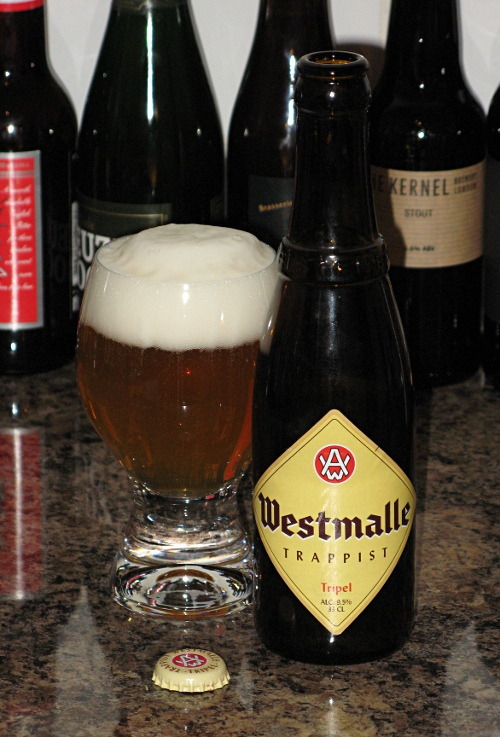
42. Westmalle Tripel

It’s with an almost crushing sense of inevitability that we come to try yet another beer brewed by Belgian monks, one of countless that are left to cover.

Never mind, this at least gives us a chance to try a Tripel, one of several designations of Trappist beers, and to compare and contrast with the Westmalle Dubbel we recently met.

In fact it was Westmalle themselves, currently Belgium’s second largest Trappist brewery, who introduced the terms Dubbel and Tripel, terms which are now widely used in Belgium and beyond. The naming seems to originate from the number of crosses branded onto casks to indicate strength, in contrast to an “Enkel” or “single”, but nowadays the terms generally denote distinct styles of beer.

A Tripel will still typically be stronger than a Dubbel—the Westmalle example weighs in at 9.5% ABV whereas its Dubbel sibling is a more modest 7.0%—but the strength doesn’t define the style. Whilst a Dubbel will be all deep dark, vinous malt and Christmas cakey dried fruits, a Tripel will be far paler and hoppier with more bitterness and lighter fruit.

image

Westmalle Tripel is certainly paler than its Dubbel counterpart, pouring a slightly cloudy golden colour, with a pillowy white head that would make Mr. Whippy proud. You really have to take care pouring this one, as there’s a good quarter inch of yeast sediment, including some great lumps of the stuff.

In fact, the yeast and the strength suggest this might be a good candidate to be cellared, or at least aged at the back of the kitchen cupboard, for a few years. It’s too late for this one: the lid’s off and I’ve a review to write.

The nose is broadly typical of a Belgian golden ale, with the distinctive esters front and centre, though there’s a conspicuous dried banana scent bursting through.

To taste, Westmalle Tripel is quite different from any of the preceding 41 beers, with the exception perhaps of Orval, another Trappist beer that could probably have done with some age on it. There’s an instant floral explosion in the mouth, and a bitterness and strong spice that’s delivered direct to the tastebuds by the considerable fizz.

The body is quite light, and that bitterness is pretty harsh, truth be told, not least as it’s accompanied by a saltiness reminiscent of Orval’s. There doesn’t seem to be a lot of subtlety about this beer, as it finishes by paintstripping your mouth dry. But kind of in a good way.

I actually quite enjoyed this beer, but it’s clear this is not the finished product, as all those flavours fall over each other to vie for your attention. Westmalle Tripel really needs at least a couple of years in the bottle to calm it down, so I’ll be putting one or two away. Who knows, if I ever get through the remaining 258 beers, I may revisit this one and see how it’s grown up.

Facts and Figures

Brewery: Brouwerij der Trappisten van Westmalle, Westmalle, Belgium
Style: Trappist Beers
ABV: 9.5%
Found at: Bossman Wines, Lordship Lane, London SE22
Dispense: 330ml Bottle

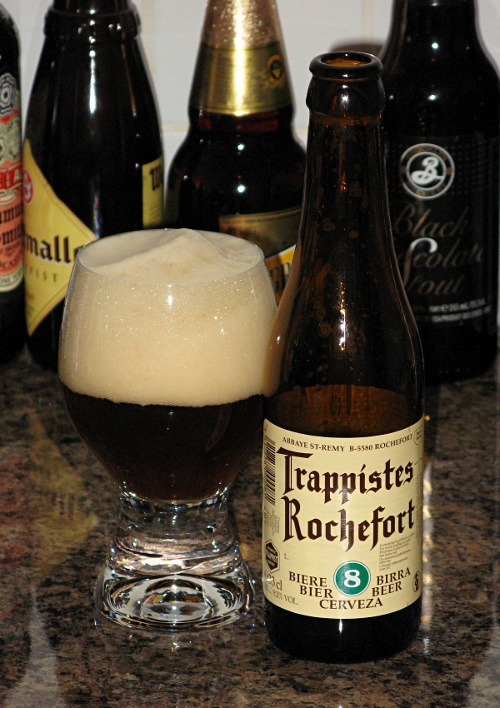
36. Rochefort 8

This is the second of three Trappistes Rochefort beers in The Book. We saw the Rochefort 6 recently, and this is a similar brew with similar ingredients, but one which ratchets up the strength a little to a very respectable 9.2% ABV.

image

Once again, there’s a gigantic foamy head, perhaps even larger than that of the 6. The 8 pours slightly darker, and is more of a burnished bronze colour.

Perhaps unsurprisingly, there isn’t a great deal of difference between the 6 and the 8. There’s that same toasty caramel and christmas pudding fruit, along with a vinous barleywine-like finish.

That said, I notice I did use the word “refreshing” about the 6, whereas with that 9.2% strength, I’m not sure I would describe this one as such. It’s more of a warming drink, and one to take a little more slowly. It’s a fairly thick beer, and gently swilling it, the way the foam holds to the glass is a thing of beauty in itself.

Rochefort 8 is certainly a good, savourable beer. I rather like it, though I slightly resent it for not giving me anything particularly interesting to say in comparison to the previous Rochefort offering. That’s clearly unfair, because I suspect if I tried this one in isolation, I’d be very impressed indeed.

We’ve one more Trappistes Rochefort beer left to try. At a mighty 11.3% ABV, the Rochefort 10 is the strongest beer I’ve ever seen in my life. I’ve sourced a bottle today, and I’m very much looking forward to it.

Facts and Figures

Brewery: Abbaye Notre-Dame de Saint-Remy, Rochefort, Belgium
Style: Trappist Beers
Strength: 9.2% ABV
Found at: City Beverage Company, Old Street, London EC1
Serving: 330ml Bottle

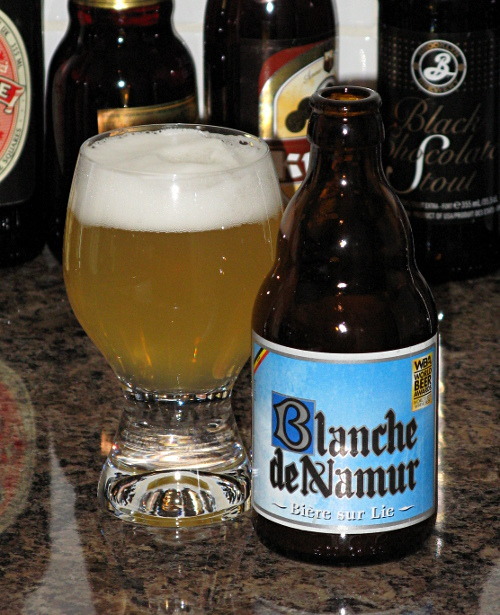
35. Du Bocq Blanche de Namur

We were hardly likely to be staying away from Belgium for long, in retrospect. In fact this one is Belgian and a Wheat Beer. I can barely contain myself.

image

Clearly I jest, but to put it politely, this is a beer for people with more subtle tastes than my own. At a paltry 4.5% ABV and a mere 12 bitterness units, it was never going to set pulses racing.

Blanche de Namur tastes like Hoegaarden, obviously, but it’s an emaciated, watery version of Hoegaarden. Honestly, beyond a faint whiff of the typical Belgian esters, the overriding flavour here is actually of water.

Supposedly the ingredients include coriander and bitter orange peel; maybe I’ve had one too many Imperial Stouts recently, but my taste buds can’t detect them.

I never set out to post overly negative reviews, and tend to feel bad if I do, but quite frankly, this is a crushingly dull beer.

Facts and Figures

Brewery: Brasserie du Bocq s.a., Purnode, Belgium
Style: Belgian-style Wheat Beers
ABV: 4.5%
Found at: Bossman Wines, Lordship Lane, London SE22
Dispense: 330ml Bottle

33. Rochefort 6

Still more Belgian monk beer for us to try, and yet this is only the first of three Trappistes Rochefort offerings that we have to work our way through.

The Rochefort beers are numbered 6, 8 and 10, with this one being the weakest of the triptych at a mere 7.5% ABV. One starts to wonder whether the cloistered Trappist lifestyle is quite as sober as they make it out to be.

image

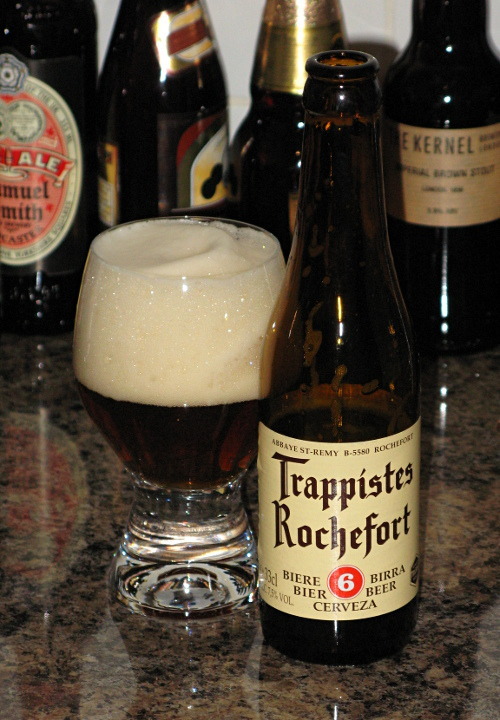
Rochefort 6 pours a rather nice looking, fairish golden ruby colour. There’s an overwhelming amount of froth, which dissipates so slowly that it’s difficult to pour, let alone drink, the beer.

There’s very little on the nose, just a faint beery smell with a tiny hint of the esters for which Belgian beer is known.

To taste, though, it’s fruit, fruit, fruit. In that regard Rochefort 6 is not unlike our previous Trappist beer, the Westmalle Dubbel, though it’s somewhat lighter, with a sweetness that’s a little reminiscent of a barleywine.

For all of its 7.5% ABV payload, Rochefort 6 is surprisingly refreshing, though the strength is not hidden. With its vinous finish, I can picture it working well after dinner, perhaps with strong cheeses. I haven’t actually tried that so don’t quote me on it. (I drank mine stood in the kitchen with a large cat on my shoulder, perhaps not the ideal use case).

All in all, I’m starting to see why “Trappist Beer” warrants its own section in The Book, as a style quite separate from the Belgian blonde beers such as Bosteels Karmeliet Tripel and Achouffe La Chouffe. While the latter exude noxious herbal esters and overbearing, imminent-hangover alcohol, the Trappist beers are all fruit, with a malty depth and comforting, warming booziness. I know which I prefer.

As I mentioned, there are two more Trappistes Rochefort beers to track down, which I’ll try to do in short order.

Facts and Figures

Brewery: Abbaye Notre-Dame de Saint-Remy, Rochefort, Belgium
Style: Trappist Beers
ABV: 7.5%
Found at: Bossman Wines, Lordship Lane, London SE22
Dispense: 330ml Bottle

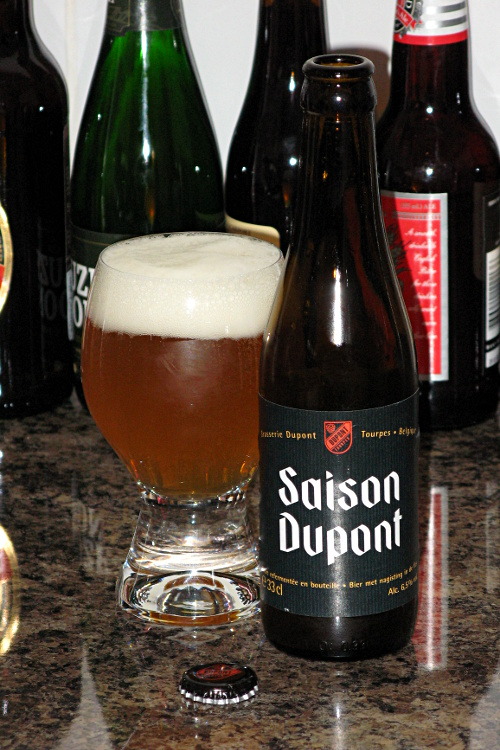
31. Westmalle Dubbel

Our latest offering from the many brewing monks of Belgian comes from Westmalle, the second largest of the country’s Trappist breweries after Chimay.

Speaking of whom, I’m vaguely expecting Westmalle Dubbel to be reminiscent of Chimay Rouge, their both being 7.0% ABV Trappist beers with, er, with red labels. But appearances can be deceptive, so it’s time once again to fire up the trusty bottle opener and find out.

image

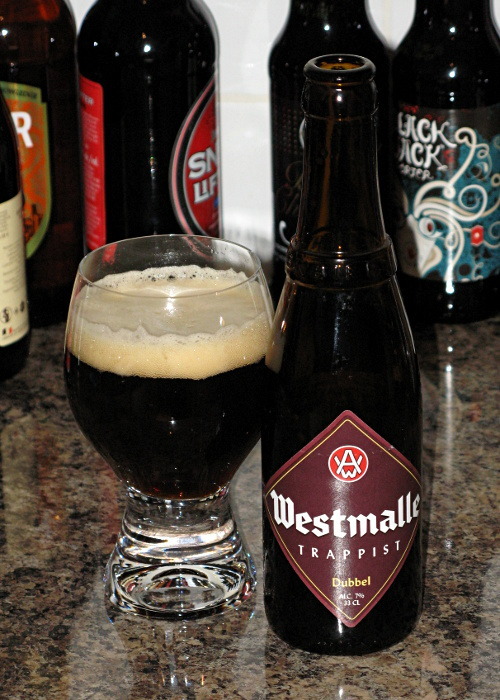
Westmalle Dubbel pours a lovely deep ruby colour, not dissimilar to, but darker and less cloudy than the Chimay Rouge, and with a big, fluffy white head that soon condenses to a dark beige lacing.

There’s a lovely, fruity, berry-like nose with inviting, boozy alcohol notes. I’m reminded immediately of Brakspear Triple, and can’t help but remark what an achievement is it for that plucky Oxfordshire brewery to be making beers that compare so well with these revered, ancient Belgian brews.

There are similarities in the flavour too: there’s yet more dark, sinister fruit, toasty malts and butterscotch sweetness. The body is surprisingly light, though far from watery, and I wonder how that would change if one were to age a bottle for a couple of years or more.

There’s a lightish finish too, with more toasty, slightly bitter butterscotch. That’s a result of the brewing process, which sees the wort being boiled over a direct flame, allowing some of the sugars to caramelise.

Finally there’s a pleasant warming afterglow from the alcohol, which I suppose there should be at 7% ABV, though it’s curious how that starts to seem like quite a low number after some other Belgian beers I’ve recently blogged!

All in all, Westmalle Dubbel is really quite a wonderful beer and I’ve no doubt I would buy it again. There’s also a Westmalle Tripel to track down—at a mere 9.5% ABV or so—and I’ll certainly be looking forward to that.

Facts and Figures

Brewery: Brouwerij der Trappisten van Westmalle, Westmalle, Belgium
Style: Trappist Beers
ABV: 7.0%
Found at: Bossman Wines, Lordship Lane, London SE22
Dispense: 330ml Bottle

29. Orval

The quite frankly prodigious contribution of Belgian monks to the world of beer continues with this Trappist ale from the tiny village of Villers-devant-Orval.

Orval

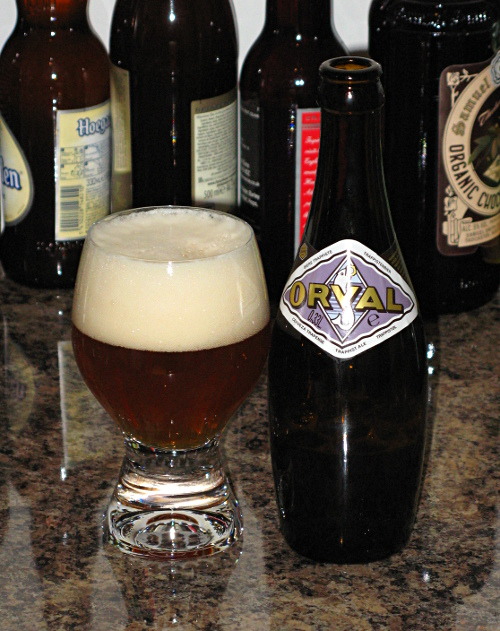
Orval pours a little darker than I expected, a fairly deep honey colour, though nowhere approaching the darkness of, say, Chimay Rouge. It’s slightly hazy, though perhaps I could have let it settle a while longer before opening. There’s more head than beer at first, but it fades quite promptly.

Labelled at a comparatively shandy-drinking 6.2% ABV, I think this might be the weakest Belgian beer so far, though it is bottle-conditioned, and there are apparently enough hops and sugar in the bottle that subsequent fermentation can see it reach about 7.0%.

It’s actually, and perhaps thankfully, somewhat different to a lot of the blonde Belgians we’ve seen. It’s smoother, and there’s none of that strange “Belgian” flavour that I can’t really describe, but would recognise a mile off (think Leffe Blonde).

It’s very drinkable, but there’s enough depth to savour, and there’s a gigantic hoppy finish. The bitterness is initially quite satisfying, but it’s so intense that it soon becomes distinctly salty, specifically sea salt. That’s something I’ve only previously noticed with Beavertown’s Black Betty black IPA. I’m not sure if it’s to do with the use of dry hopping (adding a handful of hops to the finished beer) but it really is quite prominent.

Whilst not a patch on the Chimay Bleue, Orval is up there among my favourite Belgian beers so far, but that saltiness means I’ll stick at one for now.

Facts and Figures

Brewery: Brasserie d’Orval s.a., Villers-devant-Orval, Belgium
Style: Trappist Beers
Strength: 6.2% ABV
Found at: Bossman Wines, Lordship Lane, London SE22
Serving: 330ml bottle

26. Achouffe La Chouffe

Time for yet another super-strength Belgian blonde beer. This time, however, the label forgoes the standard allusions to monks, abbeys and the Middle Ages. Instead we have this funny little bearded cartoon gnome character—the eponymous “La Chouffe”.

In fact, rather than tracing its heritage back to some distant historical legend involving cloistered friars and royal benefactors, the Brasserie d’Achouffe dates from the 1970s, when two Belgian home brewers decided to give up their day jobs. This could be interesting.

image

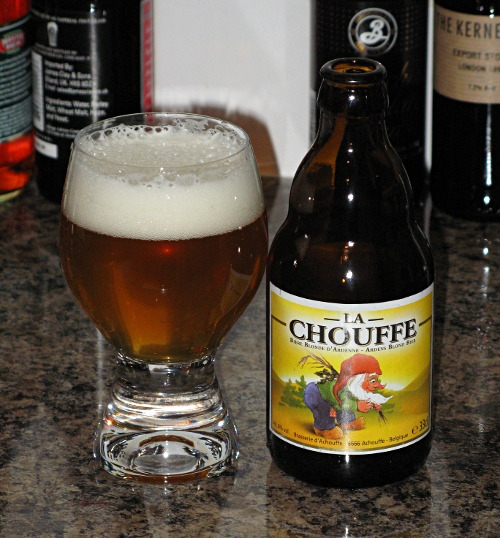
While it pours somewhat darker, La Chouffe doesn’t taste a great deal different to Bosteels Karmeliet Tripel but is smoother, dryer and a little fuller-bodied. It’s drinkable enough, and doesn’t taste as strong as 8% ABV.

Apparently the beer is flavoured with coriander. I couldn’t detect it at all, but I may be alone in that, since others could.

I don’t mind La Chouffe at all, though on the other hand I still find it hard to get excited by beers of this style.

Perhaps the reason that a lot of these extra strong Belgian beers are lost on me is to do with context. A beverage like this probably isn’t designed for an icy South London evening. Drinking it in the sun outside a Sainte-Catherine café bar with Moules-frites might be quite a different experience.

Facts and Figures

Brewery: Brasserie d’Achouffe, Achouffe, Belgium
Style: Golden Ales
ABV: 8.0%
Found at: City Beverage Company, Old Street, London EC1
Dispense: 330ml Bottle

17. Chimay Rouge

Having enjoyed Chimay Bleue quite so much, I was keen to crack on with trying the other two Chimays in The Book, the Rouge and the Blanche.

The latter two seem to be harder to get hold of, but a lunch hour stroll to the City Beverage Company was all it took to get my hands on this, the weakest—well, least strong—of the trio, weighing in at a mere 7% ABV.

image

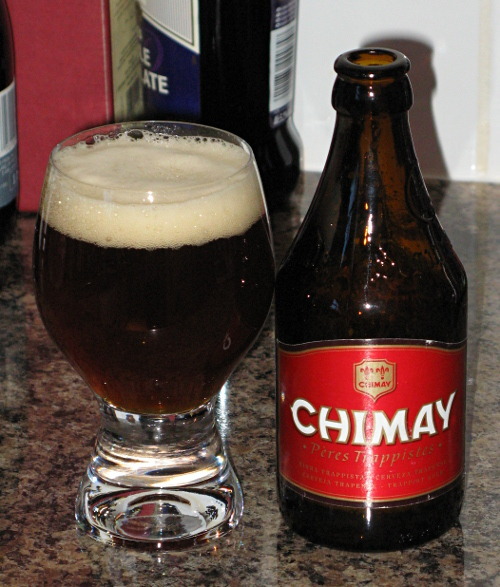
Chimay Rouge pours somewhat less dark than the Bleue, which is to say that light may actually penetrate it. It’s still a very dark, very hazy brownish colour, with a smallish off-white head that dissipates to a fine beige lacing quite promptly.

To taste, the Rouge has a noticeably lighter body than the Bleue, with more of a vinous, wine-like finish. There is also more hoppy bitterness, and a warming booziness that reminds you that if you weren’t comparing it to the 9.0% Bleue, this would be considered a very strong beer.

There isn’t the sheer luxury here that the Bleue affords, though, and the Bleue remains my favourite.

I’m aware that I’m making the Rouge sounds like a poor second-best by constantly comparing it to the Bleue, which isn’t really fair, since it’s still a genuinely good beer. It’ll be very interesting to see where the 8% Blanche fits in to the range. I feel a walk up to Old Street coming on…

Facts and Figures

Brewery: Bières de Chimay S.A., Baileux, Belgium
Style: Trappist Beers
Strength: 7.0% ABV
Found at: City Beverage Company, Old Street, London EC1
Serving: 330ml Bottle

15. Chimay Bleue

With the two previous Belgian beers I’ve tackled, I’ve wondered aloud what the exact use case for these super-strength blonde bombshells is.

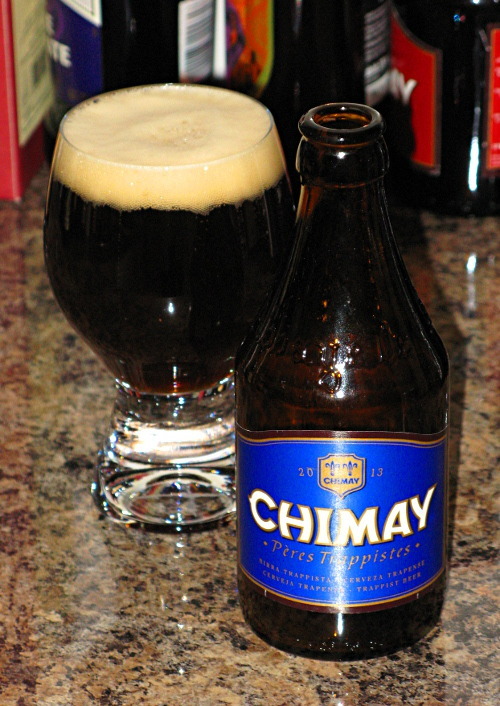
I have no such qualms about this one. Chimay Bleue is pure luxury in a glass. This is a beer just made to be savoured slowly, late at night, in your favourite armchair by the fire.

This is the first of three Chimays that are in The Book. All of them are brewed by Trappist monks at the Notre-Dame de Scourmont Abbey in Hainaut, Belgium.

image

Chimay Bleue pours almost black, though if you hold it up to the light, you can see it’s actually a lovely dark ruby colour. There’s a small and very velvety beige head, and it tastes like the beer you always wanted to drink.

You absolutely must serve Chimay beers at room temperature, as it’s only then that the sheer quality and depth truly become apparent.

Bleue is rich, dark and chocolatey without being sweet. It has the smoky depth of a good stout, such as last night’s Guinness Foreign Extra, but without any of the bitterness and grit. It’s boozy, decadent, and hopelessly moreish. Still, at a Special Brew matching 9% ABV it might be wise to stick at one, and take your time over it.

Enjoyed that way, Chimay Bleue is just a wonderful beer, and the perfect nightcap.

Facts and Figures

Brewery: Bières de Chimay S.A., Baileux, Belgium
Style: Trappist Beers
ABV: 9.0%
Found at: Waitrose, Whitecross Street, London EC1
Dispense: 330ml Bottle

12. Duvel

Back to Belgium we go, to sample the famous golden ale that looks like a lager.

Duvel dates from between the wars, and was – staggeringly – inspired by McEwan’s Export. Back then, the Export must have been a very different brew from the deeply questionable grog I used to buy at the Tollcross Superstore for 59p a can as a student, because this is nothing like it.

image

Instead, Duvel is golden, light and refreshing, not least considering that 8.5% of it is alcohol. There’s a pleasant yeasty haze to it, and it has infinitely more charm than our previous Belgian beer, the mysterious Karmeliet Tripel.

There’s just enough depth here to allow Duvel to be savoured slowly, whilst remaining remarkably easy drinking.

I’m still not completely convinced about where these super-strength golden Belgian beers fit in to one’s beery routine, exactly. Duvel is nice enough, but I’d choose a rich, dark Chimay over it given the opportunity.

Stay tuned, and I soon will. There’s one sat in the kitchen right now…

Facts and Figures

Brewery: Duvel Moortgat, Breendonk, Belgium
Style: Golden Ales
ABV: 8.5%
Found at: Sainsbury’s, Westow Street, London SE19
Dispense: 330ml Bottle