Tag Archives: Belgium

A Visit to Cantillon Brewery

For the beer lover, no trip to Belgium is complete without a visit to the venerable Cantillon brewery, home to some of the world’s most famous Lambics and Gueuzes, sour beers that are certainly an acquired taste, but have the tendency to make serious beer geeks rhapsodise for days.

Ask brewers at the height of their profession, such as Evin O’Riordain of London’s The Kernel, who they’re inspired by, and the answer is Cantillon.

And so it was that a beautiful spring afternoon saw 300 Beers make something of a pilgrimage to 56, Rue Gheude in Brussels. Here’s the brewery itself, complete with matching van:

Cantillon Brewery

The brewery appears closed at first glance, but be brave and open the door, and you step into a time capsule full of evocative sights, sounds and, in particular, smells. Cantillon have been on this site since 1900, and it shows in the accumulated dust and cobwebs. The brewery remains resolutely family-owned, and brewing methods and equipment are virtually unchanged in generations.

You pay a few euros for the visit, including a self-guided tour and samples of two beers. After a brief orientation you’re handed a detailed pamphlet which explains the workings and history of the brewery, and then you’re left to wander around at your leisure.

You can take all the time you want, and even—as I did—go around twice if you wish. I was lucky enough to have the entire brewery to myself, apart from a couple of Cantillon workers manning the bottling line, and another chap studiously washing kegs. The latter task is perhaps one of the least glamorous yet most vital parts of any brewery’s operations.

The brewing process begins with the mash tun, where malted barley, wheat and steaming water are combined to make wort, a thick, porridgy stew full of fermentable sugars and other tasty goodness:

The Cantillon Mash Tun

After being separated from the spent grain—known locally as “Draff”, which is used as animal feed—the resulting wort is pumped upstairs to the copper kettle, where it’s boiled with aged hops to sterilise and condense it, and to fill it with delicious hop resins:

The Cantillon Copper

After several hours of boiling, the wort is pumped up to the attic, where it’s left to cool overnight in a giant copper tray called a “coolship”. This is a crucial and unique part of the Cantillon process, as the attic is open to the elements, allowing the wort to become inoculated with wild yeast from the Brussels air. No yeast is added manually, and the wild yeast is what’s behind the distinctive sour flavour.

The Cantillon Coolship

The next day, the cool, yeasty wort is drained into the stainless steel fermenter where, over several days, the sugars are turned into alcohol by those magic little yeast bugs, and the liquid starts to resemble beer.

The Cantillon Fermenter

I can’t for the life of me figure out how they got that wooden cart up into the attic.

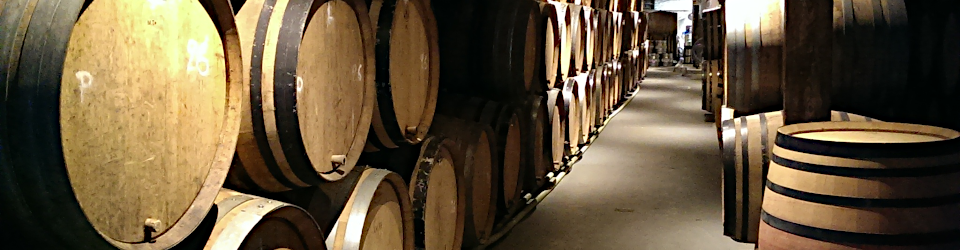
Once fermented, the beer is transferred to decades-old wooden barrels and left to bide its time in the barrel store, where it is aged for up to three years before bottling. The smell in here is fantastic:

The Cantillon Barrel Store

The barrel ageing produces a still, wine-like beer named Lambic, which is the base of all Cantillon products. You’ll have to come to the brewery to try it, though, as almost all of the Lambic is used to make Gueuze. This is a blend of one, two and three year-old Lambics, which are then refermented in the bottle in the brewery’s cellars to become the beers that are sold to the public.

Given the amount of time the beer needs in the barrel and subsequently in the bottle before it is ready, the biggest limiting factor to Cantillon’s output is storage space. The whole place is packed floor to ceiling with dusty bottles laid down. Every nook and cranny is utilised.

Bottles of Saint-Lamvinus in storage at Cantillon

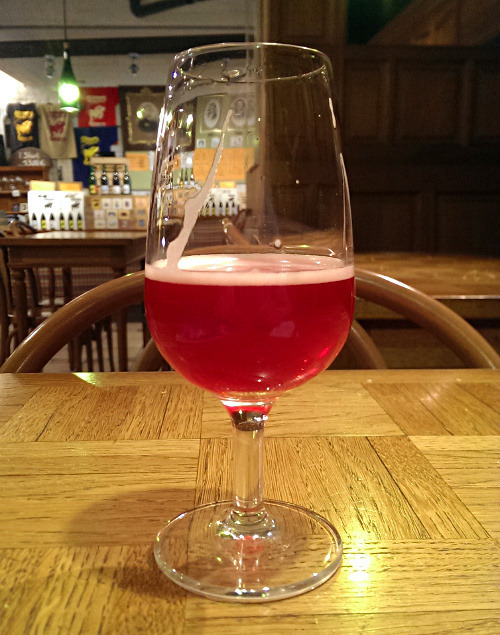
Finally, to the bar for a tasting. Visitors are given a taste of the still Lambic fresh from the barrel (left), and then allowed to choose a further beer to sample. I opted for the Kriek, a Gueuze in which sour cherries have been soaked for around six months, and then bought myself a glass of the classic Gueuze (right):

The Tasting Rooms at Cantillon Brewery, Brussels

The Lambic is reminiscent of a high quality apple juice, albeit an unsweetened one made from sour apples, while the effervescent classic Gueuze is full of zesty grapefruit flavours.

If that isn’t enough sour beer for you, the brewery will happily sell you individual bottles or whole cases to take away with you, at prices significantly lower than you’ll find Cantillon products elsewhere, if you can find them at all. All told, a visit to Cantillon is a fascinating experience and quite a treat for the beer lover.

82. Cantillon Kriek

The time has come for 300 Beers to selflessly embark on a brief, shall we say, “research” trip to Brussels to track down a few of the many Belgian beers still required for this ridiculous quest.

In this case, it’s a sour, cherry-infused beer known as Kriek, which I enjoyed in the tasting rooms at the Cantillon brewery in the Belgian capital as part of a tour of the brewery. You can read all about my visit here.

image

Cantillon Kriek starts life as two year-old, barrel-aged Lambic. Large quantities of sour Schaerbeek cherries are then soaked in the Lambic for around six months, at which point a quantity of fresh, young Lambic is blended in. The resulting blend is transferred to bottles for a period of secondary fermentation, during which time it becomes a delicious, frothy red Gueuze.

I’m not typically a fan of fruit beers, but then it’s fair to say that this isn’t a typical fruit beer. Like all Cantillon beers it’s as sour as can be, and the cherries complement that sourness beautifully.

The result is a satisfying and complex beer, and the tiny hint of sweetness provided by the cherries just offsets the mouth-puckering Lambic sourness, to leave a tart, dry and lingering finish.

Cantillon Kriek is certainly moreish, but its richness means it’s probably best enjoyed in smaller quantities. I’m not sure I’ll become a huge fan of fruit beers just yet, but it certainly makes for a refreshing change, and the chance to enjoy it just feet from where it was brewed, surrounded by the evocative sights, sounds and smells of the venerable Cantillon brewery only adds to the experience.

Facts and Figures

Brewery: Brasserie Cantillon Brouwerij, Rue Gheude, Brussels, Belgium
Style: Lambic and Gueuze
Strength: 5.0% ABV
Found at: Cantillon Brewery, Brussels
Serving: Taster, poured from a 750ml bottle

80. Rochefort 10

This time next week I’ll be in Brussels sampling some of the world’s most famous beers. Tonight though, I’m in a rainy, resolutely ungentrified Camberwell, London at the ever-magnificent Stormbird, one of my very favourite pubs in the world.

I’m reluctant to tell you about Stormbird, because it’s the sort of place you want to keep to yourself, but it truly is wonderful: an Aladdin’s cave for the beer lover, with a mouth-watering and ever changing tap lineup, lovely staff and a civilised, if somewhat youngish, clientele.

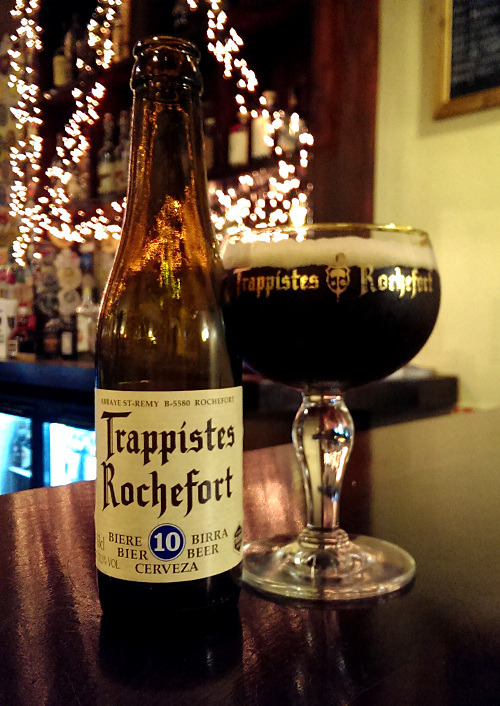
It’s time to get some Belgian beer-related practice in, and also to round off the three Rochefort beers we need by putting ourselves on the outside of this 11.3% ABV monster of a Trappist ale, served, you’ll note, in the correct glassware.

image

Without question, that’s a fine-looking beer right there. Rochefort 10 is a rich, deep brown colour with a remarkably dense tan helmet of foam that doesn’t dissipate until the last drop is drunk.

I didn’t detect a huge amount of aroma, at least compared to the eye-wateringly fresh keg Thornbridge Halcyon I’d enjoyed mere moments before. What there is though is distinctly Belgian, and reminiscent of a Dubbel, though a little lighter.

The mouthfeel is thick and smooth, and the flavour is all christmas pudding packed with dried fruits, berries, caramel and booze. That said, the 11.3% payload is well integrated, and while this is a very decadent beer, it’s oh so drinkable, and a lot more subtle than the sledgehammer of flavour and intoxication that was Samichlaus, our previous double-figures leviathan.

Splendid stuff. This would make a great after-dinner beer, to be savoured slowly and swilled around the glass in your favourite armchair. And thankfully, that’s one less ridiculously strong Belgian beer that I need to find next week.

Facts and Figures

Brewery: Abbaye Notre-Dame de Saint-Remy, Rochefort, Belgium
Style: Trappist Beers
Strength: 11.3% ABV
Found at: Stormbird, Camberwell Church Street, London SE5
Serving: 330ml Bottle

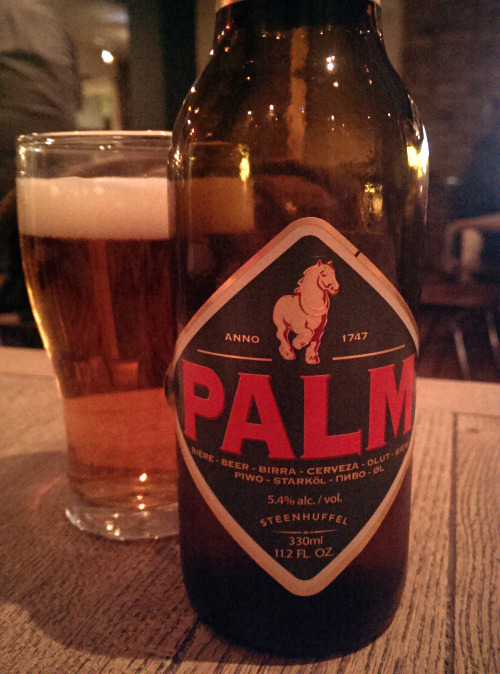
76. Palm Spéciale

Considering how close it is to my house, how youthful, winsome and alluring the staff are, and that it’s one of South London’s very few genuine brewpubs, I really don’t spend enough time at The Florence.

Still, a recent visit afforded the chance to watch brewer Peter Haydon at work, and to try this, a 5.4% Belgian ale. Perhaps this is not the most appropriate thing to drink just feet from where a fresh batch of Weasel or Bonobo is being boiled up, but the 300 Beers project is a harsh mistress. The choice is out of my hands.

image

Squinting through The Florence’s mood lighting, I can just make out that Palm Spéciale is a warm amber colour with a thick, foamy layer of froth on top. There isn’t a great deal of aroma beyond a few unmistakably Belgian esters.

The mouthfeel is dense and rich, if a little sticky, while the flavour is all caramel and toffee, and is reminiscent of Werther’s Originals. Interestingly, Palm Spéciale numbers corn among its ingredients. I’ve no idea how prevalent corn is among Belgian beers, but it does seem to add a certain complexity to proceedings.

Perhaps not surprisingly, Palm Spéciale is similar to De Koninck, but combined with the thick sweetness of Manns Original Brown Ale. In fact, this is another Belgian beer that manages to seem sweet at first, yet leaves a lingering, dry finish that lasts some time. That may well be the corn at work, now I think about it.

This is also another Belgian beer that I can’t help thinking needs a heftier dose of alcohol in it, say 6% or more, to make it really special. It’s a pleasant enough beer all the same, but I’m not sure it’s the sort of thing I’d go out of my way to find again.

That’s not a problem, since the aromas of malted barley and fresh hops in here have got me in the mood for a pint of something altogether more local.

Facts and Figures

Brewery: Palm Breweries, Steenhuffel, Belgium
Style: Pale Ales
Strength: 5.4% ABV
Found at: The Florence, Dulwich Road, London SE24
Serving: 330ml Bottle

74. De Koninck

My first ever trip to the brand spanking new Flying Pig up in East Dulwich left me spoilt for choice in terms of which of the remaining 300 Beers to pick out of the fridge first. Clearly, this pub will be a valuable ally on our ridiculous quest.

I plumped for this one: a 5.2% Belgian amber ale, almost certainly the most famous export of the city of Antwerp.

image

De Koninck, meaning “the king”, pours a bronze, toffee sort of colour with a fairly small off-white lacing. There’s a slightly musty yet resinous aroma, which isn’t nearly as unpleasant as I’ve made it sound.

The beer is slightly astringent and light bodied, or at least seemed that way after the very smooth pint of Thornbridge’s “Kill Your Darlings” I’d enjoyed just minutes before. There’s a real fruitiness though, and a butterscotch sweetness, while those distinctive Belgian esters are present yet restrained. Strangely, De Koninck manages to be very dry and quite sweet at the same time.

5.2% is quite light for a Belgian beer, and I couldn’t help feeling this one needed a heftier dose of booze in it to really make it shine, but it was enjoyable enough.

Facts and Figures

Brewery: Brouwerij De Koninck, Antwerp, Belgium
Style: Pale Ales
Strength: 5.2% ABV
Found at: The Flying Pig, East Dulwich Road, London SE22
Serving: 330ml Bottle

71. Affligem Blond

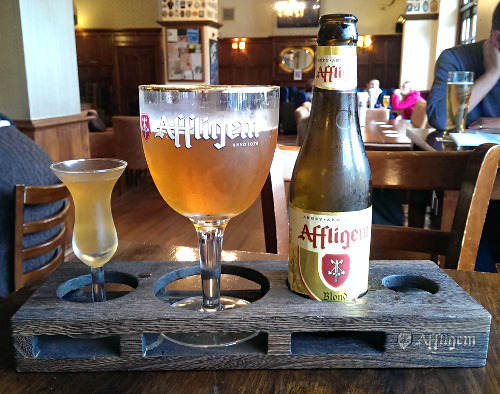
OK, I’m a little out of my depth here guys. I ordered what I though was a fairly standard bottle of Belgian golden ale, and I seem to have been served some sort of science lab.

image

It turns out that there’s a great big wanky ritual to drinking Affligem Blond.

This is a bottle-conditioned beer with a hefty dose of yeasty sediment at the bottom. Fine so far, but apparently about 90% of the beer should go into the larger glass, while the yeast is deposited into the little thimble-like thing. You then have the choice of tasting the yeast separately, dumping it into your beer, or disregarding it entirely.

Having poured the beer itself, the barman poured a dose of yeasty solution into the smaller glass but left the thickest dregs of the sediment in the bottle. I wasn’t about to argue, since quite frankly I already felt like a bit of a numpty by this point.

Bear in mind I’m in a well-respected real ale pub here, and quite the locals’ place it is too. The burly gent at the next table reading The Sun over his second pint of lager is already eyeing me suspiciously. So let’s get this one done.

After all that, this tastes like a pretty run-of-the-mill Belgian golden ale or Abbey Beer. My usual point of reference for this sort of thing is Leffe Blonde, and Affligem is not a million miles away. It’s much lighter in flavour, though, and vaguely reminiscent of a saison. Still it packs a respectable 6.8% ABV wallop, and so provides a pleasant warming glow for a lunchtime. There’s a dense, sweet finish, which isn’t entirely unpalatable.

I elected to sample the yeast solution separately at first. It tasted slightly bitter and, perhaps not surprisingly, quite yeasty, but it didn’t have much going for it otherwise. So I dumped it into the rest of the beer and pressed on. It did add a little depth and body, I think, but on balance, I would still rather have had another pint of Mild instead.

I’m not sure I can show my face in the Grape & Grain again in a hurry, but in fairness that’s five beers in a row that they’ve provided for this blog, so I’m sure this won’t be the last we’ll be hearing of that particular boozer.

Facts and Figures

Brewery: Affligem Brouwerij, Opwijk, Belgium
Style: Abbey Beers
Strength: 6.8% ABV
Found at: The Grape & Grain, Anerley Hill, London SE19
Serving: 330ml Bottle

64. Hoegaarden

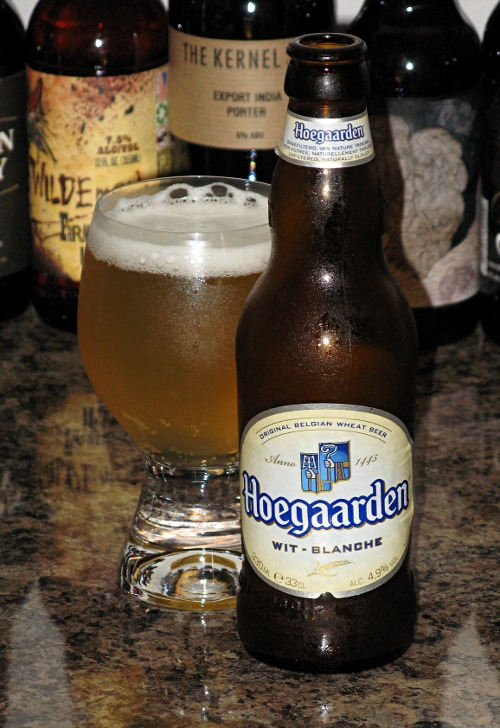
One of the slight downsides of the 300 Beers project is that occasionally I’ll have to sample a beer that I already know I’m not keen on. Hoegaarden, almost certainly the most famous of the Belgian-style Wheat Beers, is a case in point. But never mind, let’s give it another try.

Hoegarden was created in 1966 by Belgian milkman Pierre Celis, regardless of what the “Anno 1445” on the label is intended to imply. It’s made with 55% malted barley and 45% unmalted wheat, and spiced with milled coriander seeds and dried Curaçao orange peel. Finally, each bottle is primed with a small amount of sugar and fresh yeast, to encourage subsequent fermentation in the bottle.

image

I’m struck that Hoegaarden pours a pale, golden straw colour, in contrast to the cloudy whitish colour I remember it being. I wonder if the yeast in this particular bottle has settled more than usual in the several months it has been sat in the kitchen while I dragged my heels over drinking it.

It certainly smells like a wheat beer, albeit a fairly light one, with those distinctive Belgian esters present as ever. Served chilled, Hoegaarden is a reasonably refreshing, summery beer, but it just isn’t exciting. There’s a bit of a void where the flavour should be—I can barely detect either the coriander or the orange peel—and I wonder if that’s why some folks like to dress Hoegaarden up with a slice of lemon, so that at least it tastes of something.

While I’ll probably never know for sure, it’s a little hard to believe that today’s Hoegaarden, brewed in vast quantities by international brewing giant AB InBev, let us not forget, is quite the same beer that old Pierre gave up his milk round for back in the sixties.

Facts and Figures

Brewery: Brouwerij Hoegaarden (AB InBev), Hoegaarden, Belgium
Style: Belgian-style Wheat Beers
Strength: 4.9% ABV
Found at: Maxy Supermarket, Norwood Road, London SE24
Serving: 330ml Bottle

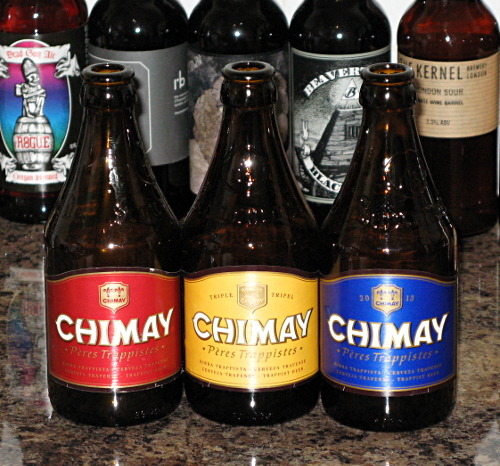
60. Chimay Blanche

This is the third and final Chimay beer to be covered here, after the luxurious Chimay Bleue and the fruity and sinister Chimay Rouge. The Blanche has proven a little harder to get hold of for some reason, but a recent lunch hour stroll to City Beverage Company finally resolved matters.

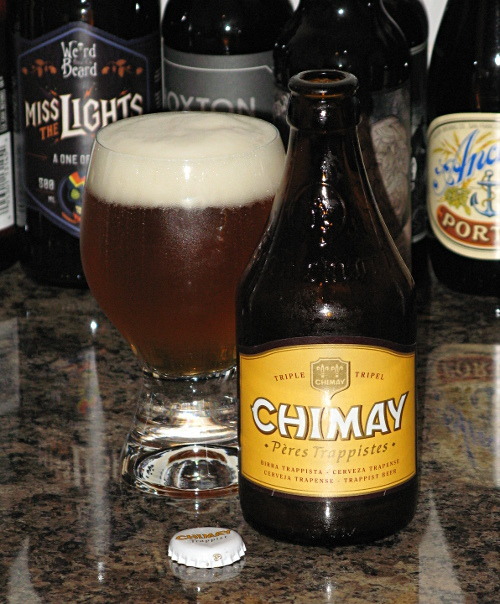
Chimay Blanche is very much in the Belgian tripel style, so should be more reminiscent of Westmalle Tripel than of the previous two Chimays. Let’s find out.

image

As expected, Chimay Blanche pours a much paler colour than its siblings, a beautiful and typically Belgian golden shade, with a pillowy white head. It smells light, subtle and again very Belgian with those distinctive esters that their golden beers always offer.

One taste is enough to know that the Blanche is far more suited to the summer months than the Bleue and the Rouge. It’s a truly refreshing beer, but at a respectable 8.0% ABV, it’s no wimpy pale ale. Instead it’s deep and rich with a huge and satisfying bitter finish.

There isn’t the complex fruit of the Westmalle Tripel, and that beer’s distinct banana notes are largely absent, being replaced by slightly darker toastier notes.

image

All in all this is a lovely beer. It isn’t a particularly easy one to describe, not least since it constantly reveals more depth as the glass drains, and the beer edges towards room temperature. I think I’m going to need to try another one!

Facts and Figures

Brewery: Bières de Chimay S.A., Baileux, Belgium
Style: Trappist Beers
Strength: 8.0% ABV
Found at: City Beverage Company, Old Street, London EC1
Serving: 330ml Bottle

56. Oude Geuze Boon

Here’s another beer that should be a completely new experience for me. Oude Geuze Boon hails from Belgium and is an example of a style of beer known as Gueuze*, itself a sub-type of Lambic, a sour wheat beer synonymous with the town of Lembeek in Belgium.

This is the first time I’ve tried a beer labelled with any of the terms Gueuze, Lambic or “sour” and, truth be told, I’ve had the bottle sitting around for quite some time while I plucked up the courage.

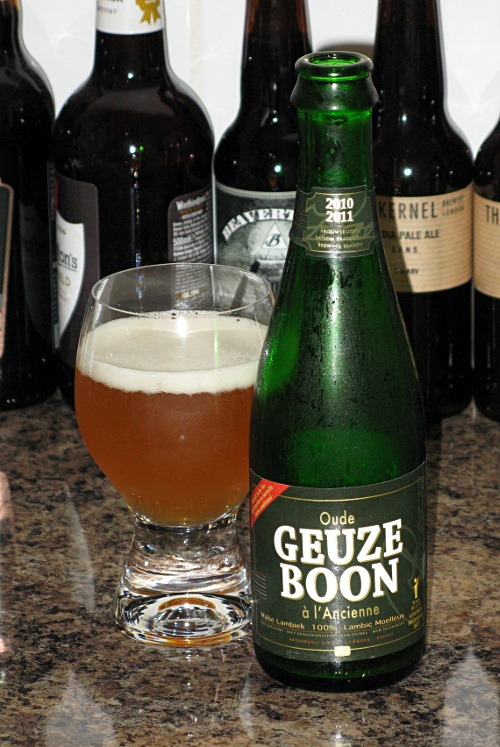
That may be no bad thing, since Lambics are well known for their tendency to improve with age. This one dates from the 2010-11 bottling and sports a “best before” date of early October 2032. You get the feeling the date is only on there at all simply to satisfy an EU bureaucrat somewhere.

image

Oude Geuze Boon is presented in a smart 375ml bottle, and is Champagne-corked, to let you know you’re dealing with something a bit grown-up. It pours a typically Belgian and slightly cloudy deep golden colour, and has a tightly frothy white head backed up with a lively fizz.

There’s an immediate and unmistakeable pong of cider, in particular the distinctive sweet-yet-sour stench of the lamentable Scrumpy Jack, which briefly transports me straight back to memories of the early 90s.

At the risk of stating the obvious, the beer tastes sour, but unfortunately, aside from a fairly standard Belgian ale hiding in there somewhere, there isn’t really much more to it than that. As with Aecht Schlenkerla Rauchbier, it’s hard to taste anything beyond the main gimmick of the beer, and as with the Rauchbier, I soon wish the bottle were smaller.

I fully accept that a lot of that will be down to my own inexperience with the style: these kinds of beers are quite literally an acquired taste, though I don’t foresee myself drinking enough of the stuff in future to acquire it. That said, there are a few more in The Book which I’ll have to wade through at some point.

Of course, at a mere three years old, this bottle has a lot of growing up to do, so it would also be fascinating to see what 20 years or so worth of cellaring would do for a beer like this.

All in all then, this is not to my taste by any means, but I’m glad I finally tried it.

* If it appears that I’m spelling things inconsistently here, my justification is that “Gueuze” is the name of the beer style as given in The Book, and on Wikipedia, while “Geuze” is the spelling used in the name of this particular beer, as seen on the label.

Facts and Figures

Brewery: Brouwerij Boon nv, Lembeek, Belgium
Style: Lambic and Gueuze
Strength: 7.0% ABV
Found at: Utobeer, Borough Market, London SE1
Serving: 375ml bottle

50. Saison Dupont

Reaching the minor landmark of Beer Number 50 seems like a good excuse to crack open something special, or at least a little bit different. To celebrate, I’ve plumped for a beer that I’ve been eyeing up for a little while: Saison Dupont.

Saison is a particular style of beer originating from Belgium—where else—where, in a refreshing deviation from the usual narrative, it was traditionally brewed not by monks, but by farmers. Saison was originally a relatively weak beer, designed to hydrate and fortify the farm workers at a time when there was no reliable source of untainted drinking water—hops and alcohol forming a particularly successful preservative partnership.

In that regard, Saison echoes the “small beer” that kept Britain alive through the centuries when cholera would take your first born as soon as look at you, and which was even issued to schoolchildren at morning break until mediaeval Tory cuts took hold, probably.

Anyway, this is only the second Saison I’ve ever tried, after London-based Beavertown’s experimental Saison 34 a few weeks ago. With the greatest of respect to Beavertown, Dupont is the real deal, the one against which all Saisons tend to be judged. The Dupont yeast strain alone is legendary, and is highly sought after by other brewers. In fact, that Beavertown Saison and many others are brewed using Dupont yeast.

image

Saison Dupont pours a slightly hazy golden colour, with a big, frothy white head. It smells fresh, floral and hoppy, and it tastes that way too, with the distinctive Belgian esters being present, but much subdued. It’s a little reminiscent of Leffe Blonde, but much more subtle.

I’m also reminded of Duvel, though there’s an extra peppery spice that Duvel lacks. Saison is often herbed and spiced, for example with coriander, cloves and orange peel, and while I’m not sure which botanicals are used to make this beer, they’re used in restrained quantities, so proceedings remain light and fragrant.

Although I mentioned that Saison is traditionally a weaker beer, times keep on changing, and you do have to remember that we’re talking about Belgium here, so Saison Dupont weighs in at 6.5% ABV. It tastes a lot lighter though, and remains particularly refreshing. It’s all finished by a crisp, dry, lingering finish.

So do I like it? I do, but it was going to be hard for Saison Dupont to live up to the high regard in which it has historically been held, not least since this isn’t a style of beer which is likely to blow your mind.

Saison Dupont is really just a very refreshing, enjoyable Belgian ale, and a very good one at that. It would be great with food, particularly mediterranean flavours, ideally sat outdoors late into a summer’s evening.

Facts and Figures

Brewery: Brasserie Dupont, Tourpes, Belgium
Style: Saison
Strength: 6.5% ABV
Found at: Utobeer, Borough Market, London SE1
Serving: 330ml Bottle