Tag Archives: Trappist Beers

176. Westvleteren Abt

And here we have it: the third in a mini-series of cupboard beers from before I moved house.

It’s also the third Westvleteren beer to be featured here, after the Blond from 2014, and the much more recent Extra from last month.
Westvleteren Abt

This is kind of the big one: a double-figures Belgian quad weighing in at 10.2% ABV, and one many consider to be the finest beer in the world. I was saving it for number 300, but practicality won out. Really, there’s no guarantee we’ll even make it that far, and it needed using.
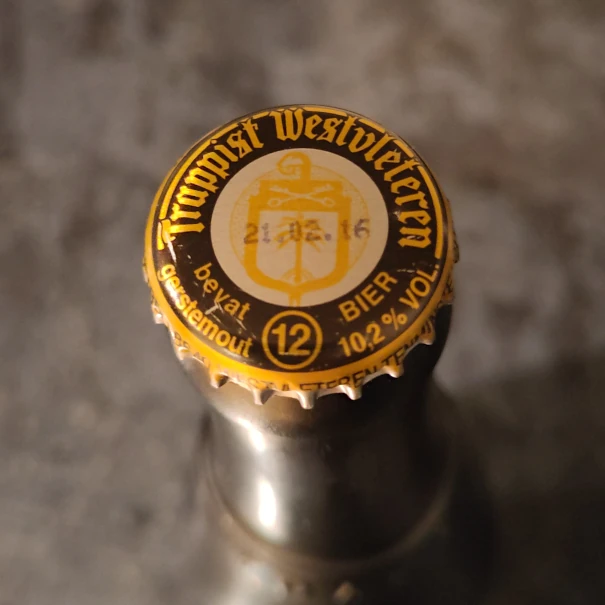
Westvleteren Abt

I won’t bore you with the mythology, and the hoops that you—in theory—have to jump through to0 find this beer, because I just bought it at De Biertempel in Brussels back in 2014. I did try a relatively fresh one at the time, so I guess I do have something to compare this veteran one with, if only I can remember it.

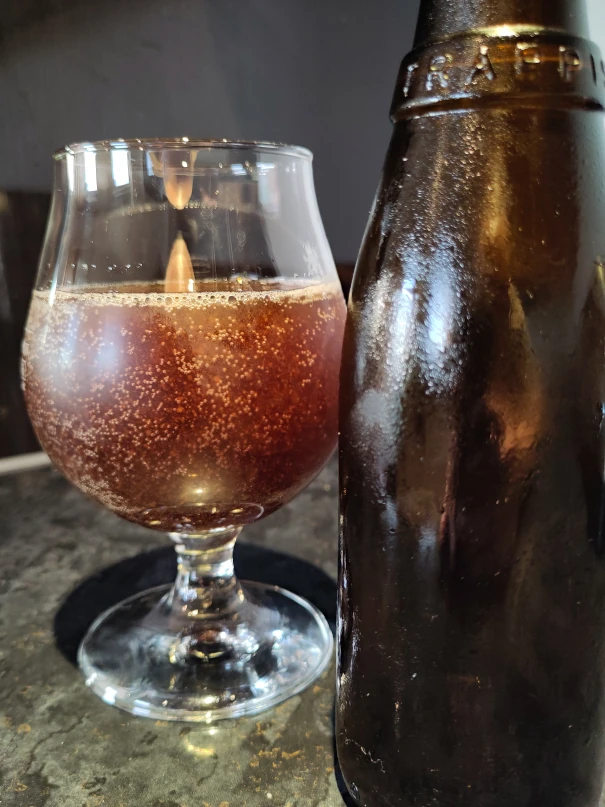
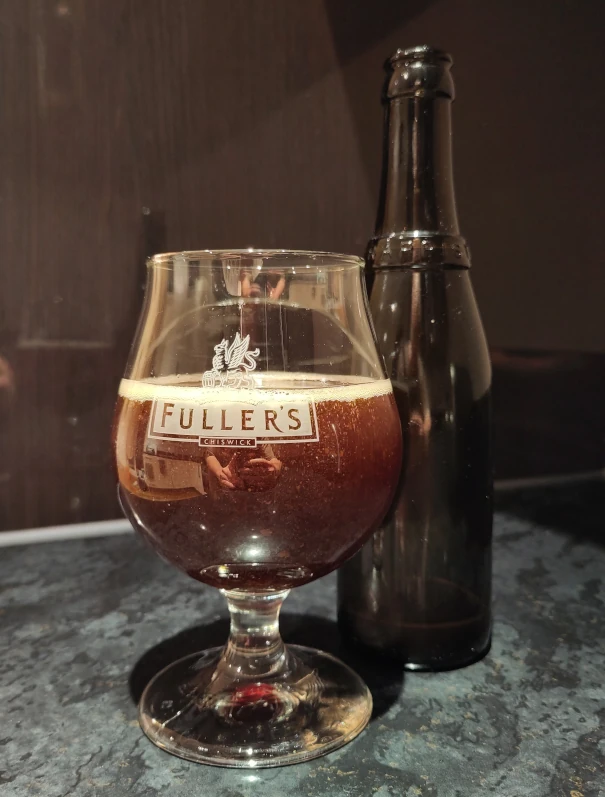
Even a decade beyond its best before data, there’s a healthy, controlled “pssst” on opening, which is reassuring. I’ll pour this one a bit more carefully than the Extra, not least because the hefty puddle of dark yeast sediment is again present. It’s darker and less fizzy than that one, with perhaps a tiny bit more head retention. Well, perhaps not a head, but a ring of foam, at least.

It’s chocolatey on the nose, and there’s definitely booze in there. Of course, any real hop character has long gone, leaving this one perhaps a little too sweet for my tastes. In fact the body is a little syrupy, and it’s sticky on the lips too, which I don’t remember from the fresher one.

There’s more body than the Extra and toffee or caramel notes, rather than dried fruit. It’s nice enough, but is it the best beer in the world? When I had the fresh one I asked myself that question and I kind of concluded that if it wasn’t, then I don’t know what you’d have to do to make it better.

In this case, drinking it sooner would probably have helped. People do age these for decades, but at that point you just have to admit you’re more interested in owning it and pointing at it occasionally than actually drinking it.

Still, I wouldn’t call this a disappointment: it was still a nice bottle of beer to have as a break from the chaos of the last couple of days before a big move.

Facts and Figures

Brewery: The Abbey of Saint Sixtus of Westvleteren, Flanders, Belgium
Style: Trappist Beers
Strength: 10.2% ABV
Found at: De Biertempel, Grasmarkt, Brussels, Belgium
Serving: 330ml bottle

175. Westvleteren Extra

After sampling the Westvleteren Blond for beer number 100, I was planning to save this one for when we reach 200 and, well, you’ll see where I was going with this.

But reality got in the way and this was the second of three beers left in the cupboard before a long-distance move. Also there’s a Belgium World Cup game on at the moment. Any excuse, right?

This was another one sourced from De Biertempel in Brussels, seemingly in February 2014. I make that over 12 years it has been sat around “maturing” so it’ll be interesting to see how it has fared. Sadly I don’t have a fresher one to compare it to.

In fact I’ve talked about the scarcity of Westvleteren beers before, and you can read all about it on the internet, so I won’t labour it again here. Suffice to say, this is the first chance I’ve had to try the 8% Westvleteren Extra, often know as the “8”.

In the book this is listed as a Trappist Ale, which seems to be a bit of a catch-all term, style-wise. I believe this is pretty close to a Dubbel, which is a much darker, maltier syle than the Blond, or something like the Westmalle Tripel.

It pours an almost copper colour, with a surprising amount of fizz. There’s no head retention and not a great deal of body after so long. There’s a hefty amount of very dark, almost black, yeasty sediment, and of course I’ve poured it like an idiot so quite a bit of that makes it into the glass.

There isn’t much in the way of aroma, and certainly no hop character has survived the passage of time. To taste though, it’s full of black treacle, dates, raisins and toffee. It’s really quite sticky on the lips, which perhaps surprised me.

Hopefully one day I’ll get a chance to try a fresher one, as I suspected it would be quite different. This one was in no way unpleasant, but I wouldn’t say the lengthy period of ageing has worked magic.

Facts and Figures

Brewery: The Abbey of Saint Sixtus of Westvleteren, Flanders, Belgium
Style: Trappist Beers
Strength: 8% ABV
Found at: De Biertempel, Grasmarkt, Brussels, Belgium
Serving: 330ml bottle

101. Koningshoeven La Trappe Blond

It must be all of two weeks since we last visited Lowlander. It’s a pleasant evening for a stroll around the West End, so why not let’s drift back. We can tackle this week’s Beelzebub crossword and sample the third and final La Trappe beer that we need while we’re there.

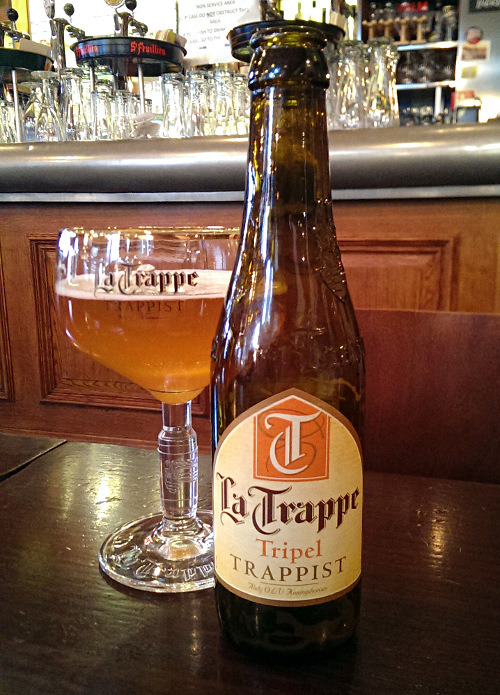
Koningshoeven La Trappe Blond at Lowlander Grand Café

We’ve already seen the La Trappe Dubbel and also the Tripel. The Blond is actually the least strong of the three, at a mere 6.5% ABV.

It pours very much the expected golden colour with a small amount of dense, white foam, and there’s a remarkable amount of fizz to it.

This is technically a Dutch beer, but like the previous La Trappe offerings, it’s basically as Belgian as a beer can get, short of, you know, actually being Belgian. It smells and tastes every inch the typical Belgian blond: floral and honey notes, banana fruit and musty farmhouse yeast.

There’s a hint of vanilla and some spicy hops, and despite being a little gassy, it’s quite refreshing. Unfortunately it’s a disappointingly inoffensive beer. There’s none of the moreish, zingy saltiness of the last Trappist blond we tried, the famous Westvleteren, or the warming alcohols of the La Trappe Tripel.

There’s nothing to particularly dislike about this one, but on balance, it’s really a rather forgettable beer.

Facts and Figures

Brewery: Abdij Onze Lieve Vrouw van Koningshoeven, Berkel-Enschot, Netherlands
Style: Trappist Beers
Strength: 6.5% ABV
Found at: Lowlander Grand Café, Drury Lane, London WC2B
Serving: 330ml bottle

100. Westvleteren Blond

I feel under a certain amount of pressure to come up with something a bit special for beer number 100. I hope this will do, as it’s a bottle of something rather rare which I brought back from Belgium when I visited in February.

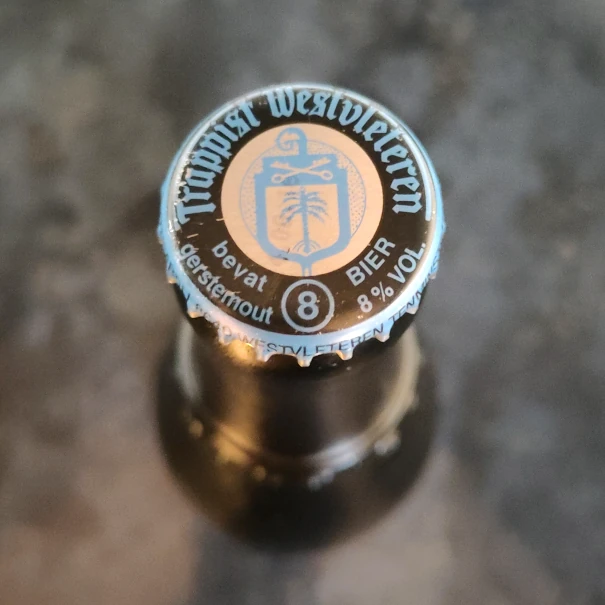
Westvletern Blond - cap

Westvleteren Blond is one of three beers brewed by the Trappist monks at The Abbey of Saint Sixtus of Westvleteren somewhere deep in the Flanders countryside. The Blond is perhaps the least famous of the three, and the lightest in terms of alcohol, at a sensible-by-Belgian-standards 5.8%.

The beers are officially only available at the monastery, and even then only after you jump through some pretty draconian hoops. The reason is that the monks have no desire to become a commercial brewing operation, instead preferring to sell just enough beer to pay for the upkeep of the monastery, and to allow them to carry on with their monky business undisturbed.

So they’ve rather shot themselves in the foot, then, by brewing what many consider to be some of the very finest beers in the world. The combination of lack of supply and huge demand mean they’re also some of the rarest and most difficult to find.

Fortunately for 300 Beers, there’s a small, shall we say, grey market in Brussels, and you can get hold of them if you know where to look, at least if you don’t mind parting with a few extra euros.

Westvleteren Blond

As you can see, the monks don’t even feel the need to do anything so pretentious as to put a label on their bottles, instead squeezing all the required information onto the cap.

There’s a hefty dose of loose yeast in the bottle, making it impossible to pour without getting a little in your glass, which doesn’t matter. As such, the beer pours an attractive, cloudy, deep golden colour with a modest amount of tenacious white froth which coats the glass beautifully.

The nose is all grapefruit, honey, delicate floral hops and Belgian yeast. The mouthfeel is interesting for a blond, as it’s so velvety smooth, and the beer is really quite full bodied.

To taste, that honey is there in spades and is joined by banana fruit courtesy of the malts, and big pepper and clove spice notes from the Northern Brewer hops.

The spices are present right through to the finish, which is surprisingly bitter for a blond. In fact it’s distinctly salty, in a way that’s reminiscent of an unaged Orval, which in many ways I guess is quite a similar beer.

The saltiness is a little odd at first, but soon becomes mouthwatering, and combines with the slightest of sour and farmhouse notes to provide an overall effect that’s a great deal more satisfying than many Belgian blonds.

Whilst it was always going to be hard for the Blond to live up to the high regard afforded to the two other beers in the Westvleteren family, in particular the Abt, there really is a very special quality to it: a real balance and refinement that only the finest beers ever achieve.

Facts and Figures

Brewery: The Abbey of Saint Sixtus of Westvleteren, Flanders, Belgium
Style: Trappist Beers
Strength: 5.8% ABV
Found at: De Biertempel, Grasmarkt, Brussels, Belgium
Serving: 330ml bottle

96. Koningshoeven La Trappe Tripel

I very much enjoy my all-too-infrequent visits to the splendid Lowlander on Drury Lane. To while away an afternoon being waited on by their charming and tirelessly efficient young staff, who unhesitatingly fetch you round after round of hopelessly strong beers at the slightest invocation, is one of London’s great pleasures.

You’ll remember that we previously enjoyed that rather special Rodenbach Grand Cru there a little while ago, but we haven’t exhausted the intersection between Lowlander’s extensive beer menu and the 300 Beers Todo List by any means. Let’s beckon our serveuse over and order a bottle of La Trappe Tripel.

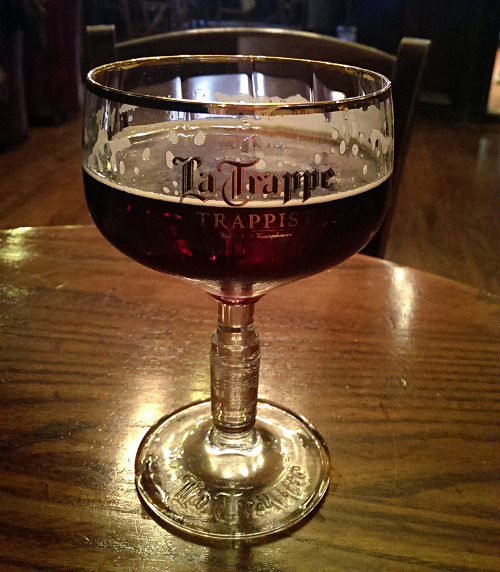
Koningshoeven La Trappe Tripel

As I mentioned when I covered La Trappe Dubbel a little while ago, the Trappist Abbey of Our Lady of Koningshoeven brewery is the only Trappist brewery in the Netherlands, and as such brews what may be regarded as quite typically Belgian beer styles.

The Tripel is no exception. Blonder, hoppier and a little stronger than the Dubbel at 8.0%, the La Trappe Tripel is absolutely typical of its style, the archetype for which is of course the Westmalle Tripel.

This is a remarkably similar beer. One whiff and I’m back in Brussels, as the Belgian yeast, subtle hops and that distinctive dried banana aroma flow freely forth. To taste, it’s fresh, zesty and astonishingly light for an eight percenter.

As it warms, peppery, spicy notes come through, and while I wouldn’t have identified it myself, it’s not entirely surprisingly to learn that the monks brew this one with a touch of coriander. It contributes a spicy heat and adds complexity, though the beer isn’t lacking in that already.

I’m becoming quite fond of this brewery, though I’d tend to lean towards their 10% ABV Quadrupel, a couple of which are quietly ageing in the Official 300 Beers Cellar (a cardboard box in the spare room). That one isn’t in The Book, but there is one more La Trappe beer to track down. Stay tuned.

Facts and Figures

Brewery: Abdij Onze Lieve Vrouw van Koningshoeven, Berkel-Enschot, Netherlands
Style: Trappist Beers
Strength: 8.0% ABV
Found at: Lowlander Grand Café, Drury Lane, London WC2B
Serving: 330ml bottle

86. Koningshoeven La Trappe Dubbel

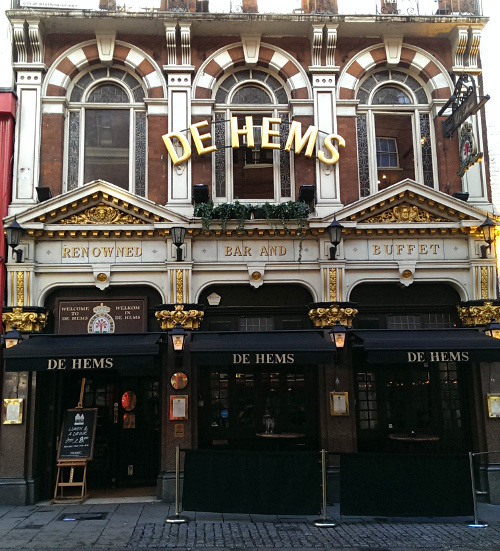
The next stop on our brief tour of London’s West End takes us to De Hems, a historically Dutch-run pub and former oyster bar, music industry meeting place and alternative comedy venue on the edge of Chinatown.

De Hems, London

De Hems is steeped in history, but has fairly recently become part of the Nicholson’s empire of chain pubs.

It’s to Nicholson’s credit, though, that they haven’t squeezed the life out of it. De Hems is thankfully more like a continental beer café than a London chain pub, and its array of Dutch and Belgian beers, its list of bewilderingly-named Dutch foodstuffs, and its friendly welcome mean it remains as popular with natives of the Netherlands as with London office workers.

Most usefully for 300 Beers, it also has this particular Trappist ale on tap.

Koningshoeven La Trappe Dubbel

The Dutch-based Koningshoeven abbey was until recently the only Trappist brewery outside Belgium. It can be reasonably tricky to find their beer in the UK even in bottles, and I’m not aware of it being available on tap anywhere else.

You could have a pint if you liked, but as this one weighs in at 7.0% ABV and it’s lunchtime, we’ll stick to a half and enjoy having it served in the correct glassware, as is typically the case at De Hems.

Served from keg it’s a little too cold, but as it warms in your hand it reveals itself to be the archetypal Trappist Dubbel: full of dates, sultanas and malt loaf. La Trappe Dubbel is smooth and very easy-drinking, and while the malty sweetness means it never quite tastes its full 7%, there’s a nice, warming booziness all the same.

While a little lighter-bodied than the Westmalle Dubbel, La Trappe is still less watery than the Chimay Rouge, both obvious points of reference for what is a very similar beer. The finish is satisfyingly peppery and perhaps a little moreish.

Moreish enough that I had a second one anyway, and have since been back to De Hems for more, drawing a knowing smile from the barman. There are two more La Trappe beers to be tracked down, and I wonder if we may have to travel further than Chinatown to find them.

Facts and Figures

Brewery: Abdij Onze Lieve Vrouw van Koningshoeven, Berkel-Enschot, Netherlands
Style: Trappist Beers
Strength: 7.0% ABV
Found at: De Hems, Macclesfield Street, London W1D
Serving: Keg, half pint

80. Rochefort 10

This time next week I’ll be in Brussels sampling some of the world’s most famous beers. Tonight though, I’m in a rainy, resolutely ungentrified Camberwell, London at the ever-magnificent Stormbird, one of my very favourite pubs in the world.

I’m reluctant to tell you about Stormbird, because it’s the sort of place you want to keep to yourself, but it truly is wonderful: an Aladdin’s cave for the beer lover, with a mouth-watering and ever changing tap lineup, lovely staff and a civilised, if somewhat youngish, clientele.

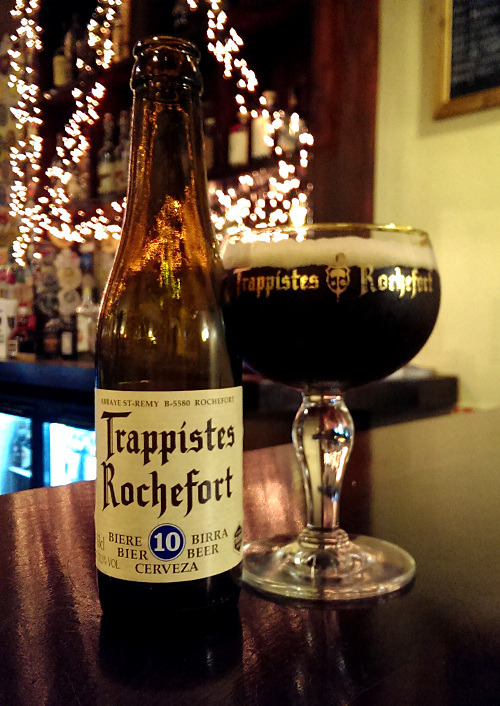
It’s time to get some Belgian beer-related practice in, and also to round off the three Rochefort beers we need by putting ourselves on the outside of this 11.3% ABV monster of a Trappist ale, served, you’ll note, in the correct glassware.

image

Without question, that’s a fine-looking beer right there. Rochefort 10 is a rich, deep brown colour with a remarkably dense tan helmet of foam that doesn’t dissipate until the last drop is drunk.

I didn’t detect a huge amount of aroma, at least compared to the eye-wateringly fresh keg Thornbridge Halcyon I’d enjoyed mere moments before. What there is though is distinctly Belgian, and reminiscent of a Dubbel, though a little lighter.

The mouthfeel is thick and smooth, and the flavour is all christmas pudding packed with dried fruits, berries, caramel and booze. That said, the 11.3% payload is well integrated, and while this is a very decadent beer, it’s oh so drinkable, and a lot more subtle than the sledgehammer of flavour and intoxication that was Samichlaus, our previous double-figures leviathan.

Splendid stuff. This would make a great after-dinner beer, to be savoured slowly and swilled around the glass in your favourite armchair. And thankfully, that’s one less ridiculously strong Belgian beer that I need to find next week.

Facts and Figures

Brewery: Abbaye Notre-Dame de Saint-Remy, Rochefort, Belgium
Style: Trappist Beers
Strength: 11.3% ABV
Found at: Stormbird, Camberwell Church Street, London SE5
Serving: 330ml Bottle

60. Chimay Blanche

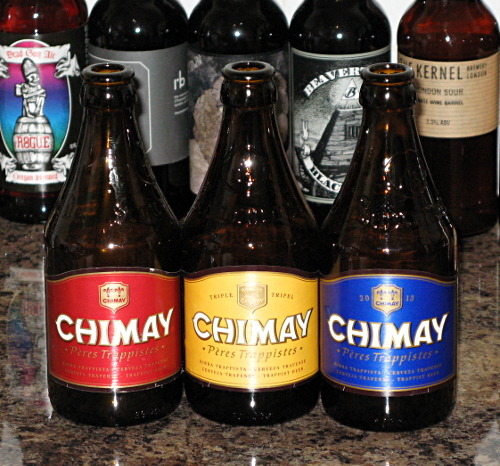
This is the third and final Chimay beer to be covered here, after the luxurious Chimay Bleue and the fruity and sinister Chimay Rouge. The Blanche has proven a little harder to get hold of for some reason, but a recent lunch hour stroll to City Beverage Company finally resolved matters.

Chimay Blanche is very much in the Belgian tripel style, so should be more reminiscent of Westmalle Tripel than of the previous two Chimays. Let’s find out.

image

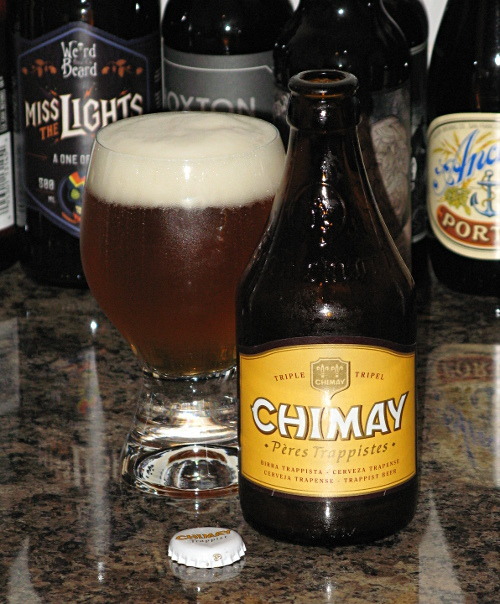
As expected, Chimay Blanche pours a much paler colour than its siblings, a beautiful and typically Belgian golden shade, with a pillowy white head. It smells light, subtle and again very Belgian with those distinctive esters that their golden beers always offer.

One taste is enough to know that the Blanche is far more suited to the summer months than the Bleue and the Rouge. It’s a truly refreshing beer, but at a respectable 8.0% ABV, it’s no wimpy pale ale. Instead it’s deep and rich with a huge and satisfying bitter finish.

There isn’t the complex fruit of the Westmalle Tripel, and that beer’s distinct banana notes are largely absent, being replaced by slightly darker toastier notes.

image

All in all this is a lovely beer. It isn’t a particularly easy one to describe, not least since it constantly reveals more depth as the glass drains, and the beer edges towards room temperature. I think I’m going to need to try another one!

Facts and Figures

Brewery: Bières de Chimay S.A., Baileux, Belgium
Style: Trappist Beers
Strength: 8.0% ABV
Found at: City Beverage Company, Old Street, London EC1
Serving: 330ml Bottle

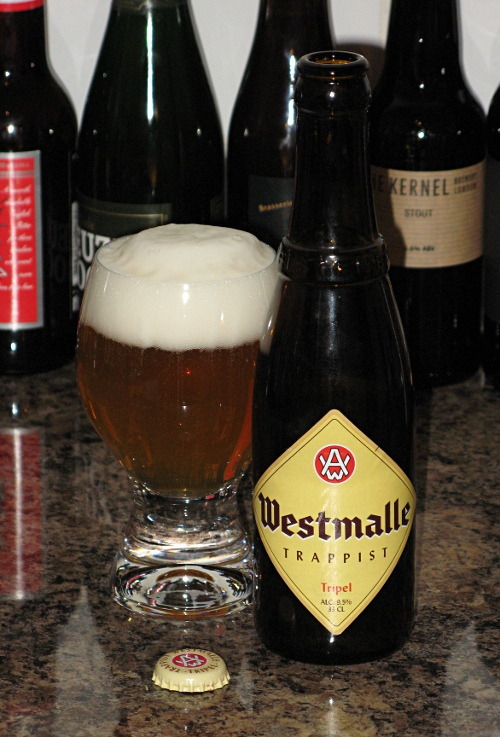
42. Westmalle Tripel

It’s with an almost crushing sense of inevitability that we come to try yet another beer brewed by Belgian monks, one of countless that are left to cover.

Never mind, this at least gives us a chance to try a Tripel, one of several designations of Trappist beers, and to compare and contrast with the Westmalle Dubbel we recently met.

In fact it was Westmalle themselves, currently Belgium’s second largest Trappist brewery, who introduced the terms Dubbel and Tripel, terms which are now widely used in Belgium and beyond. The naming seems to originate from the number of crosses branded onto casks to indicate strength, in contrast to an “Enkel” or “single”, but nowadays the terms generally denote distinct styles of beer.

A Tripel will still typically be stronger than a Dubbel—the Westmalle example weighs in at 9.5% ABV whereas its Dubbel sibling is a more modest 7.0%—but the strength doesn’t define the style. Whilst a Dubbel will be all deep dark, vinous malt and Christmas cakey dried fruits, a Tripel will be far paler and hoppier with more bitterness and lighter fruit.

image

Westmalle Tripel is certainly paler than its Dubbel counterpart, pouring a slightly cloudy golden colour, with a pillowy white head that would make Mr. Whippy proud. You really have to take care pouring this one, as there’s a good quarter inch of yeast sediment, including some great lumps of the stuff.

In fact, the yeast and the strength suggest this might be a good candidate to be cellared, or at least aged at the back of the kitchen cupboard, for a few years. It’s too late for this one: the lid’s off and I’ve a review to write.

The nose is broadly typical of a Belgian golden ale, with the distinctive esters front and centre, though there’s a conspicuous dried banana scent bursting through.

To taste, Westmalle Tripel is quite different from any of the preceding 41 beers, with the exception perhaps of Orval, another Trappist beer that could probably have done with some age on it. There’s an instant floral explosion in the mouth, and a bitterness and strong spice that’s delivered direct to the tastebuds by the considerable fizz.

The body is quite light, and that bitterness is pretty harsh, truth be told, not least as it’s accompanied by a saltiness reminiscent of Orval’s. There doesn’t seem to be a lot of subtlety about this beer, as it finishes by paintstripping your mouth dry. But kind of in a good way.

I actually quite enjoyed this beer, but it’s clear this is not the finished product, as all those flavours fall over each other to vie for your attention. Westmalle Tripel really needs at least a couple of years in the bottle to calm it down, so I’ll be putting one or two away. Who knows, if I ever get through the remaining 258 beers, I may revisit this one and see how it’s grown up.

Facts and Figures

Brewery: Brouwerij der Trappisten van Westmalle, Westmalle, Belgium
Style: Trappist Beers
ABV: 9.5%
Found at: Bossman Wines, Lordship Lane, London SE22
Dispense: 330ml Bottle

36. Rochefort 8

This is the second of three Trappistes Rochefort beers in The Book. We saw the Rochefort 6 recently, and this is a similar brew with similar ingredients, but one which ratchets up the strength a little to a very respectable 9.2% ABV.

image

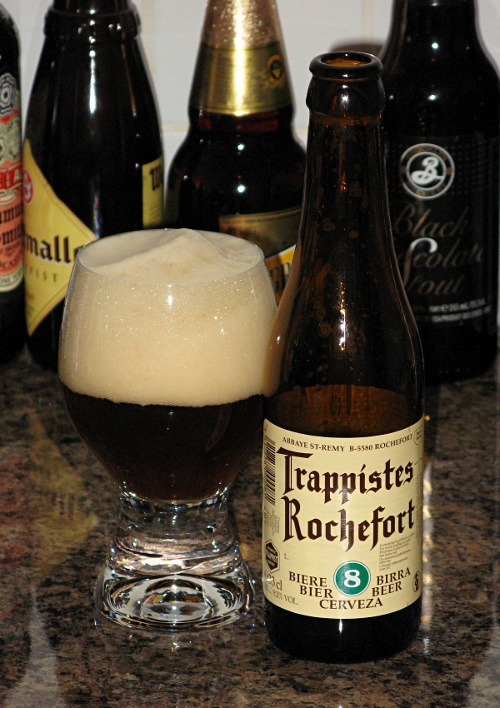
Once again, there’s a gigantic foamy head, perhaps even larger than that of the 6. The 8 pours slightly darker, and is more of a burnished bronze colour.

Perhaps unsurprisingly, there isn’t a great deal of difference between the 6 and the 8. There’s that same toasty caramel and christmas pudding fruit, along with a vinous barleywine-like finish.

That said, I notice I did use the word “refreshing” about the 6, whereas with that 9.2% strength, I’m not sure I would describe this one as such. It’s more of a warming drink, and one to take a little more slowly. It’s a fairly thick beer, and gently swilling it, the way the foam holds to the glass is a thing of beauty in itself.

Rochefort 8 is certainly a good, savourable beer. I rather like it, though I slightly resent it for not giving me anything particularly interesting to say in comparison to the previous Rochefort offering. That’s clearly unfair, because I suspect if I tried this one in isolation, I’d be very impressed indeed.

We’ve one more Trappistes Rochefort beer left to try. At a mighty 11.3% ABV, the Rochefort 10 is the strongest beer I’ve ever seen in my life. I’ve sourced a bottle today, and I’m very much looking forward to it.

Facts and Figures

Brewery: Abbaye Notre-Dame de Saint-Remy, Rochefort, Belgium
Style: Trappist Beers
Strength: 9.2% ABV
Found at: City Beverage Company, Old Street, London EC1
Serving: 330ml Bottle