Category Archives: Beers

The beers

86. Koningshoeven La Trappe Dubbel

The next stop on our brief tour of London’s West End takes us to De Hems, a historically Dutch-run pub and former oyster bar, music industry meeting place and alternative comedy venue on the edge of Chinatown.
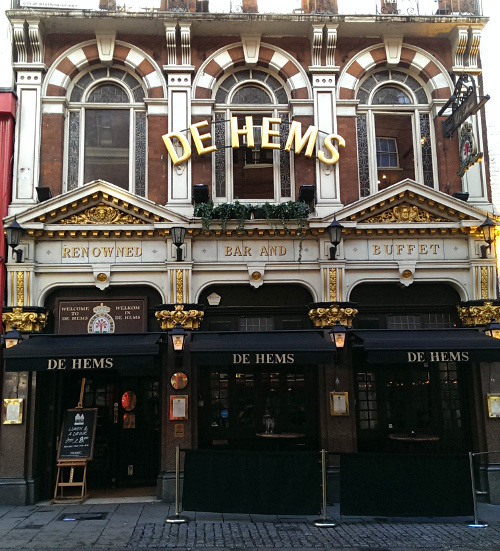
De Hems, London

De Hems is steeped in history, but has fairly recently become part of the Nicholson’s empire of chain pubs.

It’s to Nicholson’s credit, though, that they haven’t squeezed the life out of it. De Hems is thankfully more like a continental beer café than a London chain pub, and its array of Dutch and Belgian beers, its list of bewilderingly-named Dutch foodstuffs, and its friendly welcome mean it remains as popular with natives of the Netherlands as with London office workers.

Most usefully for 300 Beers, it also has this particular Trappist ale on tap.
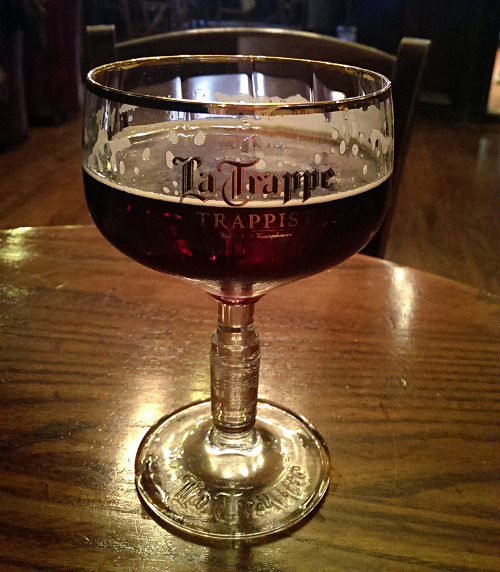
Koningshoeven La Trappe Dubbel

The Dutch-based Koningshoeven abbey was until recently the only Trappist brewery outside Belgium. It can be reasonably tricky to find their beer in the UK even in bottles, and I’m not aware of it being available on tap anywhere else.

You could have a pint if you liked, but as this one weighs in at 7.0% ABV and it’s lunchtime, we’ll stick to a half and enjoy having it served in the correct glassware, as is typically the case at De Hems.

Served from keg it’s a little too cold, but as it warms in your hand it reveals itself to be the archetypal Trappist Dubbel: full of dates, sultanas and malt loaf. La Trappe Dubbel is smooth and very easy-drinking, and while the malty sweetness means it never quite tastes its full 7%, there’s a nice, warming booziness all the same.

While a little lighter-bodied than the Westmalle Dubbel, La Trappe is still less watery than the Chimay Rouge, both obvious points of reference for what is a very similar beer. The finish is satisfyingly peppery and perhaps a little moreish.

Moreish enough that I had a second one anyway, and have since been back to De Hems for more, drawing a knowing smile from the barman. There are two more La Trappe beers to be tracked down, and I wonder if we may have to travel further than Chinatown to find them.

Facts and Figures

Brewery: Abdij Onze Lieve Vrouw van Koningshoeven, Berkel-Enschot, Netherlands
Style: Trappist Beers
Strength: 7.0% ABV
Found at: De Hems, Macclesfield Street, London W1D
Serving: Keg, half pint

85. Budweiser Budvar

Allow me, dear reader, to take you on a brief stroll down Memory Lane, or a least down St. Martin’s Lane, to a magnificent little pub in the heart of London’s West End named The Salisbury.

The Salisbury is a bit of a stunner: a proper old Victorian pub, with a well preserved Gin Palace interior full of etched mirrors, brass statuary and wood panelling, and more history than you can shake a stick at.

This is a pub where Dylan Thomas, Michael Caine and Terence Stamp have drunk, where Elizabeth Taylor and Richard Burton held their second wedding reception, and where Gered Mankowitz famously photographed a beautiful 27-year-old Marianne Faithfull in the 1960s.

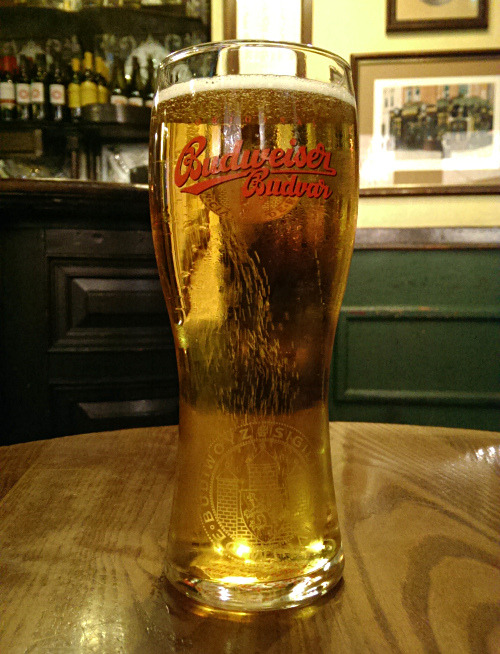
Now, bear with me when I tell you that we’re going to have a pint of lager.

image

It’s a good, Czech lager all the same and—you may be surprised to learn—it’s what I used to drink of a far-too-regular lunch hour or evening in the Salisbury many years ago, when I used to work just around the corner. See, Memory Lane after all.

There isn’t much to say about Budvar itself, in all honesty, unless one wants to read all about their legal struggles with Anheuser Busch once again, in which case go here. It’s a fizzy, golden confection, quite drinkable as lagers go, with a malty, floral taste and a slightly sweet finish. But it’s served here in peak condition, and in the correct glassware, which is why I brought you back here.

Beer aside, it’s great to see that The Salisbury is still in good hands: manager Jas is still in charge, running a tight ship as always, keeping the pub resolutely sports-free, and effortlessly switching between languages as he guides tourists through a minefield of unfamiliar beers and British pub customs.

Easily one of the better pubs in the area, a bit of nostalgia for your correspondent, and that’s 85 beers ticked off. If that was a bit boring, I have number 100 sat in The Official 300 Beers Cellar (my kitchen) and I can almost taste it now.

Facts and Figures

Brewery: Budějovický Budvar, České Budějovice, Czech Republic
Style: Pale Lagers
Strength: 5.0% ABV
Found at: The Salisbury, St. Martin’s Lane, London WC2N
Serving: Keg, pint

84. Bush Ambrée

Let’s continue on our mission to sample our way through the impressive Poechenellekelder beer menu, this time with a daunting 12.0% ABV Belgian amber beer, Bush Ambrée.

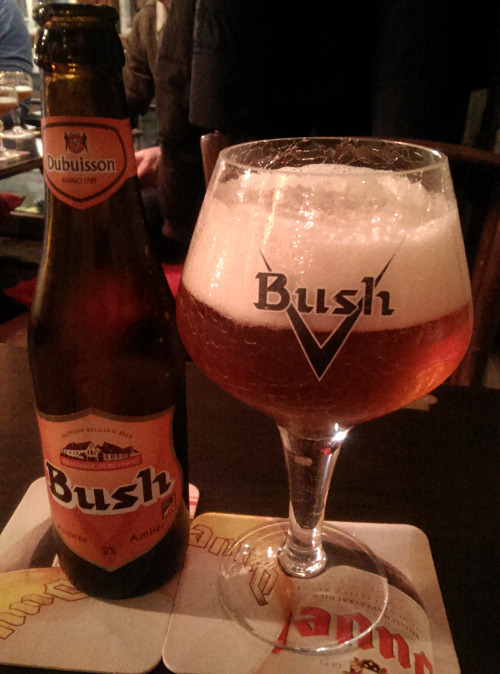
Bush Ambrée at Poechenellekelde, Brussels

The deep, rich golden beer certainly looks the part, and as with every single beer I tried at Poechenellekelder—and indeed anywhere in Brussels—it’s served in the correct glassware, in this case a rather nice looking Bush-branded chalice with a pleasing cracked glass effect.

The bottle claims this to be “The Strongest Belgian Beer”, which is a bit of a stretch since the same brewery makes at least two stronger ones, but still, as only the second beer of the evening, I’m already wondering if I’ve peaked too early.

One sip is enough to reassure me that this was a good choice. Sure, it’s boozy, but the warming alcohols are balanced out with a rich, spiced-honey sort of sweetness and a smooth, full body full of delicious sappy malts.

Bush Ambrée is reminiscent of a Barleywine, and while similar in style to Pauwel Kwak, it’s a little lighter and less sticky, making it even more easy-drinking. Which could get dangerous.

But having said that, I really enjoy the culture and civility around beer drinking in Begium. While many of the beers are hopelessly strong, the emphasis is always on quality over quantity. Table service and slow, measured enjoyment of the product are the norm, rather than a fight to the bar and necking as many pints of lager as you can before the bell rings, which is more the British approach.

I rounded off the visit to Poechenellekelder with a delicious, dark St. Bernardus Abt 12. That one isn’t The Book, but it’s probably a good job, since my notes start to become a little less legible at this point.

Facts and Figures

Brewery: Brasserie Dubuisson, Chaussée de Mons, Pipaix, Belgium
Style: Old Ales, Barley Wines and Vintage Ales
Strength: 12.0% ABV
Found at: Poechenellekelder, Rue du Chêne, Brussels, Belgium
Serving: 330ml Bottle

83. Pauwel Kwak

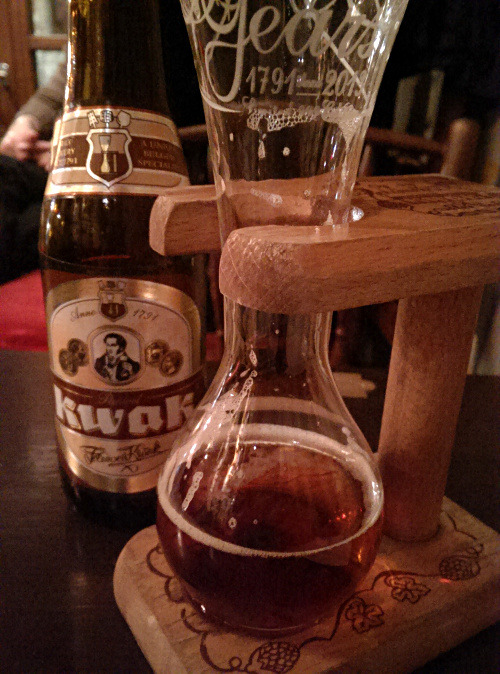
Beer number 83 is one of those ones that you really do have to travel to enjoy properly. Pauwel Kwak obviously has to be served with its unique glass and wooden stand, and quite frankly you’d feel a bit daft sitting in a boozer in South London with one of these, even if you could find it.

Fortunately, in Brussels no one bats an eyelid, though I suspect this may be more as a result of the number of tourists who order a Kwak just for the glass, rather than the number of Bruxellois who would regularly drink it.

Pauwel Kwak

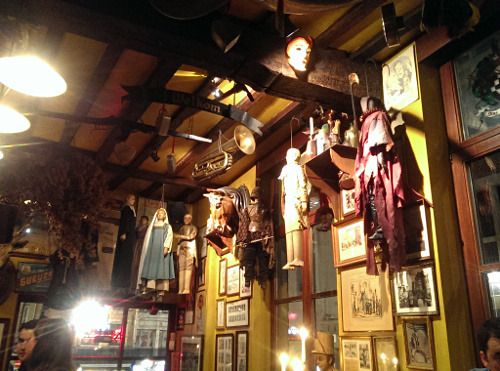
I ordered this one at the rather wonderful Poechenellekelder—“the puppet cellar”—in Rue du Chêne, an instant favourite bar lined floor-to-ceiling with masques, marionettes, ventriloquist’s dummies and all sorts of black and white photos and assorted historical memorobilia.

Helpfully for 300 Beers, it also has a truly impressive beer menu running to something like 130 beers, almost all of them Belgian.

Poechenellekelder, Brussels

The legend behind the glass, by the way, is that it was designed in the early 19th century by innkeeper Pauwel Kwak—”Fat Paul” to his mates—to be served to coachmen to slip into their stirrup as they rode away on horseback. That’s plainly nonsense, of course, and the truth seems to be that it was invented in the 1980s as a marketing gimmick.

Which is a bit of a shame really, because the fame of the glass tends to overshadow what is in fact a rather wonderful beer.

Pauwel Kwak is a warm, deep, reddish ambrée colour with a big foam head that froths all over the place when poured, but quickly calms down.

It’s thick, rich and a little sticky, and is quite reminiscent of a Barleywine. It’s low on hop bitterness, but full of treacly malt sweetness and warming alcohols.

Kwak is pleasingly strong at 8.4%, though admittedly that’s only the third strongest of three beers I tried in Poechenellekelder that night, thus making the delicious, restorative black coffee I enjoyed there the following day particularly welcome.

All in all, a lovely beer, and one I look forward to trying again some day, perhaps even as part of a return visit to Poechenellekelder before long.

Facts and Figures

Brewery: Brouwerij Bosteels, Buggenhout, Belgium
Style: Extra Strong Beers and Bitters
Strength: 8.4% ABV
Found at: Poechenellekelder, Rue du Chêne, Brussels, Belgium
Serving: 330ml Bottle

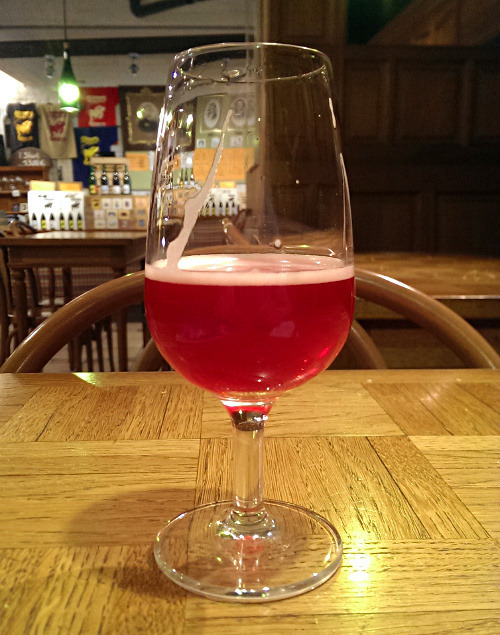
82. Cantillon Kriek

The time has come for 300 Beers to selflessly embark on a brief, shall we say, “research” trip to Brussels to track down a few of the many Belgian beers still required for this ridiculous quest.

In this case, it’s a sour, cherry-infused beer known as Kriek, which I enjoyed in the tasting rooms at the Cantillon brewery in the Belgian capital as part of a tour of the brewery. You can read all about my visit here.

image

Cantillon Kriek starts life as two year-old, barrel-aged Lambic. Large quantities of sour Schaerbeek cherries are then soaked in the Lambic for around six months, at which point a quantity of fresh, young Lambic is blended in. The resulting blend is transferred to bottles for a period of secondary fermentation, during which time it becomes a delicious, frothy red Gueuze.

I’m not typically a fan of fruit beers, but then it’s fair to say that this isn’t a typical fruit beer. Like all Cantillon beers it’s as sour as can be, and the cherries complement that sourness beautifully.

The result is a satisfying and complex beer, and the tiny hint of sweetness provided by the cherries just offsets the mouth-puckering Lambic sourness, to leave a tart, dry and lingering finish.

Cantillon Kriek is certainly moreish, but its richness means it’s probably best enjoyed in smaller quantities. I’m not sure I’ll become a huge fan of fruit beers just yet, but it certainly makes for a refreshing change, and the chance to enjoy it just feet from where it was brewed, surrounded by the evocative sights, sounds and smells of the venerable Cantillon brewery only adds to the experience.

Facts and Figures

Brewery: Brasserie Cantillon Brouwerij, Rue Gheude, Brussels, Belgium
Style: Lambic and Gueuze
Strength: 5.0% ABV
Found at: Cantillon Brewery, Brussels
Serving: Taster, poured from a 750ml bottle

81. Adnams Broadside

Whilst I’m not sure that I’ve lived down opting for that somewhat overcomplicated bottle of Affligem Blond just yet, it’s time for 300 Beers to show its face once again in the rather wonderful Grape & Grain, up the hill in Crystal Palace.

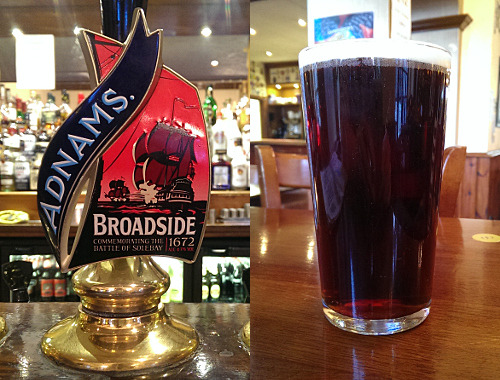
Let’s puff out our chest, involuntarily adopt a Cockney accent, and order something a bit more manly this time: a pint of cask Adnams Broadside.

image

Among their 12 handpumps, “the Grape” often have something on from Adnams, one of the most highly-regarded of the old-school English breweries. Like all the other cask ales in this pub, it’s always going to be in great nick too.

And so it is today. Broadside pours a lovely deep ruby or chestnut colour with a smallish off-white head. The aroma is all fruitcake and christmas, while the mouthfeel is thick, rich and just a little sticky.

The flavour is yet more nutty dried fruit and cake, with a dense underlying sweetness. Hops are subdued, making Broadside somewhat reminiscent of a Mild or a Brown Ale, styles of beer which continually prove that low on hops needn’t equate to low on flavour.

And Broadside is full of flavour. It tastes stronger than the nominal 4.7% ABV it claims to be, but goes down as smoothly as can be. Still I’m not sure I could drink more than a couple, as this really is quite a heavy, rich beer. It’s good though.

Broadside is also available in a 6.3% ABV bottled version, named “Strong Original”, acknowledging the fact that Broadside was once a much stronger beer. It’s a testament to Adnams’ considerable brewing skills that they’ve managed to tame the cask version down to the lower ABV without neutering the flavour one bit.

Facts and Figures

Brewery: Adnams Sole Bay Brewery, Southwold, Suffolk, England
Style: Best Bitters
Strength: 4.7% ABV
Found at: The Grape & Grain, Anerley Hill, London SE19
Serving: Cask, pint

80. Rochefort 10

This time next week I’ll be in Brussels sampling some of the world’s most famous beers. Tonight though, I’m in a rainy, resolutely ungentrified Camberwell, London at the ever-magnificent Stormbird, one of my very favourite pubs in the world.

I’m reluctant to tell you about Stormbird, because it’s the sort of place you want to keep to yourself, but it truly is wonderful: an Aladdin’s cave for the beer lover, with a mouth-watering and ever changing tap lineup, lovely staff and a civilised, if somewhat youngish, clientele.

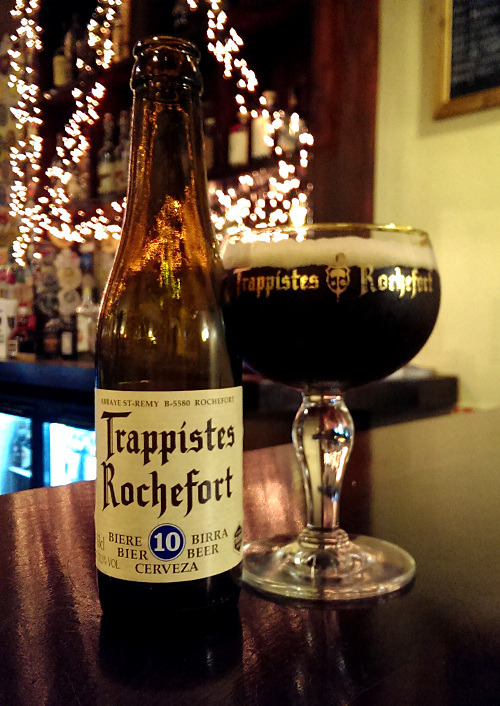
It’s time to get some Belgian beer-related practice in, and also to round off the three Rochefort beers we need by putting ourselves on the outside of this 11.3% ABV monster of a Trappist ale, served, you’ll note, in the correct glassware.

image

Without question, that’s a fine-looking beer right there. Rochefort 10 is a rich, deep brown colour with a remarkably dense tan helmet of foam that doesn’t dissipate until the last drop is drunk.

I didn’t detect a huge amount of aroma, at least compared to the eye-wateringly fresh keg Thornbridge Halcyon I’d enjoyed mere moments before. What there is though is distinctly Belgian, and reminiscent of a Dubbel, though a little lighter.

The mouthfeel is thick and smooth, and the flavour is all christmas pudding packed with dried fruits, berries, caramel and booze. That said, the 11.3% payload is well integrated, and while this is a very decadent beer, it’s oh so drinkable, and a lot more subtle than the sledgehammer of flavour and intoxication that was Samichlaus, our previous double-figures leviathan.

Splendid stuff. This would make a great after-dinner beer, to be savoured slowly and swilled around the glass in your favourite armchair. And thankfully, that’s one less ridiculously strong Belgian beer that I need to find next week.

Facts and Figures

Brewery: Abbaye Notre-Dame de Saint-Remy, Rochefort, Belgium
Style: Trappist Beers
Strength: 11.3% ABV
Found at: Stormbird, Camberwell Church Street, London SE5
Serving: 330ml Bottle

79. Samichlaus

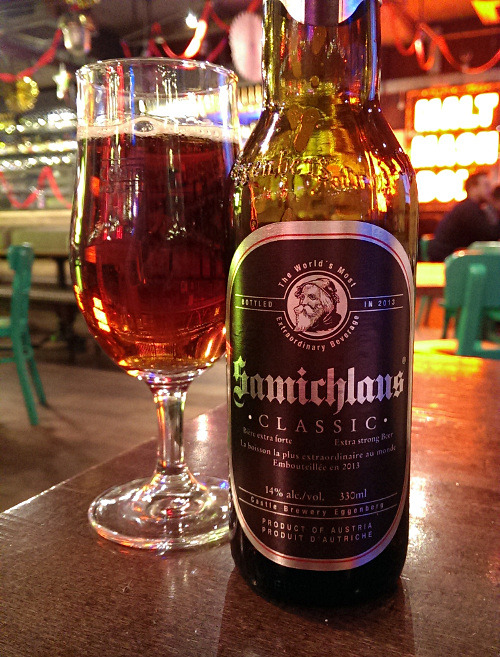
Now then. For beer number 79, we turn to something a little bit special. Samichlaus is a remarkable beer, which has by turns been described as “the world’s strongest lager”, “perhaps the rarest beer in the world”, and according to its own label, “the world’s most extraordinary beverage”.

Whether any of those claims is true is perhaps best left to the reader to decide, but let’s just say it’s a bit of a stonker. Brewed at Schloß Eggenberg in Austria just once per year on December the 6th, and then aged for 10 months before bottling, it attains a formidable 14.0% ABV.

You rarely see this stuff, but The Draft House’s newest branch, on Seething Lane in the City of London, came up with the goods this weekend, instantly earning a place in your correspondent’s heart at the first visit.

Samichlaus

You can tell just by looking that this is something special, and it certainly is. Reminiscent of a Barleywine or Vintage Ale, it’s rich, thick, spicy and medicinal, with a dense sweetness that can’t possibly compete with the alcohol heat.

In fact there’s a huge, warming alcohol hit that’s very welcome indeed at this time of year. Your lips stick together, your face blushes a fiery crimson, and your head begins to forget all its troubles.

Yet behind all that booze, there’s a truly delicious, complex beer full of dried fruit, spice and sherry flavours.

Samichlaus is the perfect winter beer by design, and it’s one of those beers that you could drink all night if your wallet would stretch to it, or at least if you wouldn’t fall off your chair half way through the second one.

It’s lovely stuff, and a real winter treat. I may well be back for more.

Facts and Figures

Brewery: Brauerie Schloss Eggenberg, Eggenburg, Austria
Style: Bocks
Strength: 14.0% ABV
Found at: The Draft House, Seething Lane, London EC3N
Serving: 330ml Bottle

78. Samuel Smith’s Oatmeal Stout

After the rather wonderful pint of Kelham Island Pale Rider I recently enjoyed in Sheffield, this is the second beer in a row to hail from Yorkshire.

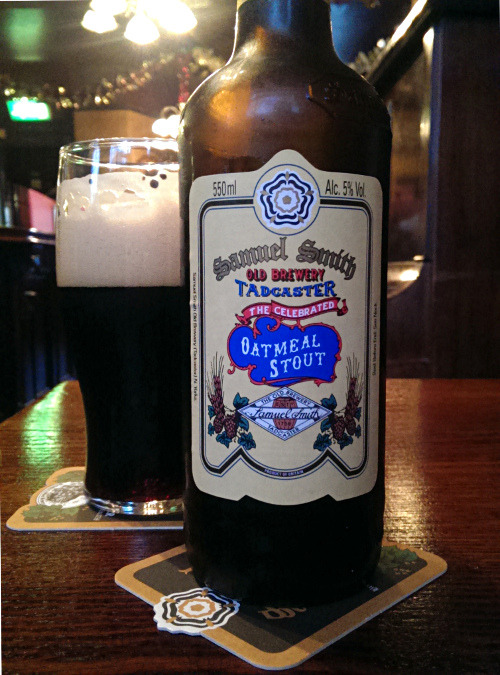
This time, however, we’re a little closer to home. A mild December Saturday saw me drift back to the Anchor Tap in SE1, the same pub where I sampled the Taddy Porter, to discover yet more of their tiny wood-panelled rooms. This one had a piano, and it had a burly man happy to dispense a bottle of this rather nice Oatmeal Stout.

image

The use of oats in the brewing process dates back centuries, and while it is apparently a bit of a sod to brew with, turning the wort a gelatinous, porridgy sort of texture and clogging all the equipment, it imparts a lovely, silky smooth texture, which complements a good stout beautifully.

And this is a terrifically good stout, pouring a deep reddish colour that’s almost black unless you hold it up to the light, and with a huge, dense tan head.

At first taste Sam Smith’s Oatmeal Stout is sweet, tangy and remarkably smooth, thanks to that oatmeal in the mash. Straight from the fridge it’s a little too cold, but as it warms hints of licorice and aniseed appear, and the finish becomes dry and moreishly bitter.

This is another top notch beer from old Sam Smith. It’s very easy-drinking for a stout, and it’s even certified vegan, if that floats your boat. If push came to shove, I’d probably plump for the Taddy Porter over this if I wasn’t blogging, but the Oatmeal Stout beats something like a Guinness hands down.

Facts and Figures

Brewery: Samuel Smith Old Brewery, Tadcaster, North Yorkshire, England
Style: Porters and Stouts
Strength: 5.0% ABV
Found at: The Anchor Tap, Horselydown Lane, London SE1
Serving: 550ml Bottle

77. Kelham Island Pale Rider

I’ve had my eye on Kelham Island Pale Rider since I first spotted it in The Book.

Not only is this a very well-regarded beer in its own right—Pale Rider was CAMRA’s Champion Beer of Britain back in 2004—but family connections in Sheffield meant that a visit to Kelham Island’s own brewery tap, The Fat Cat, was always going to be on the cards.

image

This weekend, I finally made it. It was a nostalgic sort of visit, having spent many school trips and family outings at Kelham Island Museum some 30 years ago. But this time I wasn’t there for education and amusement: I was there for a beer.

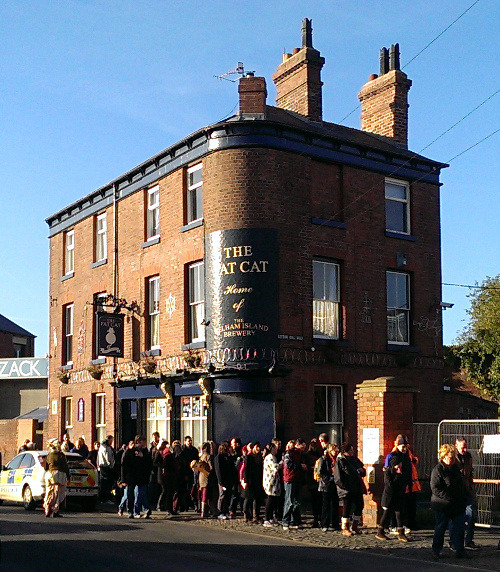
The Fat Cat is a tiny little place, and was justifiably packed on the busy Saturday lunchtime that I visited. It’s as genuine and as down-to-earth as pubs get these days, but it’s a real charmer. As one fellow customer remarked to her toddler “this is what pubs used to look like”. Thankfully some still do.

It’s also as friendly as can be, albeit in a no-nonsense Yorkshire sort of way, and it always, without exception, sells a cracking pint of Pale Rider.

image

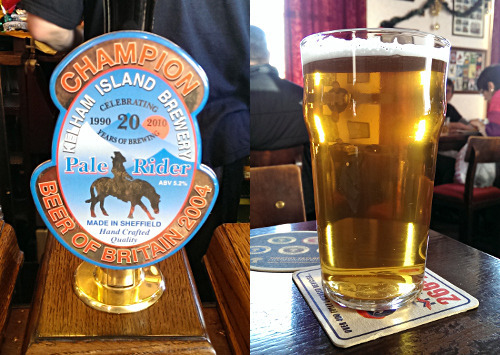
Pale Rider is a beautiful golden beer, as you can see, though it’s a difficult one to categorise. It’s broadly in the same style as many modern American-style Pale Ales, and is hopped exclusively with American Willamette hops, yet its recipe predates the “craft” beer era by many years.

It goes without saying that as Kelham Island’s flagship beer, served at the brewery tap, it’s in exceptional condition. On first tasting there’s a huge hop explosion at the front of the mouth, but it’s perfectly balanced by juicy smooth malts, and a much fuller body than one might expect from the colour.

There’s almost a honeyed flavour and texture too, rounding out those delicious bitter hops with a hopelessly moreish sweetness, though I’m certain no actual honey goes anywhere near the beer.

My pint lasted about five minutes, and this really is the sort of beer that any beer drinker would love. You could give it to a lager drinker and it would be light and refreshing enough for their tastes, yet it’s unquestionably complex and satisfying enough for even a stout/porter lover such as myself. It also blows many “craft” drinkers’ usual pints out of the water.

The Fat Cat’s Pale Rider is an immediate entry into my top five cask beers of all time, and at something like £2.60 a pint, let’s just say that it’s a good job I live a couple of hundred miles away, or I’d never leave.

Facts and Figures

Brewery: Kelham Island Brewery, Sheffield, England
Style: Golden Ales
Strength: 5.2% ABV
Found at: The Fat Cat, Alma Street, Sheffield S3
Serving: Cask, pint