Category Archives: Beers

The beers

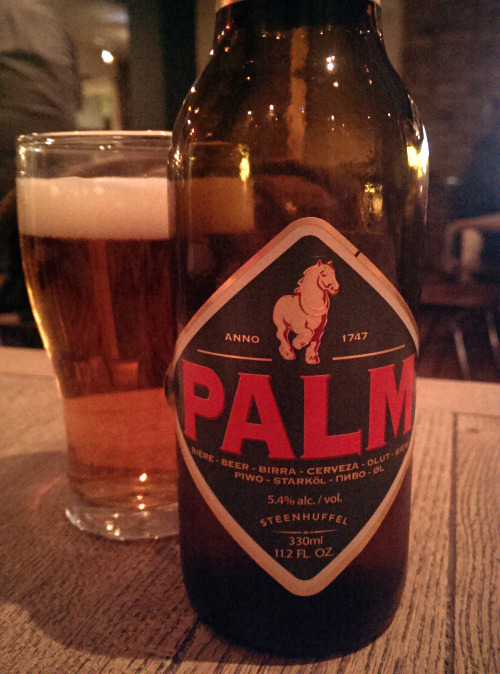
76. Palm Spéciale

Considering how close it is to my house, how youthful, winsome and alluring the staff are, and that it’s one of South London’s very few genuine brewpubs, I really don’t spend enough time at The Florence.

Still, a recent visit afforded the chance to watch brewer Peter Haydon at work, and to try this, a 5.4% Belgian ale. Perhaps this is not the most appropriate thing to drink just feet from where a fresh batch of Weasel or Bonobo is being boiled up, but the 300 Beers project is a harsh mistress. The choice is out of my hands.
image

Squinting through The Florence’s mood lighting, I can just make out that Palm Spéciale is a warm amber colour with a thick, foamy layer of froth on top. There isn’t a great deal of aroma beyond a few unmistakably Belgian esters.

The mouthfeel is dense and rich, if a little sticky, while the flavour is all caramel and toffee, and is reminiscent of Werther’s Originals. Interestingly, Palm Spéciale numbers corn among its ingredients. I’ve no idea how prevalent corn is among Belgian beers, but it does seem to add a certain complexity to proceedings.

Perhaps not surprisingly, Palm Spéciale is similar to De Koninck, but combined with the thick sweetness of Manns Original Brown Ale. In fact, this is another Belgian beer that manages to seem sweet at first, yet leaves a lingering, dry finish that lasts some time. That may well be the corn at work, now I think about it.

This is also another Belgian beer that I can’t help thinking needs a heftier dose of alcohol in it, say 6% or more, to make it really special. It’s a pleasant enough beer all the same, but I’m not sure it’s the sort of thing I’d go out of my way to find again.

That’s not a problem, since the aromas of malted barley and fresh hops in here have got me in the mood for a pint of something altogether more local.

Facts and Figures

Brewery: Palm Breweries, Steenhuffel, Belgium
Style: Pale Ales
Strength: 5.4% ABV
Found at: The Florence, Dulwich Road, London SE24
Serving: 330ml Bottle

75. Manns Original Brown Ale

Beer number 75 seemed like a suitable enough landmark to justify a lengthy, shall we say, “research” expedition around the hostelries of South East London. And truth be told, there are some exquisite pubs tucked away off the beaten track, if you know where to look.

The Blythe Hill Tavern, in a sense, is about as on the beaten track as it gets, sitting as it does directly on the South Circular. It’s a famous little place too, widely and rightly acknowledged for the quality of both its beers and its welcome. And yet to my shame, I had never visited.

I have now.

Manns Original Brown Ale

And what a lovely boozer it is. The range of beers is a gloriously unplanned mixture, as are the clientele, but this little beauty caught my eye immediately.

Manns Original Brown Ale weighs in at a mighty 2.8% ABV and comes in hefty 275ml bottles. I know, steady on.

It’s packed with flavour, though. Rich, dark, sweet and dense, this is by no means a lightweight beer. It turns out that Manns was originally brewed in 1902 as a mixer, to be added to your pint of draught bitter. It seems that at the time, draught beer could be a little on the rough side, so you added a drop of the sweet, unctuous Manns brew to take the edge off it.

Which I guess explains the smaller bottles: maybe you’d get one for the table and share it around your Edwardian buddies’ pints. At only 2.8%, maybe if you were the designated penny-farthing operator, you could knock back a whole one and still get home without attracting the attention of the Bow Street Runners.

Obviously such grotesque historical inaccuracies are a shameless cover for the fact that the Blythe Hill Tavern’s exceptional hospitality diverted me from taking any further meaningful notes. I think it tasted pretty good though.

Facts and Figures

Brewery: Marston’s Beer Co, Burton upon Trent, Staffordshire, England
Style: Brown and Mild Ales
Strength: 2.8% ABV
Found at: The Blythe Hill Tavern, Stanstead Road, London SE23
Serving: 275ml Bottle

74. De Koninck

My first ever trip to the brand spanking new Flying Pig up in East Dulwich left me spoilt for choice in terms of which of the remaining 300 Beers to pick out of the fridge first. Clearly, this pub will be a valuable ally on our ridiculous quest.

I plumped for this one: a 5.2% Belgian amber ale, almost certainly the most famous export of the city of Antwerp.

image

De Koninck, meaning “the king”, pours a bronze, toffee sort of colour with a fairly small off-white lacing. There’s a slightly musty yet resinous aroma, which isn’t nearly as unpleasant as I’ve made it sound.

The beer is slightly astringent and light bodied, or at least seemed that way after the very smooth pint of Thornbridge’s “Kill Your Darlings” I’d enjoyed just minutes before. There’s a real fruitiness though, and a butterscotch sweetness, while those distinctive Belgian esters are present yet restrained. Strangely, De Koninck manages to be very dry and quite sweet at the same time.

5.2% is quite light for a Belgian beer, and I couldn’t help feeling this one needed a heftier dose of booze in it to really make it shine, but it was enjoyable enough.

Facts and Figures

Brewery: Brouwerij De Koninck, Antwerp, Belgium
Style: Pale Ales
Strength: 5.2% ABV
Found at: The Flying Pig, East Dulwich Road, London SE22
Serving: 330ml Bottle

73. Augustiner Hell

Perhaps I missed a trick by not covering this Munich-brewed lager during October. Or at least during Oktoberfest, much of which—in a rare departure from the traditional Teutonic common-sense approach to matters—is in September.

In fact, this one had been sat around the kitchen for a while before I noticed the Mindestens haltbar bis Ende date on the bottle. I don’t know exactly what that means, but it sounds fairly sure about it, so we’d better get a move on.

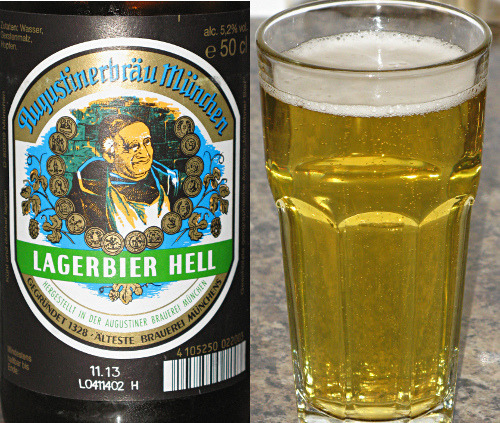
image

Behind that quite handsome, ornate label sits a predictably pale, golden lager with a thinnish head of white froth which doesn’t hang around.

On cracking open the bottle and pouring, there’s a strong waft of a beery, slightly stale aroma that’s neither alluring nor especially offputting.

There isn’t a great deal of flavour of course: German lagers tend to be made for drinking by the Steinful and getting heartily yet pragmatically sloshed in the Bierkeller rather than savouring slowly by the fire.

There’s a sort of maltiness in there somewhere, along with some strangely sharp-tasting fruit notes, but not even the faintest hint of hops, at least to my palate, which admittedly is more accustomed to gigantic American-style IPAs and whatnot.

All in all, Augustiner Hell isn’t an unpleasant beer by any means, and might be quite refreshing if drunk chilled in the Biergarten in the Munich sun, but it’s hard to get excited about this one.

Facts and Figures

Brewery: Augustiner-Bräu, Munich, Germany
Style: Pale Lagers
Strength: 5.2% ABV
Found at: City Beverage Company, Old Street, London EC1
Serving: 500ml Bottle

72. Brains SA

At the very real risk of becoming predictable, it’s back to the Grape & Grain we go for another pint of CAMRA-approved “real ale”. This turns out to be the first Welsh beer to be covered in these pages, which is terribly exciting.

image

And I use the word “exciting” quite wrongly.

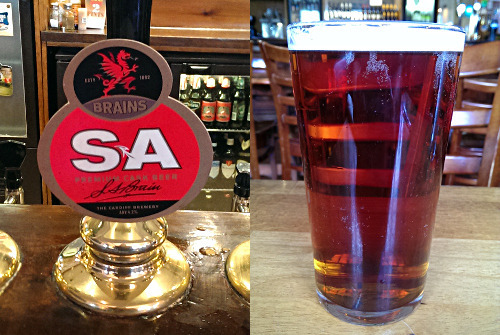
Brains SA is a fairly standard Best Bitter, and as such pours a typically warm, dark chestnut colour, but with the tiniest of frothy heads.

It has a sharp, harshly bitter flavour, which only temporarily masks the fact that it has absolutely nothing else going for it. It’s dry, but in this case that’s really more of an unpleasant aftertaste than a finish. The body is watery and lifeless, and it’s next to impossible to find anything more to say about this beer.

The Welsh and the old guard CAMRA types apparently wet themselves over it, but this is a crushingly unexciting beer. The term “real ale” seems more dated and less relevant than ever.

Facts and Figures

Brewery: S.A. Brain and Co., Cardiff, Wales
Style: Best Bitters
Strength: 4.2% ABV
Found at: The Grape & Grain, Anerley Hill, London SE19
Serving: Cask, pint

71. Affligem Blond

OK, I’m a little out of my depth here guys. I ordered what I though was a fairly standard bottle of Belgian golden ale, and I seem to have been served some sort of science lab.

image

It turns out that there’s a great big wanky ritual to drinking Affligem Blond.

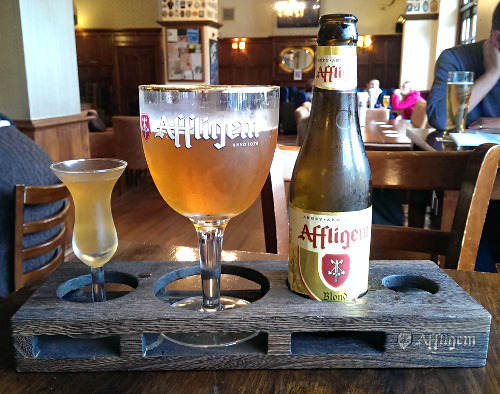
This is a bottle-conditioned beer with a hefty dose of yeasty sediment at the bottom. Fine so far, but apparently about 90% of the beer should go into the larger glass, while the yeast is deposited into the little thimble-like thing. You then have the choice of tasting the yeast separately, dumping it into your beer, or disregarding it entirely.

Having poured the beer itself, the barman poured a dose of yeasty solution into the smaller glass but left the thickest dregs of the sediment in the bottle. I wasn’t about to argue, since quite frankly I already felt like a bit of a numpty by this point.

Bear in mind I’m in a well-respected real ale pub here, and quite the locals’ place it is too. The burly gent at the next table reading The Sun over his second pint of lager is already eyeing me suspiciously. So let’s get this one done.

After all that, this tastes like a pretty run-of-the-mill Belgian golden ale or Abbey Beer. My usual point of reference for this sort of thing is Leffe Blonde, and Affligem is not a million miles away. It’s much lighter in flavour, though, and vaguely reminiscent of a saison. Still it packs a respectable 6.8% ABV wallop, and so provides a pleasant warming glow for a lunchtime. There’s a dense, sweet finish, which isn’t entirely unpalatable.

I elected to sample the yeast solution separately at first. It tasted slightly bitter and, perhaps not surprisingly, quite yeasty, but it didn’t have much going for it otherwise. So I dumped it into the rest of the beer and pressed on. It did add a little depth and body, I think, but on balance, I would still rather have had another pint of Mild instead.

I’m not sure I can show my face in the Grape & Grain again in a hurry, but in fairness that’s five beers in a row that they’ve provided for this blog, so I’m sure this won’t be the last we’ll be hearing of that particular boozer.

Facts and Figures

Brewery: Affligem Brouwerij, Opwijk, Belgium
Style: Abbey Beers
Strength: 6.8% ABV
Found at: The Grape & Grain, Anerley Hill, London SE19
Serving: 330ml Bottle

70. Banks’s Mild

Following a recent pub conversation with a colleague who was lamenting how difficult it has become to find a pint of Mild these days, I realised two things: firstly, he was right, and secondly, he was so right that I’m not sure that I even know what a Mild is.

So I was particularly grateful to spot this one at, you guessed it, The Grape & Grain. Time for your correspondent to learn a little bit more about good old-fashioned beer.

While modern Milds are typically quite low in alcohol—this one tips the scales at a sober 3.5% ABV—the term “mild” does not imply weak in that sense. Rather it means a beer lower in hop bitterness and sweeter than, say, a bitter. That’s why it’s no contradiction whatsoever for a brewery such as Partizan to create a rather tasty Mild weighing in at 6.4%.

image

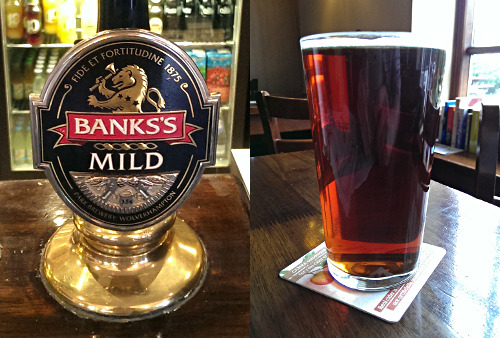
The Banks’s Mild pours a lovely deep chestnut colour, with a thin off-white head. Despite the low ABV, it certainly isn’t mild in taste: it’s a hugely full-flavoured, full-bodied ale, not unlike a Best Bitter.

It’s dark, fruity and rich, and there’s a delicious underlying caramel sweetness followed by a satisfyingly long bitter finish.

Whatever the current score in the keg/cask debate, this is a beer that absolutely must be cask conditioned, and by someone who knows what they’re doing. I certainly cannot fault “the Grape” on that front.

This is a relentlessly sessionable beer, and at just £3.20 a pint (less for CAMRA members) I would happily have had another. Trouble is, I think I just spotted beer number 71 in the fridge…

Facts and Figures

Brewery: Banks’s Park Brewery (Marston’s), Wolverhampton, England
Style: Brown and Mild Ales
Strength: 3.5% ABV
Found at: The Grape & Grain, Anerley Hill, London SE19
Serving: Cask, pint

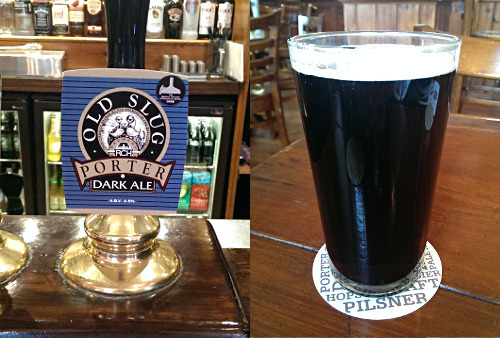
69. RCH Old Slug Porter

In retrospect, when I blogged about Pendle Witches Brew, I may have been a little harsh on The Grape & Grain, one of Crystal Palace’s very best pubs.

I criticised their slightly conservative selection of ales, but in fairness, recent weeks have seen guest visits from ales from some of London’s new wave of craft breweries: London Fields, By the Horns and The CronX have all been represented. To top that, the G&G have now provided three beers in a row for my humble blog, so I really should learn what side my bread’s buttered on.

The very day after I sampled the cask “Witches” and a lovely bottle of Worthington’s White Shield, this one came on tap: a curiously-named porter from a Somerset brewery I’d previously heard absolutely nothing about.

Any excuse to pay another visit to what is, truth be told, a great, authentic beer lovers’ pub where all walks of life rub shoulders.

image

Despite the name, RCH Old Slug Porter certainly is a fine looking pint. At first glance it’s as black as night, but closer inspection reveals a beautiful deep ruby red colour with a tan head.

It tastes just like a top-notch porter should. It’s dark and rich but medium-bodied, which is ideal for a porter. There isn’t too much of the tar, soot and smokiness that are more typical of a stout, and instead the “Slug” is full of dried fruits and christmas cake.

There’s a hugely satisfying dry, bitter yet wine-like finish, but the whole thing remains relentlessly quaffable and refreshing. Many people don’t expect that sort of drinkability from a dark beer, but my pint lasted no more than 10 minutes, and I’d gladly have had another.

It may be named after the least glamorous of creatures, but this is a first class porter, served here in prime condition.

Facts and Figures

Brewery: RCH Brewery, Weston Super Mare, Somerset, England
Style: Porters and Stouts
Strength: 4.5% ABV
Found at: The Grape & Grain, Anerley Hill, London SE19
Serving: Cask, pint

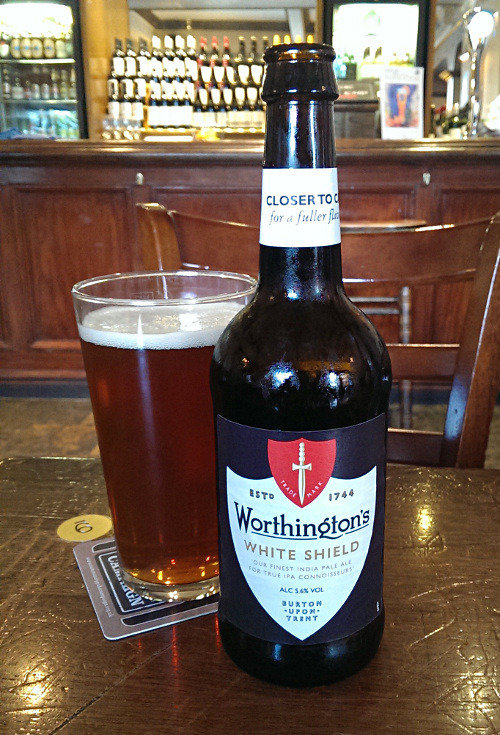
68. Worthington’s White Shield

Worthington’s White Shield is a near-legendary India Pale Ale from one of Britain’s most venerable brewing names. White Shield is the world’s oldest surviving IPA, and the one considered by connoisseurs to be as close as you can get these days to the original IPAs brewed in Burton-on-Trent in the eighteenth century to be exported to India.

The Worthington’s brand and White Shield in particular have had something of a chequered recent past, having been shunted around various regional breweries, and almost disappearing from existence at one point, having been deemed surplus to requirements by previous owners.

However, in a perhaps surprising turn of events under the stewardship of international brewing giant Molson Coors, in 2000, production of White Shield returned to Burton-on-Trent where it is brewed to this day almost entirely unchanged from its original 1829 recipe.

image

Worthington’s White Shield is typically found in bottle-conditioned form. It pours a not-especially-pale chestnut colour with a tight tan head.

There’s a massive, almost paintstripping, hop bitterness front and centre, but it’s perfectly well offset by the fat malt backbone so typical of the older, English style of IPA. There are toffee and caramel notes, dried fruits, and even a hint of esters that are reminiscent of a Belgian Dubbel.

It’s a remarkably complex beer, but all the flavours are in perfect balance, making for a particularly satisfying end product. This truly is a classic beer, and it’s great to see it being brewed to its full potential once again.

Facts and Figures

Brewery: Worthington’s (Molson Coors), Burton-upon-Trent, Staffordshire, England
Style: India Pale Ales
Strength: 5.6% ABV
Found at: The Grape & Grain, Anerley Hill, London SE19
Serving: 500ml bottle

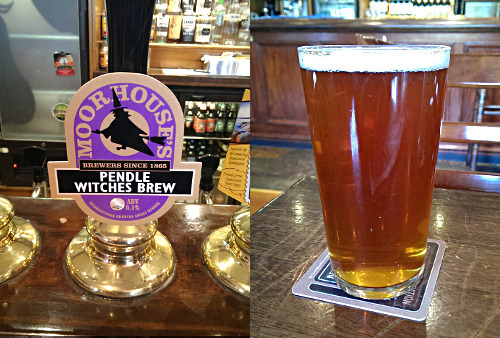
67. Moorhouse’s Pendle Witches Brew

A recent spell out of the office due to a minor injury left me keen to get away from daytime TV and back into the real world. Or at least the pub. Tell you what, shall we go to the pub?

We shall. The Grape & Grain up in Crystal Palace is a great little boozer, and very much one for the real ale purists. I like it. I want to love it, but I don’t yet. With a dozen hand pumps, knowledgeable staff, and discounts for CAMRA members, you know where you stand, and it’s a huge improvement on its previous incarnation.

That isn’t terribly hard, since as a “Jack Beard’s” it was part of a chain of utterly hopeless pubs that were a scourge on the entire South London area.

That’s no longer the case. Excellent management is now in place, the ales are plentiful and in prime condition, and you can even get a salad here if you ask nicely. My only real reservation is that the selection of beers tends to be quite conservative. With that many pumps, a pub can afford to take a few risks and whack on a good craft Black IPA, Barleywine or Imperial Stout, whereas here you’re usually going to be choosing between ten or so inoffensive, sessionable English bitters.

Today at least, one of those bitters was one that we need to cover here on Three Hundred Beers: Pendle Witches Brew.

image

Pendle Hill is well-known to anyone who, like your author, grew up in Lancashire. It has a long history of association with witchcraft and other supernatural activities, and so it gives its name to this beer.

“Witches” is fruity, vinous, bitter and floral. It’s pleasant enough, but it’s deeply, deeply unexciting. It has won all the CAMRA awards, yet you can drink it without actually noticing it, which, inconveniently enough, leaves you rather short of words if you’re trying to describe it on a blog later.

This is a beer very much from the old guard: safe but boring. It’s beers like this that are the very reason exciting new breweries like The Kernel and Beavertown exist. Breweries that challenge you to think about what you’re drinking.

Facts and Figures

Brewery: Moorhouse’s, Burnley, Lancashire, England
Style: Extra Strong Beers and Bitters
Strength: 5.1% ABV
Found at: The Grape & Grain, Anerley Hill, London SE19
Serving: Cask, pint