Author Archives: simon

41. Boston Samuel Adams Lager

It’s Friday evening, the weekend has begun, and I think it might be time to reach into the fridge and randomly select a beer from the growing 300 Beers queue.

Sure enough, out comes this famous American lager, and having had a run of excellent American beers recently, including two from the Brooklyn Brewery and three from San Francisco’s Anchor, trying our first offering from the Boston Brewing Company seems like an appropriate start to the weekend.

image

Having already met the very tasty Brooklyn Lager, I’m not at all surprised when Sam Adams pours a lovely, rich amber colour. It looks like we may have another Vienna-style lager on our hands, though The Book points out that this is more in the Bavarian March style. The subtleties are left as an exercise for the reader.

There’s a small white head which doesn’t stick around for long, and a promisingly malty aroma, balanced out with some gentle hops.

Sam Adams is a really full-bodied, grown-up beer with a heavy, malty backbone and an explosion of caramel and hops in the mouth, followed by a remarkably long, pleasing bitter finish.

There’s so much flavour here, and this is the absolute antithesis of the usual emaciated, gassy pale lagers that we’re all too familiar with in this country. This is a really top notch beer, and at a sane 4.8%, it’s sessionable enough too.

Just when I’m about to praise the Americans for brewing another winner, I notice an anomaly, in that this is a 330ml bottle rather than the traditional US 12 fluid ouncer. And there it is on the back label: brewed by Shepherd Neame, Faversham, Kent. This one hasn’t come far at all!

Perhaps one day I’ll be able to check out an original US-brewed Sam Adams for comparison, but for now, this will have to do.

Facts and Figures

Brewery: Shepherd Neame, Faversham, Kent, England
Style: Vienna Red, Märzen and Oktoberfest Beers
ABV: 4.8%
Found at: Sainsbury’s, Westow Street, London SE19
Dispense: 330ml Bottle

40. Anchor Old Foghorn

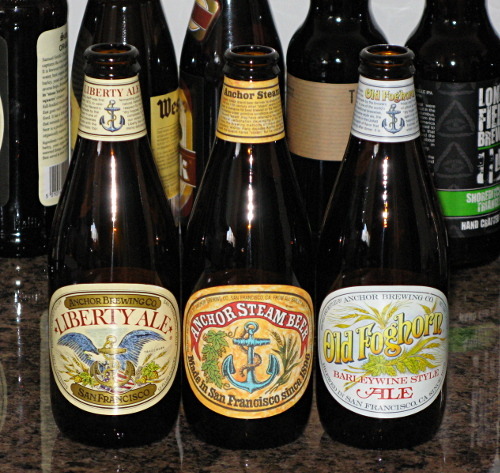
This is the third and final one of the 300 Beers to be produced by the Anchor Brewery, following on from the Steam Beer and the Liberty Ale. While the latter didn’t blow me away, the Steam Beer was a revelation, and I must admit to taking a bit of a shine to this plucky San Francisco brewery with their stout little brown bottles and handsome label artwork.

Even more excitingly, this is the first chance I’ve had to try a beer labelled as a Barleywine. Barleywine is essentially just very, very strong beer, fermented for significant periods of time. It’s apparently a centuries-old English style of beer, originally brewed for the aristocracy, but it’s one we really don’t see a lot of in this country these days, to the extent that I’d always assumed it was an American style.

In fact it was Anchor themselves and their Old Foghorn which introduced the style to the States, where it quickly caught the imagination of brewers and drinkers alike. I think we’d better get more intimately acquainted. I’m looking forward to this.

image

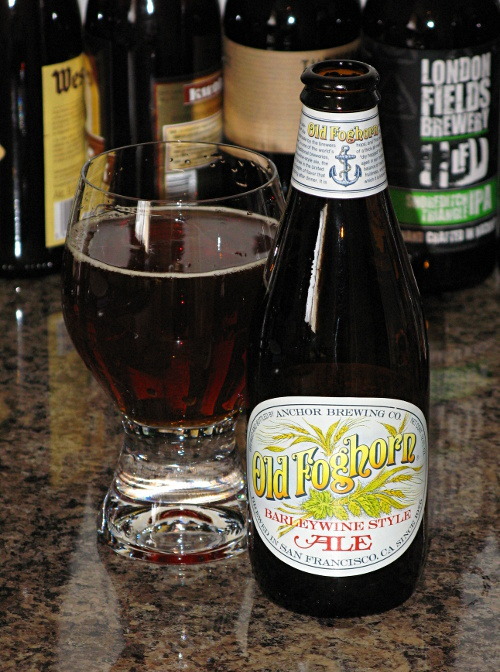
Like the previous Anchor beers, this one is impeccably presented, though its label diverges from the usual sailor tattoo artwork for something a little more pastoral, featuring barley and hops. The beer itself is a dark, glossy Greek honey sort of colour with little to no head, just a light off-white lacing.

There isn’t a great deal of aroma to Old Foghorn, which lulls you into a false sense of security, as it completely belies the massive amounts of flavour within.

Old Foghorn is thick and rich, and almost the same texture as Greek honey too. It’s full of plump dried fruit and treacle. There’s a faintly medicinal note to it, which is less unpleasant than it sounds, along with a real sweetness, albeit a pleasing, tart, bitter sweetness which lingers in the mouth.

That bitterness comes from Old Foghorn being matured on a bed of Cascade hops for no less than 10 months, before being dry hopped, meaning that yet more hops are added to the finished beer. I suspect a lot of the depth also comes from the fact that only the first pressing of the mash is used, a technique we previously saw applied to a quite different beer, Japan’s Kirin Ichiban.

All in all, I’m reminded strongly of one of my favourite guilty pleasures, Fuller’s Golden Pride, though this is a little richer and darker. I’m starting to like it a lot.

This is a strong old beverage at 9.4% ABV, and there are naturally huge boozy notes, enough to remind you to take it slowly and savour Old Foghorn respectfully. The alcohol isn’t overbearing though: it just provides a lovely warming hit that gets to work pretty promptly.

image

This is a terrific beer, and one that reminds me why I started this blog. It’s thanks to breweries like Anchor and Brooklyn (particularly their Vienna-style Lager and Black Chocolate Stout) that my preconceptions about American beers have been shot to pieces, with Anchor Old Foghorn being the final, delicious bullet.

Facts and Figures

Brewery: Anchor Brewing Co, San Francisco, CA
Style: Old Ales, Barley Wines and Vintage Ales
Strength: 9.4% ABV
Found at: Utobeer, Borough Market, London SE1
Dispense: 355ml Bottle

39. Negra Modelo

Time for a little geographical diversity, as we come to sample the first of the 300 Beers to originate in Mexico, an interesting cerveza named Negra Modelo.

Hailing as it does from the land that brought us such beers as Sol and Corona, both chronically lacking in flavour and excitement, and being brewed by Grupo Modelo, the giant brewery responsible for the aforementioned Corona, we may fear the worst.

Of course, I’ve had such fears before and they’ve turned out to be misplaced. Let’s see if Negra Modelo deserves its place in The Book.

image

Well, as with the Brooklyn Lager, once again my preconceptions look to be on rocky ground. For a start, Negra Modelo is much darker than I expected, and in fact it pours a deep brownish ruby colour, with a small off-white lacing. It looks like we have another Vienna-style lager on our hands.

There’s a lightish, fruity nose and a nutty yet rounded, berry-like fruit to the flavour too. In fact the fruit reminds me a little of one or two of the Belgian Dubbel-style Trappist beers we’ve seen, such as Westmalle Dubbel, and I really did not expect to be saying that about a Mexican beer!

That said, at a sensible 5.4% ABV, Negra Modelo also tastes a little watered-down compared to those beers, and the body is a fair bit lighter than the colour might suggest. Helpfully, though, there’s a subtle bitter finish to give the beer some length and keep things satisfying.

Negra Modelo is certainly an interesting beer, though I can’t help finding it a little schizophrenic: it’s slightly too dark and full-bodied to be the truly refreshing quencher that you’d want to accompany your hot tamales on a scorching Tijuana afternoon, while on the other hand it doesn’t have the strength and depth to really be savoured like one would the Trappist beers I mentioned.

Still, Negra Modelo is a good beer all the same, and this has certainly been another revelation and indeed an education.

Facts and Figures

Brewery: Grupo Modelo, Mexico City, Mexico
Style: Vienna Red, Märzen and Oktoberfest Beers
ABV: 5.4%
Found at: Bossman Wines, Lordship Lane, London SE22
Dispense: 355ml Bottle

38. Samuel Smith’s Imperial Stout

Just when you think it’s going to start getting difficult to find all these beers, you make a discovery like Utobeer. Little more than a big cage in an unpleasantly busy market in London, Utobeer claim stocks of around 2,000 distinct beers, of which, given space constraints, around 700 are on display at any one time. Needless to say, Utobeer will be a trusty ally on our beery quest.

Sam Smith’s are primarily known in Britain for their chain of countless improbably well-priced pubs, none of which happen to sell any beer you’ve ever heard of. That’s because they only sell Sam Smith’s beer, brewed up in Tadcaster, North Yorkshire. To my surprise, a lot of their beer is available in bottles, and four such beers are in The Book.

Conveniently enough, Utobeer stocks at least one of them: Samuel Smith’s Imperial Stout.

image

Imperial Stout is fast becoming my favourite style of beer. Essentially, the style is like stout but stronger. Way stronger in some cases: I glowed about the 10% ABV Brooklyn Black Chocolate Stout, while my current favourite is probably The Kernel’s Imperial Brown Stout, which is marginally weaker at 9.9%.

Those are both incredibly good beers, so old Sam Smith’s version, clocking in at a comparatively shandy-drinking 7% ABV has some tough competition on its hands.

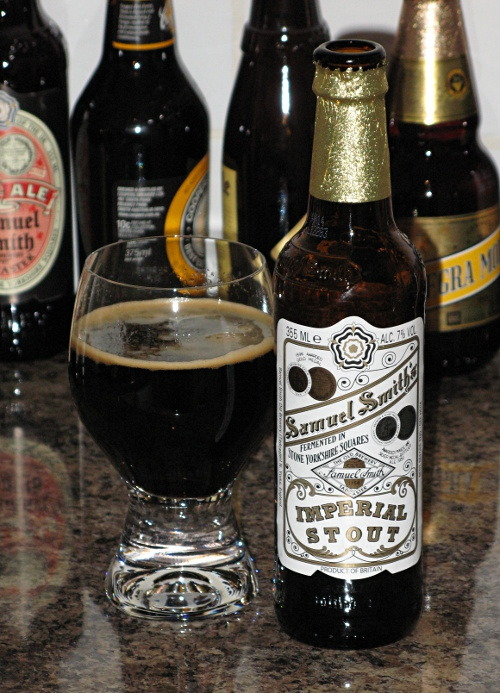
It’s a handsome enough bottle, with a charmingly old timey label, apparently designed by Charles Finkel, founder of Merchant du Vin who import Sam Smith’s beers to the US. True to form, even Sam Smith’s bottles are of a generous size, coming in at 355ml like this one, or at 550ml.

On cracking open the bottle, there’s an immediate chocolate aroma, though strangely it doesn’t stick around for long. Pouring the Imperial Stout, it certainly looks the part: black as it comes, with a smallish tan head.

It tastes, unsurprisingly, like a strongish stout but there’s slightly too much sweetness to it, followed by a odd bitterness that seems out of place for some reason. It’s also a little thin-bodied and kind of sticky.

Sam Smith’s Imperial Stout is quite drinkable, but it doesn’t rock my world. There just isn’t that depth of chocolate and coffee and smoke that one expects from a really good stout. It’s not a bad beer, but it’s not the best Imperial Stout out there by a long shot.

I’m no expert on brewing, but my feeling is that this beer is just crying out for more of the sugar to be fermented off, which would in turn result in an ABV more fitting for its style, and would no doubt add some of that complexity that it lacks.

Facts and Figures

Brewery: Samuel Smith Old Brewery, Tadcaster, North Yorkshire, England
Style: Porters and Stouts
ABV: 7.0%
Found at: Utobeer, Borough Market, London SE1
Dispense: 355ml Bottle

37. Fuller’s ESB

There are several Fuller’s beers in The Book, and given their ubiquity here in London, I’m a little surprised it’s taken so long to get around to covering one.

Fuller’s ESB is something of a classic: there aren’t many beers that have inspired and indeed given their name to a entire style of beer, but ESB has.

Fuller's ESB at The Mad Hatter, SE1

ESB is very easy to get hold of in London, especially in bottles, but to be enjoyed at its very best, it really needs to be tracked down on cask, ideally in one of the better Fuller’s pubs, where it should be served to perfection.

This one certainly was, and compared to the bottled stuff, it’s a revelation. There’s a whole new depth to it, with rich treacle toffee notes, bittersweet marmalade fruit and a vinous, lightly bitter finish.

It’s a weighty pint in many ways, but Fuller’s ESB slips down a treat and is incredibly moreish. At 5.5% ABV it isn’t exactly what one would call sessionable, but two or three won’t do too much damage.

Great stuff, and I’ll be back for more.

Facts and Figures

Brewery: Fuller, Smith & Turner, Chiswick Lane South, London W4
Style: Extra Strong Beers and Bitters
Strength: 5.5% ABV
Found at: The Mad Hatter Hotel, Stamford Street, London SE1
Serving: Cask, pint

36. Rochefort 8

This is the second of three Trappistes Rochefort beers in The Book. We saw the Rochefort 6 recently, and this is a similar brew with similar ingredients, but one which ratchets up the strength a little to a very respectable 9.2% ABV.

image

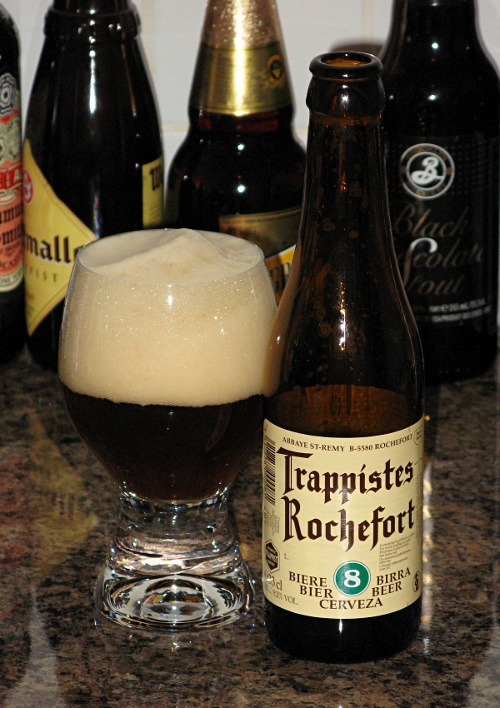
Once again, there’s a gigantic foamy head, perhaps even larger than that of the 6. The 8 pours slightly darker, and is more of a burnished bronze colour.

Perhaps unsurprisingly, there isn’t a great deal of difference between the 6 and the 8. There’s that same toasty caramel and christmas pudding fruit, along with a vinous barleywine-like finish.

That said, I notice I did use the word “refreshing” about the 6, whereas with that 9.2% strength, I’m not sure I would describe this one as such. It’s more of a warming drink, and one to take a little more slowly. It’s a fairly thick beer, and gently swilling it, the way the foam holds to the glass is a thing of beauty in itself.

Rochefort 8 is certainly a good, savourable beer. I rather like it, though I slightly resent it for not giving me anything particularly interesting to say in comparison to the previous Rochefort offering. That’s clearly unfair, because I suspect if I tried this one in isolation, I’d be very impressed indeed.

We’ve one more Trappistes Rochefort beer left to try. At a mighty 11.3% ABV, the Rochefort 10 is the strongest beer I’ve ever seen in my life. I’ve sourced a bottle today, and I’m very much looking forward to it.

Facts and Figures

Brewery: Abbaye Notre-Dame de Saint-Remy, Rochefort, Belgium
Style: Trappist Beers
Strength: 9.2% ABV
Found at: City Beverage Company, Old Street, London EC1
Serving: 330ml Bottle

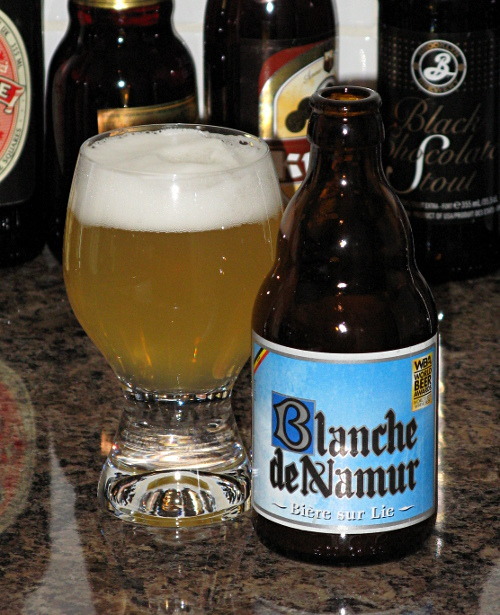
35. Du Bocq Blanche de Namur

We were hardly likely to be staying away from Belgium for long, in retrospect. In fact this one is Belgian and a Wheat Beer. I can barely contain myself.

image

Clearly I jest, but to put it politely, this is a beer for people with more subtle tastes than my own. At a paltry 4.5% ABV and a mere 12 bitterness units, it was never going to set pulses racing.

Blanche de Namur tastes like Hoegaarden, obviously, but it’s an emaciated, watery version of Hoegaarden. Honestly, beyond a faint whiff of the typical Belgian esters, the overriding flavour here is actually of water.

Supposedly the ingredients include coriander and bitter orange peel; maybe I’ve had one too many Imperial Stouts recently, but my taste buds can’t detect them.

I never set out to post overly negative reviews, and tend to feel bad if I do, but quite frankly, this is a crushingly dull beer.

Facts and Figures

Brewery: Brasserie du Bocq s.a., Purnode, Belgium
Style: Belgian-style Wheat Beers
ABV: 4.5%
Found at: Bossman Wines, Lordship Lane, London SE22
Dispense: 330ml Bottle

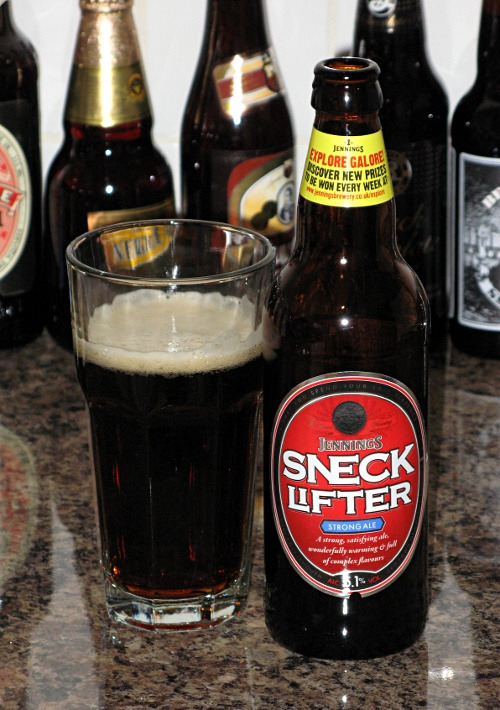
34. Jennings Sneck Lifter

Amid the vast sea of Belgian beer I’ve been obliged to drink my way through recently, it’s nice to have a change of scenery, and head back to Blighty and to the Lake District for a big old bottle of this famous ESB-style beer.

image

Jennings Sneck Lifter pours a very deep, dark ruby colour with a smallish tan head. The nose is all christmas cake fruits and toasty malts.

To taste, there’s even more fruit and rich caramel from the black malts, followed by a strong, peppery bitter finish courtesy of the whole flower hops. It’s dark and complex, though perhaps not to the same extent as Theakston’s Old Peculier.

All in all, a good winter beer, best served at toom temperature to let all those flavours emerge. I’d be happy to see this on cask in more pubs, but sadly it doesn’t seem to be widely available down here in London.

Facts and Figures

Brewery: Jennings Brewery, Cockermouth, Cumbria, England
Style: Extra Strong Beers and Bitters
ABV: 5.1%
Found at: Bossman Wines, Lordship Lane, London SE22
Dispense: 500ml Bottle

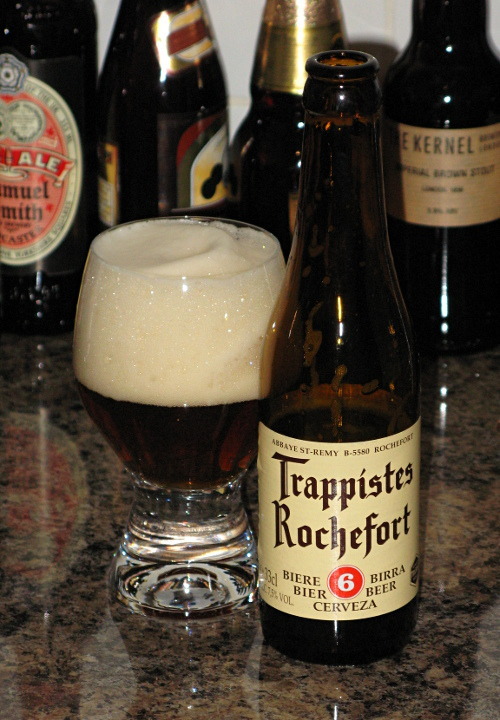
33. Rochefort 6

Still more Belgian monk beer for us to try, and yet this is only the first of three Trappistes Rochefort offerings that we have to work our way through.

The Rochefort beers are numbered 6, 8 and 10, with this one being the weakest of the triptych at a mere 7.5% ABV. One starts to wonder whether the cloistered Trappist lifestyle is quite as sober as they make it out to be.

image

Rochefort 6 pours a rather nice looking, fairish golden ruby colour. There’s an overwhelming amount of froth, which dissipates so slowly that it’s difficult to pour, let alone drink, the beer.

There’s very little on the nose, just a faint beery smell with a tiny hint of the esters for which Belgian beer is known.

To taste, though, it’s fruit, fruit, fruit. In that regard Rochefort 6 is not unlike our previous Trappist beer, the Westmalle Dubbel, though it’s somewhat lighter, with a sweetness that’s a little reminiscent of a barleywine.

For all of its 7.5% ABV payload, Rochefort 6 is surprisingly refreshing, though the strength is not hidden. With its vinous finish, I can picture it working well after dinner, perhaps with strong cheeses. I haven’t actually tried that so don’t quote me on it. (I drank mine stood in the kitchen with a large cat on my shoulder, perhaps not the ideal use case).

All in all, I’m starting to see why “Trappist Beer” warrants its own section in The Book, as a style quite separate from the Belgian blonde beers such as Bosteels Karmeliet Tripel and Achouffe La Chouffe. While the latter exude noxious herbal esters and overbearing, imminent-hangover alcohol, the Trappist beers are all fruit, with a malty depth and comforting, warming booziness. I know which I prefer.

As I mentioned, there are two more Trappistes Rochefort beers to track down, which I’ll try to do in short order.

Facts and Figures

Brewery: Abbaye Notre-Dame de Saint-Remy, Rochefort, Belgium
Style: Trappist Beers
ABV: 7.5%
Found at: Bossman Wines, Lordship Lane, London SE22
Dispense: 330ml Bottle

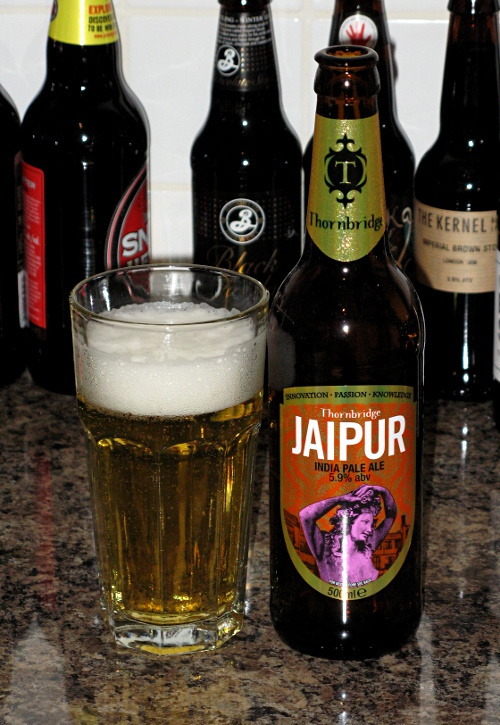
32. Thornbridge Jaipur IPA

Now, here’s a post that I could probably write without even drinking the beer, being rather well acquainted with Thornbridge Jaipur IPA already.

Having said that, there are rules we must follow on this blog. I’m simply obliged to go and buy another bottle. Such hardship.

image

Thornbridge are one of the success stories of contemporary British brewing. Beginning life as a tiny craft outfit just eight years ago, they’ve managed to marry a traditional product—real ale—with bang up-to-date science and technology, along with an obvious nose and drive for business. In doing so, they’ve grown into one of the biggest names in the field today.

Over the years, Thornbridge have created a prolific range of beers, all of them innovative and of the highest quality, and at the same time, a burgeoning pub empire has emerged, particularly in and around Sheffield in the north of England.

Of their beers, Jaipur is probably the best known and most widely available, and it’s fast becoming the modern British IPA against which all are to be compared. It’s the epitome of a contemporary citrus hop bomb.

I must confess I’m a little spoilt when it comes to Jaipur, having last year enjoyed a couple of pints kept and presented to absolute perfection in one of Thornbridge’s own pubs, the rather lovely Coach & Horses in Dronfield.

Served from cask, the smooth head and restrained natural carbonation help to balance out those zingy hops, resulting in a terrifically satisfying, moreish pint.

In a bottle, Jaipur is a somewhat different proposal, as you’re hit full in the face by the huge fresh, bitter hops with their quite literally mouth-watering lemon and grapefruit nose.

It’s a bracing beer, yet served lightly chilled Jaipur is thoroughly refreshing. Then, as it warms towards room temperature, a biscuity, malty depth emerges and the finish gets longer and longer. This is an unmistakeable sign of a top notch IPA.

Jaipur is one of those beers that fits any occasion, but it’d be especially suitable as a chilled summer beer, as well as being the perfect accompaniment to a good curry. I simply can’t think of a better beer to go with a chicken biryani, for example, and that’s exactly how I enjoyed this one.

A true modern classic.

Facts and Figures

Brewery: Thornbridge, Bakewell, Derbyshire, England
Style: India Pale Ales
ABV: 5.9%
Found at: Waitrose, Whitecross Street, London EC1
Dispense: 500ml Bottle