Category Archives: Beers

The beers

56. Oude Geuze Boon

Here’s another beer that should be a completely new experience for me. Oude Geuze Boon hails from Belgium and is an example of a style of beer known as Gueuze*, itself a sub-type of Lambic, a sour wheat beer synonymous with the town of Lembeek in Belgium.

This is the first time I’ve tried a beer labelled with any of the terms Gueuze, Lambic or “sour” and, truth be told, I’ve had the bottle sitting around for quite some time while I plucked up the courage.

That may be no bad thing, since Lambics are well known for their tendency to improve with age. This one dates from the 2010-11 bottling and sports a “best before” date of early October 2032. You get the feeling the date is only on there at all simply to satisfy an EU bureaucrat somewhere.
image

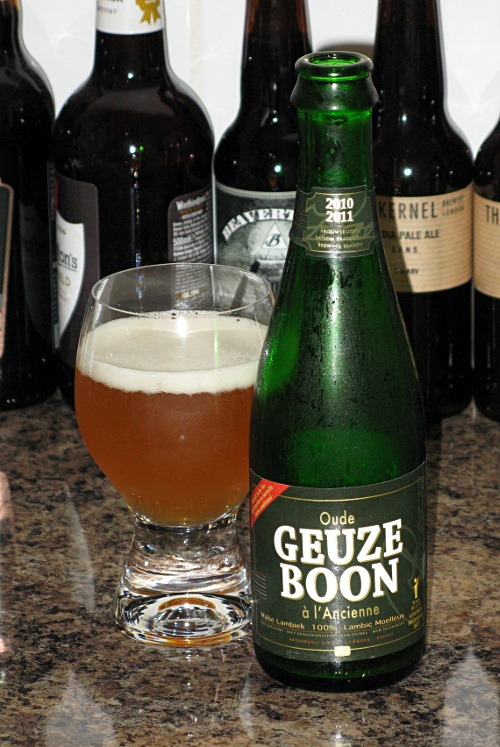
Oude Geuze Boon is presented in a smart 375ml bottle, and is Champagne-corked, to let you know you’re dealing with something a bit grown-up. It pours a typically Belgian and slightly cloudy deep golden colour, and has a tightly frothy white head backed up with a lively fizz.

There’s an immediate and unmistakeable pong of cider, in particular the distinctive sweet-yet-sour stench of the lamentable Scrumpy Jack, which briefly transports me straight back to memories of the early 90s.

At the risk of stating the obvious, the beer tastes sour, but unfortunately, aside from a fairly standard Belgian ale hiding in there somewhere, there isn’t really much more to it than that. As with Aecht Schlenkerla Rauchbier, it’s hard to taste anything beyond the main gimmick of the beer, and as with the Rauchbier, I soon wish the bottle were smaller.

I fully accept that a lot of that will be down to my own inexperience with the style: these kinds of beers are quite literally an acquired taste, though I don’t foresee myself drinking enough of the stuff in future to acquire it. That said, there are a few more in The Book which I’ll have to wade through at some point.

Of course, at a mere three years old, this bottle has a lot of growing up to do, so it would also be fascinating to see what 20 years or so worth of cellaring would do for a beer like this.

All in all then, this is not to my taste by any means, but I’m glad I finally tried it.

* If it appears that I’m spelling things inconsistently here, my justification is that “Gueuze” is the name of the beer style as given in The Book, and on Wikipedia, while “Geuze” is the spelling used in the name of this particular beer, as seen on the label.

Facts and Figures

Brewery: Brouwerij Boon nv, Lembeek, Belgium
Style: Lambic and Gueuze
Strength: 7.0% ABV
Found at: Utobeer, Borough Market, London SE1
Serving: 375ml bottle

55. Shepherd Neame Master Brew

This is another beer that I’ve had sitting around for a while, and never quite got round to trying. With some of the amazing beers that small London breweries like Beavertown and The Kernel have been putting out recently, it has been difficult to summon up much enthusiasm for a 4.0% English Bitter from the corner shop.

Of course, that sort of lackadaisical approach to the 300 Beers project isn’t going to have the thing finished any time soon, so let’s crack this one open and see what I’ve been missing out on.

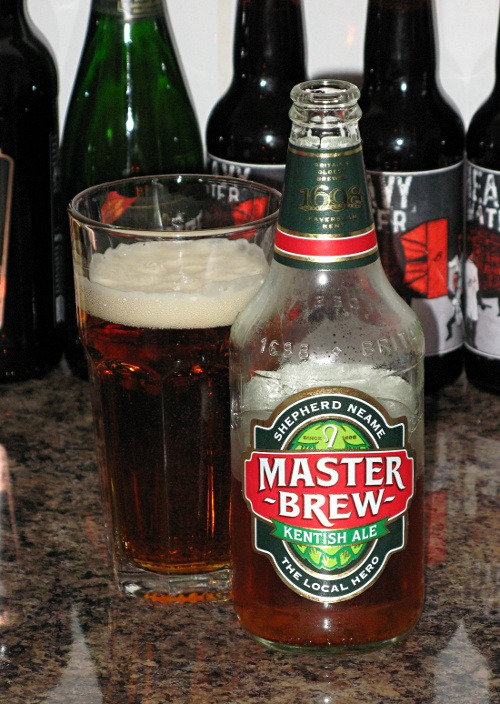
image

Well, Shepherd Neame Master Brew is certainly a fine looking beer, pouring an inviting deep bronze colour with a generous off-white head. The aroma is remarkably malty, with delicate hops and the faintest hint of the distinctive smell of a beer that’s been sat in a colourless glass bottle for slightly too long. That’s entirely my fault, rather than the beer’s, of course.

And it tastes…absolutely terrific. I’m taken aback, as if I’ve learned nothing from my expectations turning out to be entirely misguided countless times already. Master Brew is full of biscuity malts and peppery English hops, and there’s an underlying toffee and dried fruit sweetness that’s the signature of a good Bitter.

Those toffee and fruit notes remind me of the last Shepherd Neame beer we saw, Bishop’s Finger and also Fuller’s ESB, though Master Brew is much lighter and more floral than both of those.

At a fairly tame 4.0% ABV, this one would be eminently sessionable too, and I suspect it has the potential to be absolutely wonderful on cask if kept and served well. I also discovered by accident that it pairs surprisingly well with cheeses such as Camembert, and no doubt other food too.

Good stuff from Shepherd Neame once again.

Facts and Figures

Brewery: Shepherd Neame, Faversham, Kent, England
Style: Bitters
Strength: 4.0% ABV
Found at: Maxy Supermarket, Norwood Road, London SE24
Serving: 500ml Bottle

54. Kelpie Seaweed Ale

Jonathan Swift famously and quite rightly observed that “It was a bold man that first ate an oyster”. One might say the same about the person who, on happening upon the bladderwrack seaweed, no doubt during a leisurely stroll along a near-tropical Scottish beach, thought to themself “you know, I reckon this would taste pretty good if I put it in my beer”.

Yes, this is an ale brewed with seaweed, “Kelpie” being the Gaelic word for that most improbable of beer ingredients. Kelpie Ale is brewed by Williams Brothers Brewery, the same chaps who recently brought us Fraoch Heather Ale, an altogether less ill-advised concept.

It has taken me a little while to pluck up the courage to crack this one open, but the 300 Beers project is a relentless mistress, and so the time has come.

image

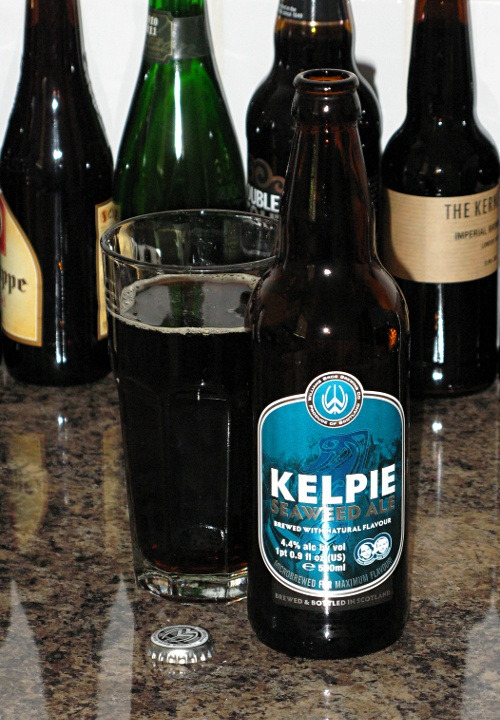
Kelpie Ale pours an especially dark ruby colour, and in fact is almost black in bad light. It has a very distinctive nose reminiscent of a strong stout, with quite pronounced Scotch whisky notes. In that regard I’m reminded of Harviestoun’s Ola Dubh, a strong porter aged in whisky barrels.

To taste, Kelpie is again distinctive. It’s very fruity and tangy, with a vinous edge and perhaps the faintest touch of saltiness. It’s also slightly smoky, so there really are a lot of different flavours vying for attention

That smokiness further reminds me of a stout, as does the beer’s remarkably full body. Whilst I can’t detect any flavours that I can definitively identify as seaweed, there is a slightly gelatinous texture to the beer, which could simply be my imagination playing tricks on me, but it does call to mind the rubberiness of freshly beached bladderwrack seaweed.

All in all, this is an interesting beer. As with the brewery’s heather ale, whilst I can’t see it becoming a regular tipple, I’m glad I’ve tried it.

Facts and Figures

Brewery: Williams Brothers Brewing Co, Alloa, Scotland
Style: Beers made with Fruit, Spices, Herbs and Seeds
Strength: 4.4% ABV
Found at: Utobeer, Borough Market, London SE1
Serving: 500ml Bottle

53. Pitfield Shoreditch Stout

This is the first beer I’ve ever tried from the Pitfield Brewery, and until today I knew very little about them. In fact, I still know very little other than they are a small, independent brewery with a complicated history.

Founded in the cellar of a specialist beer shop in Pitfield Street in Shoreditch, London, the brewery is now based on a farm in the Essex countryside, having changed location and ownership several times over its 30-year existence.

The core beers in Pitfield’s range are all certified organic and vegan, but are otherwise a fairly traditional-looking selection of pale ales, IPAs, porters and stouts. The naming of the Shoreditch Stout harks back to the brewery’s geographical roots, and conveniently I didn’t have to travel to Essex to find it: instead all that was required was a ten-minute stroll from the office to Old Street in—appropriately enough—Shoreditch.

image

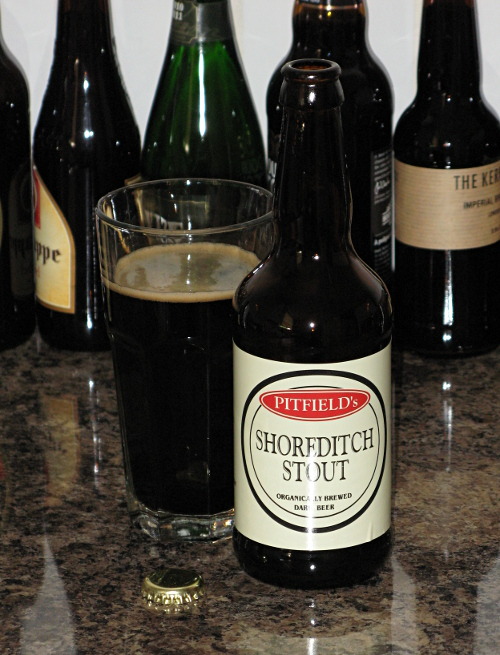
Pitfield Shoreditch Stout pours a deep blackish brown colour, as befits a stout, and there’s a generous tan lacing and a promising smoky aroma. It’s remarkably malty and full of date, fig and other dried fruit flavours topped off with a dry, bitter and slightly salty finish.

This one is a little lighter-bodied than might be expected from a truly top-notch stout, but it’s far from watery. It’s very drinkable, and at a restrained 4.0% ABV it’s eminently sessionable.

I may be a little spoilt in the stout department, having easy access to the Kernel Brewery and their magnificent Export and Imperial Brown stouts, but I do feel the Shoreditch Stout struggles to really distinguish itself from many other half-decent stouts. That said, if the vegan/organic thing is up your street then this is probably one of your better options.

There are two more Pitfield beers in The Book: a London Porter and an Imperial Stout. I’ve yet to find a source for the latter, but I certainly look forward to tracking it down and seeing how it compares to this one.

Facts and Figures

Brewery: Dominion Brewery Co, Moreton, Essex, England
Style: Porters and Stouts
Strength: 4.0% ABV
Found at: City Beverage Company, Old Street, London EC1
Serving: 500ml Bottle

52. Aecht Schlenkerla Rauchbier

Every so often, along comes a beer that takes me far outside my comfort zone. This is just such a beer, and I have very little idea what to expect.

Aecht Schlenkerla Rauchbier hails from Bavaria, Germany and is a smoked beer. Smoked beers are made much like any other, except that the barley malt is infused with smoke from wood fires prior to mashing.

I’ve very little experience with this style of beer, beyond having once accidentally ordered a pint of Anarchy’s Smoke Bomb, which was so over the top as to be rather charming, and Beavertown’s much more subtle, and remarkably smooth, Smog Rocket.

Let’s see how this rather authentic looking beer compares to those two upstarts.

image

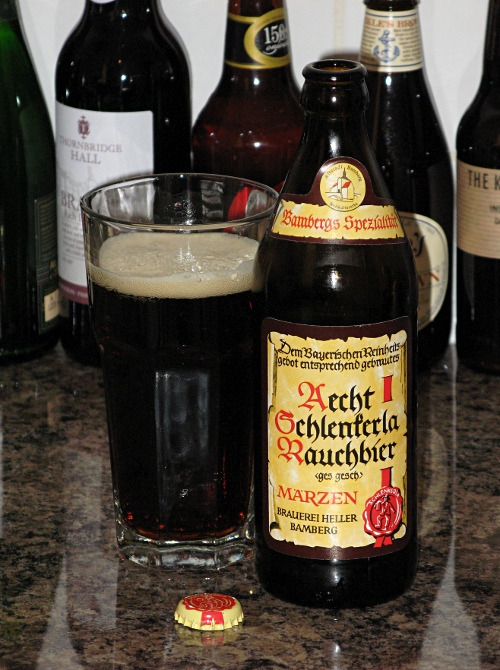
On cracking open the bottle, there’s an instant, ominous smoky aroma, and I’m reminded strongly of Lapsang Souchong tea. The beer pours a sinister and not entirely appetising dark greyish brown colour.

It tastes absolutely awful, of course. The use of smoke is in no way restrained, providing an unpleasantly bitter taste that sticks in your mouth and nose for hours afterwards. You can’t taste the underlying beer, as its flavour is completely obscured by the smoke. Apparently this one started life as a Märzen, but there’s no way of knowing that without reading the label.

The experience is reminiscent of sucking on charcoal or a burnt log, which is not my idea of a good time. The brewers have tried to tame the smokiness a little by upping the sweetness, but it just muddies the flavours and makes the beer sickly and cloying.

I’m sure there’s a lot of love and craft goes into Aecht Schlenkerla Rauchbier, and the brewers are no doubt extremely proud of it, but it isn’t to my tastes. To be frank, if it weren’t for my dedication to the 300 Beers challenge, and to both of my readers, this one would be going down the sink.

Facts and Figures

Brewery: Brauerei Schlenkerla, Bamberg, Germany
Style: Smoked Beer
Strength: 5.1% ABV
Found at: Utobeer, Borough Market, London SE1
Serving: 500ml Bottle

51. Goose Island Honker’s Ale

It’s always interesting to experience American attempts to replicate classic British beer styles. This time we’ll be trying Chicago-based Goose Island Brewery’s interpretation of a Best Bitter.

I wasn’t entirely convinced by Goose Island’s IPA when I reviewed it a few weeks ago, finding it far too sweet and cloying. Let’s see how their endearingly-named Honker’s Ale compares.

image

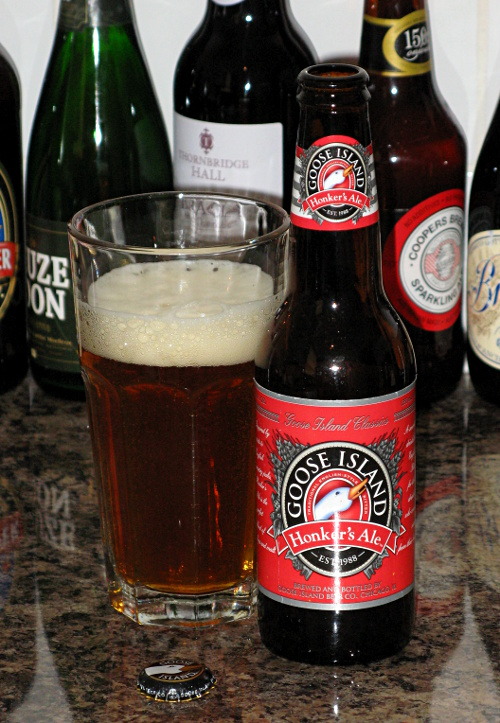
Goose Island Honker’s Ale pours a lovely warm bronze colour with a generous off-white head, and there’s an enticingly fragrant malty aroma.

The beer is very full-bodied, and packed full of flavour: there are big biscuity malts, tart fruit and an intriguing marzipan note.

Unfortunately, that sweetness that plagued the IPA is back. Although Honker’s Ale isn’t quite as tooth-janglingly sugary as the IPA, it’s still too sweet. Bitter is named that way for a reason, and while there is a bitter finish here, it’s well hidden under a coating of sugar.

This is a genuinely good beer that’s let down by what seems to be a pandering to the American palate. That’s a real shame, because I’m sure that the kind of drinkers that would buy Goose Island’s beers have far more sophisticated tastes than mainstream beer swillers.

Maybe I’m wrong—Goose Island are currently owned by Anheuser-Busch InBev, the giant international corporation responsible for Budweiser, Stella Artois and Corona, after all—but I don’t think so.

Facts and Figures

Brewery: Goose Island Beer Co., Chicago, IL
Style: Best Bitters
Strength: 4.3% ABV
Found at: Bossman Wines, Lordship Lane, London SE22
Serving: 355ml Bottle

50. Saison Dupont

Reaching the minor landmark of Beer Number 50 seems like a good excuse to crack open something special, or at least a little bit different. To celebrate, I’ve plumped for a beer that I’ve been eyeing up for a little while: Saison Dupont.

Saison is a particular style of beer originating from Belgium—where else—where, in a refreshing deviation from the usual narrative, it was traditionally brewed not by monks, but by farmers. Saison was originally a relatively weak beer, designed to hydrate and fortify the farm workers at a time when there was no reliable source of untainted drinking water—hops and alcohol forming a particularly successful preservative partnership.

In that regard, Saison echoes the “small beer” that kept Britain alive through the centuries when cholera would take your first born as soon as look at you, and which was even issued to schoolchildren at morning break until mediaeval Tory cuts took hold, probably.

Anyway, this is only the second Saison I’ve ever tried, after London-based Beavertown’s experimental Saison 34 a few weeks ago. With the greatest of respect to Beavertown, Dupont is the real deal, the one against which all Saisons tend to be judged. The Dupont yeast strain alone is legendary, and is highly sought after by other brewers. In fact, that Beavertown Saison and many others are brewed using Dupont yeast.

image

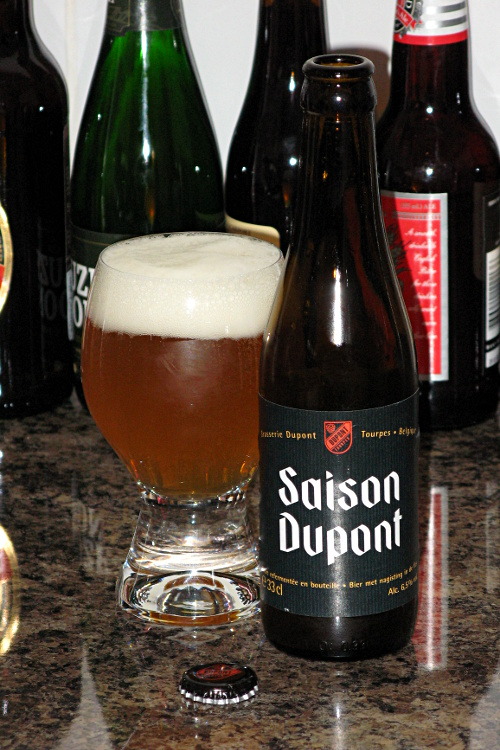
Saison Dupont pours a slightly hazy golden colour, with a big, frothy white head. It smells fresh, floral and hoppy, and it tastes that way too, with the distinctive Belgian esters being present, but much subdued. It’s a little reminiscent of Leffe Blonde, but much more subtle.

I’m also reminded of Duvel, though there’s an extra peppery spice that Duvel lacks. Saison is often herbed and spiced, for example with coriander, cloves and orange peel, and while I’m not sure which botanicals are used to make this beer, they’re used in restrained quantities, so proceedings remain light and fragrant.

Although I mentioned that Saison is traditionally a weaker beer, times keep on changing, and you do have to remember that we’re talking about Belgium here, so Saison Dupont weighs in at 6.5% ABV. It tastes a lot lighter though, and remains particularly refreshing. It’s all finished by a crisp, dry, lingering finish.

So do I like it? I do, but it was going to be hard for Saison Dupont to live up to the high regard in which it has historically been held, not least since this isn’t a style of beer which is likely to blow your mind.

Saison Dupont is really just a very refreshing, enjoyable Belgian ale, and a very good one at that. It would be great with food, particularly mediterranean flavours, ideally sat outdoors late into a summer’s evening.

Facts and Figures

Brewery: Brasserie Dupont, Tourpes, Belgium
Style: Saison
Strength: 6.5% ABV
Found at: Utobeer, Borough Market, London SE1
Serving: 330ml Bottle

49. Hook Norton Old Hooky

It’s off to the Cotswolds we go to try the first beer I’ve ever had from the Hook Norton Brewery, their delightfully and somewhat misleadingly named Old Hooky.

I say misleadingly, because unlike Old Peculier or Old Tom, this is a Best Bitter rather than an Old Ale.

image

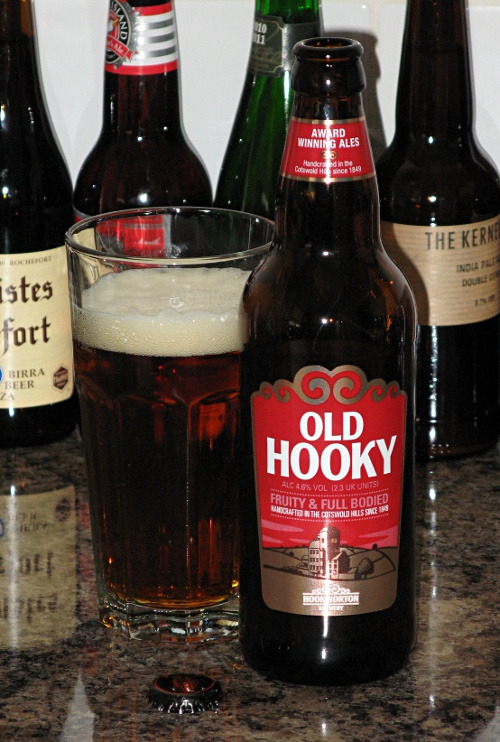
It’s a handsome enough looking beer, pouring a warm, rubyish amber colour with a big off-white head, albeit one that fades quickly. The nose is remarkably fruity, and I’m surprised to notice that it smells almost like a Belgian Dubbel, such as Westmalle Dubbel or Chimay Rouge. There’s that distinctive, estery waft of dried fruit so typical of that style.

The fruitiness comes through in the flavour too, where it’s especially reminiscent of sultanas, and is backed up by some hefty malts. There’s a huge bitterness, but also a sweetness, and finally a saltiness that’s reminiscent of Marston’s Pedigree.

There’s a lot going on flavour-wise here then, but I’m not sure it all comes together into more than the sum of its parts. I’m just not sure what this beer’s driving at or trying to be.

In fairness, Hook Norton are all about cask ale: they refuse to let a drop of their beer be served from a keg, and sell very few bottles. It’s quite possible that I’m doing them a disservice by trying this one from a bottle, but given that Old Hooky is nigh impossible to find on cask outside Oxfordshire, it’s all I have to work with.

A reasonably good beer then, full of flavour, but not mind-blowing in any way. Still, I promise I’ll try it on cask if I ever have the opportunity!

Facts and Figures

Brewery: The Hook Norton Brewery, Hook Norton, Oxfordshire, England
Style: Best Bitters
Strength: 4.6% ABV
Found at: Bossman Wines, Lordship Lane, London SE22
Serving: 500ml Bottle

48. Coopers Extra Strong Vintage Ale

This is the third and final one of the three beers in The Book to hail from the Adelaide-based Coopers Brewery, following on from their Sparkling Ale, and their Best Extra Stout. I happen to suspect that this one is a little bit special.

This is Coopers Extra Strong Vintage Ale. A few breweries put out a Vintage Ale, which will typically be a limited edition, once-yearly bottling of a strong, high quality ale. Each year’s vintage will tend to take on its own unique characteristics, and once in the bottle, will improve greatly for years to come.

This is one beer that I thought would be a challenge to get hold of—not least since these things typically become collectors’ items within weeks—until it silently and without fanfare appeared on the shelves of my favourite local boozeteria.

And knock me down with a feather if this isn’t the 2007 vintage, which was the first that was made available in the UK. The internet tells me there were only about 5,000 of these ever made. The bottle carries an oddly-specific “best after” date of 3:17pm on the 8th of June, 2007. No problem there then. It’s probably about time to drink the stuff.

image

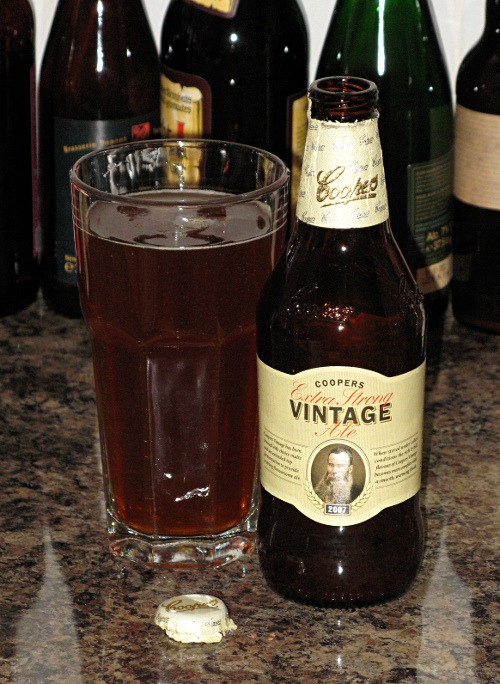
Once again we see Coopers stock 375ml bottle, with a hefty dose of yeast at the bottom to allow the beer to continue to ferment and improve in the bottle. As with Coopers previous beers, there’s so much yeast in there that it’s impossible to pour the beer clear, even if you wanted to. Instead it pours a dark, cloudy ruby colour with absolutely no head at all.

I’ve very little idea what to expect from the flavour: my only point of reference for a Vintage Ale so far has been a couple of bottles of too-young Fuller’s Vintage Ale. That one is essentially a bottle-conditioned Barleywine, and there’s certainly a hint of Barleywine in the aroma of the Coopers brew.

There’s a lovely, spicy bonfire toffee note on top of that though, and I’m reminded strongly of Texels Bock, which is rich, sweet and thick, and tastes just like liquid Werther’s Original candy.

To taste, that sweetness is there in spades but it’s balanced with just enough bitterness to prevent it becoming cloying. The beer is still full of caramel and butterscotch, though, and the body is thick, rich and treacly.

At a nominal 7.5% ABV, the alcohol is warming without being overpowering, and I wonder if six years of bottle-conditioning hasn’t made it a little stronger than the label states. Either way, this is not an everyday beer by any means: it’s one to take time over and savour.

And it’s good. I’m not convinced that it’s six-year-wait good, but then I only bought it last week, so can’t have any complaints. Even so, I’ve a couple of bottles put aside in the Official 300 Beers Cellar—my kitchen cupboard—and I look forward to seeing how it performs with another couple of years behind it.

All in all, I have to admit that Coopers have single-handledly changed my perception of Australian beer over the last few weeks, a little like Brooklyn Brewery destroyed my prejudices about American beer.

Facts and Figures

Brewery: Coopers Brewery, Adelaide, South Australia
Style: Old Ales, Barley Wines and Vintage Ales
Strength: 7.5% ABV
Found at: Bossman Wines, Lordship Lane, London SE22
Serving: 375ml Bottle

47. Bitburger Pils

It’s time to add a new category to the site, as we come to try our first Pilsner so far. In this case it’s a Pilsner not from Pilsen, or even from the Czech Republic, but from Bitburg, Germany.

image

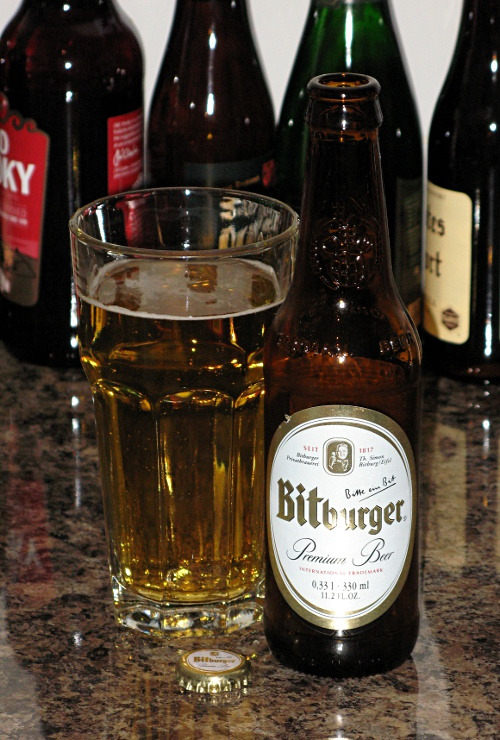
Bitburger Pils pours a dark golden colour with an almost negligible amount of white foam. What there is doesn’t stick around for long. There’s a toasty malt aroma with the faintest whiff of hops.

Bitburger is slightly fuller-bodied than is typical for a lager, and better for it. A good malty backbone is present to underpin the nicely balanced bitterness and sweetness, and it’s all followed by a long, dry finish.

I’m secretly enjoying this one more that I tend to expect from a lager. Bitburger is a very gluggable yet satisfying beer. Whilst I wouldn’t pass over a good ale or stout for it, this is a very pleasant beverage to drink straight from the fridge on a summery evening like this one.

Another enjoyable beer, and there will be a few more Pilsners along in due course, including some actually from Pilsen, so it’ll be interesting to see how Bitburger measure up against those.

Facts and Figures

Brewery: Bitburger Braugruppe GmbH, Bitburg, Germany
Style: Pilsners
Strength: 4.8% ABV
Found at: Bossman Wines, Lordship Lane, London SE22
Dispense: 330ml Bottle