Author Archives: simon

100. Westvleteren Blond

I feel under a certain amount of pressure to come up with something a bit special for beer number 100. I hope this will do, as it’s a bottle of something rather rare which I brought back from Belgium when I visited in February.

Westvletern Blond - cap

Westvleteren Blond is one of three beers brewed by the Trappist monks at The Abbey of Saint Sixtus of Westvleteren somewhere deep in the Flanders countryside. The Blond is perhaps the least famous of the three, and the lightest in terms of alcohol, at a sensible-by-Belgian-standards 5.8%.

The beers are officially only available at the monastery, and even then only after you jump through some pretty draconian hoops. The reason is that the monks have no desire to become a commercial brewing operation, instead preferring to sell just enough beer to pay for the upkeep of the monastery, and to allow them to carry on with their monky business undisturbed.

So they’ve rather shot themselves in the foot, then, by brewing what many consider to be some of the very finest beers in the world. The combination of lack of supply and huge demand mean they’re also some of the rarest and most difficult to find.

Fortunately for 300 Beers, there’s a small, shall we say, grey market in Brussels, and you can get hold of them if you know where to look, at least if you don’t mind parting with a few extra euros.

Westvleteren Blond

As you can see, the monks don’t even feel the need to do anything so pretentious as to put a label on their bottles, instead squeezing all the required information onto the cap.

There’s a hefty dose of loose yeast in the bottle, making it impossible to pour without getting a little in your glass, which doesn’t matter. As such, the beer pours an attractive, cloudy, deep golden colour with a modest amount of tenacious white froth which coats the glass beautifully.

The nose is all grapefruit, honey, delicate floral hops and Belgian yeast. The mouthfeel is interesting for a blond, as it’s so velvety smooth, and the beer is really quite full bodied.

To taste, that honey is there in spades and is joined by banana fruit courtesy of the malts, and big pepper and clove spice notes from the Northern Brewer hops.

The spices are present right through to the finish, which is surprisingly bitter for a blond. In fact it’s distinctly salty, in a way that’s reminiscent of an unaged Orval, which in many ways I guess is quite a similar beer.

The saltiness is a little odd at first, but soon becomes mouthwatering, and combines with the slightest of sour and farmhouse notes to provide an overall effect that’s a great deal more satisfying than many Belgian blonds.

Whilst it was always going to be hard for the Blond to live up to the high regard afforded to the two other beers in the Westvleteren family, in particular the Abt, there really is a very special quality to it: a real balance and refinement that only the finest beers ever achieve.

Facts and Figures

Brewery: The Abbey of Saint Sixtus of Westvleteren, Flanders, Belgium
Style: Trappist Beers
Strength: 5.8% ABV
Found at: De Biertempel, Grasmarkt, Brussels, Belgium
Serving: 330ml bottle

99. Crouch Vale Brewers Gold

Fancy a quick pint on the way home from work? Tell you what, let’s pop in to the Edgar Wallace. I’ve heard a lot of good things about the pub, and have an inkling that they might be able to help 300 Beers out with a beer or two.

It turns out to be a very nice pub. It’s pretty traditional, and the walls and ceiling are lined with brewery and other booze-related memorabilia and pump clips.

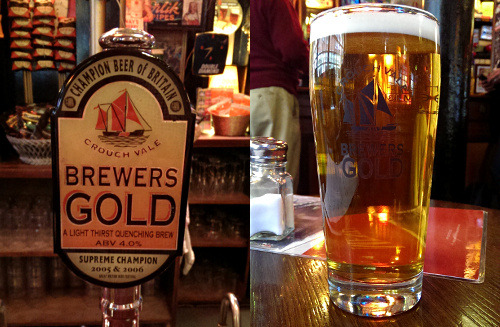
Sure enough, among the eight handpumps is Crouch Vale Brewers Gold (no apostrophe, note), a beer about which I know very little, other than it’s in The Book, and that it’s the only beer to have been crowned Champion Beer of Britain two years running.

Crouch Vale Brewers Gold

As you can tell, it’s kind of dark inside the Edgar Wallace, even on a sunny evening, but I can just make out that Brewers Gold is well-named, as it’s gold in colour, with a white head that fades to nothing a within a few minutes of getting back to your seat.

It’s in good nick here all the same, much as I’d been told it would be. The first taste is sweet, sappy and resiny. It’s full bodied, with rich honey flavours and a slight chemical note that I can’t quite place.

The sweetness carries through strongly to the finish, where it’s joined by a restrained hop bitterness that builds noticeably as you work your way towards the bottom of the glass.

Brewers Gold reminds me somewhat of the Kelham Island Pale Rider that I enjoyed a great deal up in Sheffield, but I’m not sure it’s quite in the same league.

It’s a pleasant enough, slightly moreish and very sessionable beer, though I didn’t find it particularly exciting. I’d drink it again, but probably wouldn’t go out of my way for another pint.

Facts and Figures

Brewery: Crouch Vale Brewery, South Woodham Ferrers, Essex, England
Style: Golden Ales
Strength: 4.0% ABV
Found at: The Edgar Wallace, Essex Street, London WC2R
Serving: Cask, pint

98. Pilsner Urquell

It may not always be obvious, but I do try to think about how to make some of these posts interesting for both my readers. And I had wondered what I could find to say about Pilsner Urquell, a beer that you can find by the bottle in any supermarket in the land.

So when the very pleasant The Canonbury up in North London announced they were to hold a Pilsner Urquell Oak Barrel Event this weekend, Threehundredbeers was predictably first on the scene.

Pilsner Urquell Oak Barrel Event

What we have here is unfiltered, unpasteurised Pilsner Urquell, drained directly from the lagering tanks at the brewery in Pilsen into a very limited number of oak casks, and then promptly escorted over to the UK to be dispensed by gravity into the glasses of eagerly waiting beer nerds who come from far and wide. All for the regular price of a pint of the keg stuff.

Having got in early, the beer was still settling when I arrived, and the first pint was mostly froth. It turned into actual beer quickly and I was invited to return for as many refills as I fancied, so I was a very happy camper indeed.

Oak Barelled Pilsner Urquell

As you can see, the beer is a beautiful cloudy amber colour. CAMRA types should take note that this is what “real” beer actually looks like, rather than the artificially, chemically clarified stuff they seem to prefer.

The aroma is absolutely huge for a lager, and full of Pilsner malts, oak and restrained, floral hops. Being served at room temperature certainly helps.

To taste, the beer is quite subtle and delicate at first. It’s full bodied and malty though, all Digestives and Rich Tea biscuits. This is not a sledgehammer of a beer. Instead it takes its time, and quietly works its way up to a gigantic, bitter finish, leaving you wanting more immediately. Back in the queue we go.

This really is special. It’s still a lager, but with all the flavours turned up to 11. There’s even banana fruit and a caramel richness in there, but absolutely zero sweetness. In fact this is one of the driest beers I’ve come across in a long time, and I like that.

I was told that the oaked Pilsner Urquell is the same strength as the regular stuff, which is 4.4%. Now, maybe I didn’t have enough breakfast before setting off, but this one went to my head much quicker than a beer of that strength usually would. I’ll survive.

Sadly, the last of this year’s oaked Pilsner Urquell consignment has been drunk now, but I can strongly recommend keeping your eyes peeled for future events, and making your way along if some does turn up. I certainly shall.

Facts and Figures

Brewery: Plzeňský Prazdroj, Pilsen, Czech Republic
Style: Pilsners
Strength: 4.4% ABV
Found at: The Canonbury, Canonbury Place, London N1
Serving: Oak cask, gravity, somewhat more than a pint

97. Meantime Raspberry Wheat Beer

Now, cards on the table, I’m not sure I’m going to like this one. Not that Meantime would ever make a bad beer, but if there are two styles I don’t tend to care much for, it’s wheat beers, and beers with any kind of fruit in them.

And here we are then, a Raspberry Wheat Beer. Still, it’s a good excuse for another trip back to The Old Brewery in Greenwich, where we sampled the Coffee Porter a week or so ago.

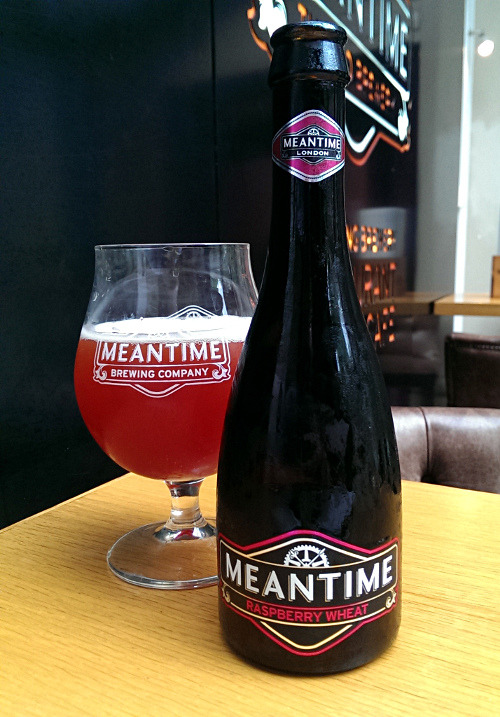
Meantime Raspberry Wheat Beer

Much like the Coffee Porter, the Raspberry Wheat Beer is an ever-so-slight substitution for the original beer in The Book. The “Red Beer” covered in there no longer exists, but a touch of research suggests this one to be almost identical in all but name and ABV, being a fraction stronger at 5%. If anyone can confirm or deny this, do let me know in the comments.

Perhaps not surprisingly, the Raspberry Wheat Beer pours a pleasingly cloudy, frothy orangey-pink colour, and there’s an immediate waft of raspberry filling the air. Upon seeing a grown man drink a pink beer, one nearby American tourist did look a bit puzzled, but I can live with that.

To taste, it’s certainly fruity, but thankfully not over-sweet, which really wouldn’t be to my taste. Instead, the fruit is tart, perhaps slightly bitter, and perfectly balanced, with the tiniest hint of sourness. In fact the effect is more reminiscent of a Kriek, such as the Cantillon one, than any raspberry beer I can remember.

I think I detect Belgian yeast in there too, and all in all it quickly becomes apparent that these Meantime chaps really do know what they’re doing. It’s an extremely high-quality beer, and almost despite myself, I find myself enjoying it greatly.

Served chilled, the Raspberry Wheat Beer is hugely refreshing, and this would be a great summer afternoon beer. That said, even on a rainy evening in South East London, it’s no hardship to drink it. It was a very pleasant change from the usual, even though next time I’m in Greenwich I’d probably still opt for the IPA or the very tasty new Black Pale.

In conclusion, I’d say that this beer is a great example of why I persist with this ridiculous blog project. I simply wouldn’t have tried this beer otherwise, and I really would have been missing out.

Facts and Figures

Brewery: Meantime Brewing Company, Blackwall Lane, London SE10
Style: Beers made with Fruit, Spices, Herbs and Seeds
Strength: 5.0% ABV
Found at: The Old Brewery, Greenwich, London SE10
Serving: 330ml bottle

96. Koningshoeven La Trappe Tripel

I very much enjoy my all-too-infrequent visits to the splendid Lowlander on Drury Lane. To while away an afternoon being waited on by their charming and tirelessly efficient young staff, who unhesitatingly fetch you round after round of hopelessly strong beers at the slightest invocation, is one of London’s great pleasures.

You’ll remember that we previously enjoyed that rather special Rodenbach Grand Cru there a little while ago, but we haven’t exhausted the intersection between Lowlander’s extensive beer menu and the 300 Beers Todo List by any means. Let’s beckon our serveuse over and order a bottle of La Trappe Tripel.

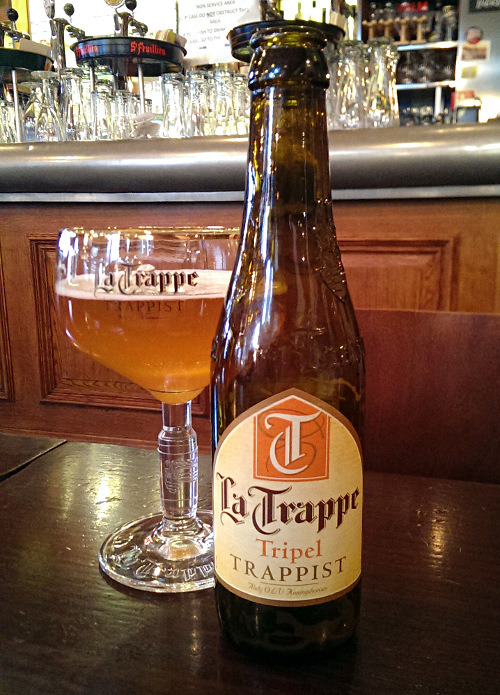
Koningshoeven La Trappe Tripel

As I mentioned when I covered La Trappe Dubbel a little while ago, the Trappist Abbey of Our Lady of Koningshoeven brewery is the only Trappist brewery in the Netherlands, and as such brews what may be regarded as quite typically Belgian beer styles.

The Tripel is no exception. Blonder, hoppier and a little stronger than the Dubbel at 8.0%, the La Trappe Tripel is absolutely typical of its style, the archetype for which is of course the Westmalle Tripel.

This is a remarkably similar beer. One whiff and I’m back in Brussels, as the Belgian yeast, subtle hops and that distinctive dried banana aroma flow freely forth. To taste, it’s fresh, zesty and astonishingly light for an eight percenter.

As it warms, peppery, spicy notes come through, and while I wouldn’t have identified it myself, it’s not entirely surprisingly to learn that the monks brew this one with a touch of coriander. It contributes a spicy heat and adds complexity, though the beer isn’t lacking in that already.

I’m becoming quite fond of this brewery, though I’d tend to lean towards their 10% ABV Quadrupel, a couple of which are quietly ageing in the Official 300 Beers Cellar (a cardboard box in the spare room). That one isn’t in The Book, but there is one more La Trappe beer to track down. Stay tuned.

Facts and Figures

Brewery: Abdij Onze Lieve Vrouw van Koningshoeven, Berkel-Enschot, Netherlands
Style: Trappist Beers
Strength: 8.0% ABV
Found at: Lowlander Grand Café, Drury Lane, London WC2B
Serving: 330ml bottle

95. McMullen’s AK

I had wondered if I was going to have to make a trip up to Hertfordshire for this one. McMullen’s appear to have countless pubs up that way, but happily I found this pint of AK a little closer to home, or at least to work.

The Spice of Life in Soho is quite familiar to me, having worked just across the road a few years ago. It’s a famous place, apparently a cornerstone of both the folk and later punk movements. It’s now a fairly traditional and very pleasant London boozer with charmingly friendly staff, but it still hosts regular live music, and the fish and chips I used to enjoy there is among the best I’ve ever had.

Yet I hadn’t twigged it was a McMullen’s pub, and so would perhaps be able to help 300 Beers out, until I started work in the area again recently. It’s time for a brief jaunt up to the far end of Soho.

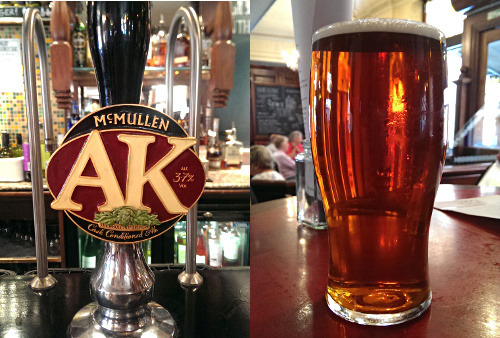
McMullen's AK

McMullen’s AK is listed in The Book under Brown and Mild Ales, which I find hard to understand. I can’t believe it has changed much in the intervening years, but it’s absolutely, unquestionably an English bitter these days.

As such it pours a typical copper colour with a thinnish cream-coloured head that fades quickly. The aroma is all floral English hops, with a hint of pepperiness that carries through to the flavour.

It’s in impeccable condition here, as you’d hope from the brewery’s own pub, but even so I’m finding it hard to conjure up much to say about it. It’s your standard session bitter—refreshing, tasty and, well, bitter, but it isn’t deeply exciting.

Again, as with the Oakham JHB, that probably isn’t the point. I personally prefer a beer that packs a bit more of a wallop, but if you like a decent cask bitter, you won’t find much to complain about with this one.

Indeed, if you like “Real Ale” but are looking for something with a bit more flavour, I’m pleased to note that the McMullen’s IPA and also the Country Bitter at the Spice of Life are very enjoyable beers indeed.

Facts and Figures

Brewery: McMullen & Sons, Hertford, Hertfordshire, England
Style: Brown and Mild Ales
Strength: 3.7% ABV
Found at: The Spice of Life, Moor Street, London W1D
Serving: Cask, pint

94. Diebels Alt

This bottle of Diebels Alt is the second beer from that Beers of Europe case I mentioned when we met Švyturys Ekstra. It’s also the first beer to be covered here from the Alt and Amber Beers chapter of The Book.

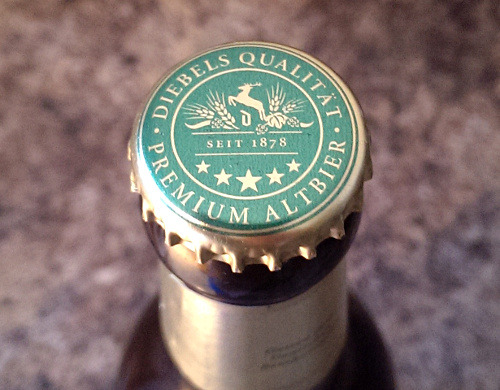
Diebel Alt - cap

Which is terribly exciting, not least because I don’t really know a great deal about the style at all. I know that Alt is a German style, and a little light reading tells me that it’s predominantly brewed in and around Düsseldorf, just as this one is.

Interestingly, it turns out that the Alt style predates the widespread proliferation of lager in Germany. That’s intriguing, because one tends to associate Germany strongly and almost exclusively with lagers such as Kölsch, perhaps with a few strange wheat beers thrown in for variety.

Which has me wondering what we’re in for. We’d better give this a try, then.

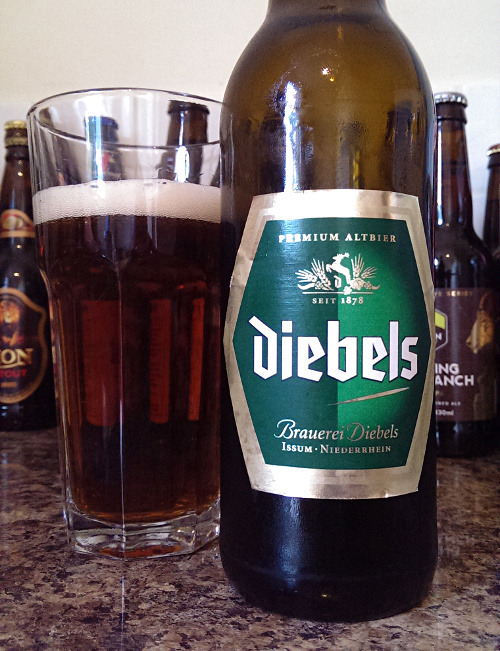
Diebels Alt

Diebels Alt immediately surprises me by coming out of the bottle remarkably dark. Held up to the light, it’s a really deep copper colour with a creamy white head.

In fact, it looks more like an English bitter than anything I had expected from Germany. Perhaps I shouldn’t have chilled this one overnight.

The beer smells deep and malty, a little like an ESB, but with a faint hoppy aroma that becomes distinctly peppery when you get your nose right in there.

And it tastes pretty blooming good, to be fair, especially after a long day at work. It’s dark and slightly sinister, with those peppery flavours coming through strongly and complementing the plentiful rich dried fruit notes. There’s a tiny hint of orange too, again reminding me of an ESB, in particular Fuller’s.

There’s a big old bitter finish, and a very modest degree of fizz, so despite being full of flavour, Diebels Alt is hopelessly easy-drinking. You never seem to see beers like this on tap in the UK, but it could be a great session pint, particularly served from a keg.

Well I never. That was all a bit of a pleasant surprise, and I wouldn’t mind another just now. Still, there was another Alt in that case, so I imagine we’ll be seeing that one in these pages before long.

Facts and Figures

Brewery: Brauerei Diebels, Issum, Germany
Style: Alt and Amber Beers
Strength: 4.9% ABV
Found at: Beers of Europe
Serving: 500ml bottle

93. Meantime Coffee Porter

There are no less than four Meantime beers in The Book, an honour shared only by Tadcaster’s Samuel Smith’s, and also the venerable Cantillon brewery, which you’ll remember I visited in Brussels.

Given that Meantime are based right here in South East London, it’s perhaps a little remiss that I’ve not managed to cover any of them yet. So to put things right, I headed over to Meantime’s neck of the woods, Greenwich, and to one of the two pubs that they own there, The Old Brewery.

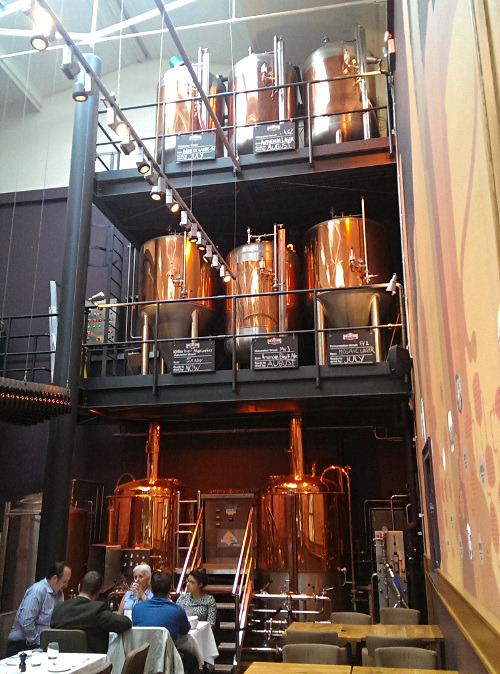
The Old Brewery is a bar, restaurant and working microbrewery in the heart of Maritime Greenwich. Sited within the Old Naval College, right next to the Cutty Sark and the Thames, and with a spacious and attractive beer garden, I suspect I wouldn’t want to visit in the height of tourist season.

However, on a quiet Tuesday evening, it was a very pleasant place to sample a couple of different Meantime beers, including the Coffee Porter.

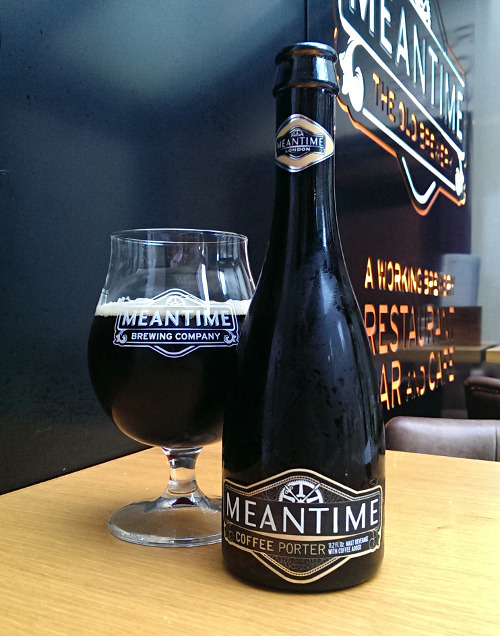
Meantime Coffee Porter

Strictly speaking, the Coffee Porter isn’t in The Book. However the “Coffee Beer”—which seems to have been based on a 4.0% ABV stout—no longer exists, and has been directly replaced within Meantime’s range by this somewhat stronger offering. I think this is as close as we’re likely to get.

This beer tends only to be available in bottles, and this being Meantime’s own pub, it’s presented here with a rather handsome branded glass.

For a porter, it appears surprisingly thin when poured, and it’s certainly quite rare to be able to see your own hand through a glass of porter. There’s a frothy tan head that dissipates fairly quickly.

And of course there’s a big, smoky aroma of coffee. Well, not actually of coffee, but of the sort of coffee flavouring you find in cakes, liqueurs and the like.

Thankfully, that thin appearance doesn’t translate into an unusually light body, and the coffee flavour tastes a lot more natural than it smells.

The Old Brewery, Greenwich

I don’t usually care for flavoured beers of any sort, but in this case the coffee flavour is subtle enough to work well, and does complement the underlying porter well. Having said that, there’s not a lot going on beyond the coffee.

This one was served chilled, which may not have helped, but as it warmed, more flavours did emerge, in particular quite a big, bitter finish that did make matters a little more satisfying.

If I’m struggling to sound enthusiastic, that’s probably more down to my tastes than anything specific about the quality of this beer, which it’s hard to fault. The Coffee Porter was pleasant enough as something a little bit different, but I’ll probably try something else next time I’m in Greenwich.

Facts and Figures

Brewery: Meantime Brewing Company, Blackwall Lane, London SE10
Style: Beers made with Fruit, Spices, Herbs and Seeds
Strength: 6.0% ABV
Found at: The Old Brewery, Greenwich, London SE10
Serving: 330ml bottle

92. Švyturys Ekstra

This particular beer achieves several firsts for Threehundredbeers. For a start, it’s the first beer to be tackled from the Dortmunder Export chapter of The Book, and it’s also certainly the first Lithuanian beer I’ve ever tried.

Finally, this is the first bottle from an interesting case of beers ordered from Beers of Europe. We’ll be seeing a few more from that batch before long, and there are a couple of intriguing ones in there, so do stay tuned.

Let’s start with Švyturys Ekstra, a rather handsomely presented Lithuanian lager.

Švyturys Ekstra - lid

Dortmunder Export-style lagers originated in Germany, and tend to be made with darker malts than, say, Pilsners, while being slightly higher in alcohol. Not all of the sugar is fermented off, potentially making for a slightly sweeter-tasting end result.

Švyturys Ekstra seems, then, to be surprisingly pale in colour, being a very light straw colour with a frothy but quite thin white head. It tastes like a fairly standard lager, though it’s slightly fuller-bodied and smoother than expected. There is a sweetness there, but it’s thankfully more of a malty than a sugary one.

Švyturys Ekstra

I chilled this one, but as it warms a lot more flavour comes out, including some citrus notes, and a surprisingly big, bitter hoppy finish.

This isn’t a bad beer by any means, and it’s kind of refreshing and easy-drinking, but it’s not an easy one to get excited about. If you like lager you’ll certainly like it a lot, and if you don’t, then Švyturys Ekstra probably won’t change your mind.

Facts and Figures

Brewery: UAB „Švyturys – Utenos alus“, Klaipėda, Lithuania
Style: Dortmunder Export
Strength: 5.2% ABV
Found at: Beers of Europe
Serving: 500ml bottle

91. Ringwood Old Thumper

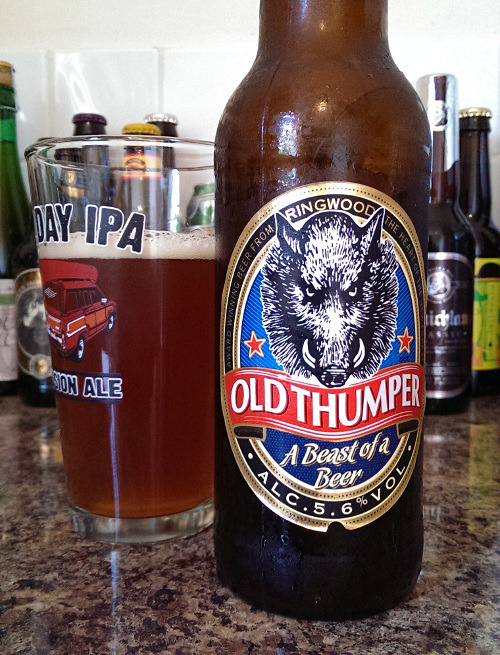
Whoops. I must have bought this one at my corner shop quite some time ago, because I found it in the kitchen last night, and it’s almost five months out of date.

In a way, that may be no bad thing, because as those with a keen eye will recognise, this is the old Old Thumper, a beer which was last year watered down from 5.6% to 5.1% and rebranded.

This could then be one of the very last bottles of the older, stronger stuff. Whilst it would be unfair to review a beer that had gone off, let’s give this one a chance. It’s long overdue that we should crack it open, pour it into an inappropriately-branded glass, and see if it has survived.

Ringwood Old Thumper

Pouring a rich, burnished bronze colour with a smallish tan head, I’m a tiny bit concerned that this one looks a little cloudier than I remember Old Thumper being. That said, it’s a long old while since I’ve had one, so I could be imagining it.

It smells just fine, with a peppery yet sweet and malty waft that’s highly reminiscent of Fuller’s ESB, perhaps no great surprise as Old Thumper belongs firmly within the same style of beer, and indeed the same chapter of The Book.

I’d better taste it. Well, there’s certainly nothing wrong with this one. It’s a good, strong-tasting beer, again very similar to the ESB. It’s rich and dark and and full of chewy malts and dried fruit.

There are citrus notes too, particularly mandarin, tangerine, that sort of thing. It’s actually a really tasty beer, and I’m wondering how on earth it managed to avoid getting drunk for so long.

I’m even starting to wonder if the extra time in the bottle might even have improved it, as there’s a robustness and a rich caramel sweetness that remind me strongly of another Fuller’s beer, the Vintage Ale. It’s lovely stuff, and I could drink another one, if it were still possible to buy it.

I suppose at some point I should try a bottle of the newer, weaker Old Thumper, but I do worry that it could be quite a disappointment if it turns out they’ve compromised it at all.

Facts and Figures

Brewery: Ringwood Brewery, Ringwood, Hampshire, England
Style: Extra Strong Beers and Bitters
Strength: 5.6% ABV
Found at: Jolly Good News, Rosendale Road, London SE24
Serving: 500ml bottle