Author Archives: simon

167. Marble Gale’s Prize Old Ale

Threehundredbeers is still up here in The North, but after a brief stay in Bamford, Derbyshire, we’ve moved on to Leeds. These days, Leeds is a great beer city crammed with excellent specialist venues such as North Bar, Friends of Ham and the venerable Whitelock’s Ale House, all of which Threehundredbeers visited.

If you are in Leeds though, it’s well worth a gentle stroll out of the city centre and down to Northern Monk Brewery and their spiffy Refectory, where you’ll find countless taps full of rare and powerful beers from Northern Monk and from many other breweries besides.

The Northern Monk Refectory, Leeds

Including this one. This is a slight substitution for the actual beer listed in The Book: Gale’s Brewery was based in Horndean, Hampshire from 1847 until 2006, shortly after it was purchased by London’s Fuller’s. The Prize Old Ale was a limited-numbers, bottle-conditioned Old Ale weighing in at 9% ABV, which was sadly discontinued by Fuller’s in 2011, making it nigh impossible to come by these days.

In a pleasing turn of events, Manchester’s well-regarded Marble Brewery, in a collaboration with Fuller’s director of brewing John Keeling, revived the recipe in 2017 and created four slightly different barrel-aged versions, including Pinot Noir, Madeira and Barbera wine barrels, and this one: the bourbon barrel-aged version.

All four varieties were available in bottles, but this is the first and only time I’ve ever seen one on tap. I don’t think there’s any doubt that we’re about to order a half.

Marble Gale's Prize Old Ale

Marble’s brew pours brown and cloudy, and it’s immediately evident from the aroma that the barrel-aging has done its work: the nose is all bourbon, front and centre. It’s a shade too cold straight from a keg, but at 10.6% ABV this is one to drink slowly anyway, which should give it a chance to warm gently as we sip away at it.

I’d never tried the original Prize Old Ale, so it was hard to know what to expect. An obvious point of reference is Fuller’s own Vintage Ale, though this is a little different, being lighter in body and less rich. It’s vinous and full of toffee, raisins and lingering peppery spice. There is a sweetness to it, and a stickiness on the lips.

Given the ABV and the boozy spirit notes, this is a deeply warming beer, well-suited to a winter evening in Leeds. Yet it’s hugely drinkable for the strength and style. I do wonder if the bourbon perhaps overpowers the subtleties of the base beer, rendering it a little more one-dimensional that it deserves to be, but without a “straight” version to compare it to, it’s impossible to say.

What is undeniable is that Marble have brewed a cracking beer here, regardless of how it compares to the original. I’m extremely pleased to have had the chance to try it, particularly in the pleasant surroundings of the Northern Monk brewery.

Facts and Figures

Brewery: Marble Brewery, Manchester, England
Style: Old Ales, Barley Wines and Vintage Ales
Strength: 10.6% ABV
Found at: The Northern Monk Refectory, Marshall’s Mill, Leeds
Serving: Keg, half pint

166. Black Sheep Best Bitter

Exciting times, once again, as Threehundredbeers hits the road and heads for The North. Today we’re in the tiny village of Bamford in the Peak District.

It’s Sunday and we’re in The Anglers Rest, the community-owned village pub, post office, café, gift shop and of course dry cleaning drop-off point. What’s not to like?

Very little, as it happens. The pub was once under threat, but is currently owned and run by about 300 local residents, reminding me of The Ivy House, another pioneering community-owned favourite, that one a little nearer to my home in South-East London.

The Anglers Rest, Bamford

As per tradition, Threehundredbeers is first to the bar, staking our claim to a barstool before the cagoule-and-muddy-boots hordes arrive for a well-earned pint and a Sunday roast.

The bar is stocked with local treats including beers from Sheffield’s Abbeydale and Bradfield breweries, and—conveniently enough for our ridiculous project—Black Sheep Best from Masham in North Yorkshire.

Black Sheep Best at the Anglers Rest, Bamford

The beer itself? Well, it’s a classic Yorkshire Bitter and you’d be hard pushed to wander around this part of the world without finding a pint of Black Sheep Best in front of you. Not that you’d complain.

It pours a lovely burnished copper colour with a light tan froth on top. It isn’t sparkled here, so we can’t be that far north, after all. The aroma is all woody English hops and tired-but-happy Morris dancers, but it tastes better than that.

Black Sheep Best weighs in at just 3.8% and I’d say that’s reflected in the taste. This is not a strong beer and does not pretend to be. Instead you’ve got a good, sessionable pint. It’s refreshing, if a little light and watery at first, but soon fills the mouth with a huge bitterness, alloyed by a rich, caramel sweetness.

The bitterness builds to an almost numbing level, much to my surprise. You could drink a few of these, as long as it’s in good condition, as it most certainly will be at the Rest.

Threehundredbeers is starting to wonder if we could sneak another one in before the cagoules arrive with their mud-spattered dogs and tired, disagreeable children but let’s not. The Official Threehundredbeers Mother has Sunday dinner in the stove back in the cottage, and some things are more important than beer.

Facts and Figures

Brewery: Black Sheep Brewery, Masham, North Yorkshire
Style: Bitters
Strength: 3.8% ABV
Found at: The Anglers Rest, Bamford, Derbyshire
Serving: Cask, pint

165. Wells Bombardier

It’s not getting any easier to track down beers from The List, but fortunately there are one or two quite widely-available ones left. Wells Bombardier, for example.

The exact relationship between Charles Wells and Young’s, who together were once Wells & Young’s—not to mention Marston’s, who actually brew this beer—is bewildering to me. But happily enough, it still seems to be the case that you can visit any of countless Young’s pubs and confidently expect to see Bombardier on the hand pumps.

Which is what we’ll do today. Welcome to the very pleasant The Clock House pub, overlooking the green expanses of Peckham Rye here in South London. Peckham Rye is known for being where wordsmith, engraver and general-purpose nutcase William Morris claimed to have seen visions of trees filled with angels and whatnot. But it’s probably changed a bit since then.

Wells Bombardier at the Clock House, Peckham Rye

Wells Bombardier is a famous Best Bitter, weighing in at 4.1% ABV and served here from cask. The colour is the classic deep, reddish chestnut that befits a Best. It’s certainly aromatic, with big, fruity notes wafting up at you from the glass.

The Clock House, Peckham Rye

And very drinkable it is too. Bombardier won’t surprise anyone familiar with the style, but it’s certainly a good example. Again it’s fruity to taste, all raisins and sultanas, with biscuity malts and a pleasing bitterness lingering at the end, courtesy of what I would assume to be English hops.

It’s a decent pint, all told, though a beer that absolutely has to be in peak condition, which it is today here at the Clock House. Perhaps not a style that’s always been guaranteed to excite your blogger, but without question this is a beer I would happily drink again.

Facts and Figures

Brewery: Charles Wells, Bedford, England
Style: Best Bitters
Strength: 4.1% ABV
Found at: The Clock House, Peckham Rye, London SE22
Serving: Cask, pint

164. Mighty Oak Oscar Wilde

Fine. It’s a famous, famous beer that gets the CAMRA types all excited, and we’re in a great pub that has done wonders for this blog.

Mighty Oak Oscar Wilde

And honestly, all I can say is it smells quite nice—kind of like Parma Violets—it tastes of beer, and it isn’t horrible. It’s all yours CAMRA.

Facts and Figures

Brewery: Mighty Oak Brewery, Maldon, Essex, England
Style: Brown and Mild Ales
Strength: 3.7% ABV
Found at: The Grape & Grain, Anerley Hill, London SE19
Serving: Cask, pint

163. Girardin Gueuze Black Label 1882

When the lovely people behind Camberwell’s ever-magnificent Stormbird open a brand new pub in South London, you can sort of predict that Threehundredbeers will make an effort to be first on the scene.

Slightly too much of an effort in fact, as I pitched up outside the Star & Garter on opening night to find the place still to be something of a building site. Never mind, a couple of days later with the paint still drying, I was able to spend a very pleasant Sunday afternoon working through the impressive tap lineup.

And the fridge of course, because quietly minding its own business in there was a beer from the list which has not been at all easy to track down. In fact I’m not sure I recall even seeing it in Brussels. Anyway, here’s the Girardin Gueuze 1882, or “Black Label” as it’s known, for fairly self-evident reasons.

Girardin Gueuze Black Label 12882 at the Star and Garter, Bromley

Girardin are a family-run brewery based in the tiny Belgian village of Sint-Ulriks-Kapelle, and they produce two editions of their Gueuze: the White Label and this, the Black. This is the one the proper beer nerds tend to seek out, as it’s the unfiltered, unpasteurised version, bursting with delicious Lambic flavours.

It’s a complex beer, blended from 12, 18 and 24 month aged Lambics. It’s sour as befits the style, but not as brow-moisteningly so as some examples. Instead it’s zesty and citrussy yet full of soft vanilla and peach flavours and the unmistakable musty notes provided by the Brettanomyces yeast.

There are constantly extra depths to discover as you take your time over it and wish you had one of the larger bottles instead.

I shall certainly return to the Star & Garter before long and see what else we can find there. Bromley has certainly hit the jackpot now beer-wise, and I wish everyone involved in the new pub all the best.

Facts and Figures

Brewery: Brouwerij Girardin, Sint-Ulriks-Kapelle, Belgium
Style: Lambic and Gueuze
Strength: 5.0% ABV
Found at: The Star & Garter, 227 High Street, Bromley, London BR1
Serving: 375ml bottle

162. Nethergate Umbel Magna

After furnishing us with the Batemans XXXB and the Hambleton Nightmare, The Crosse Keys in the City of London is becoming a valuable ally on our quest.

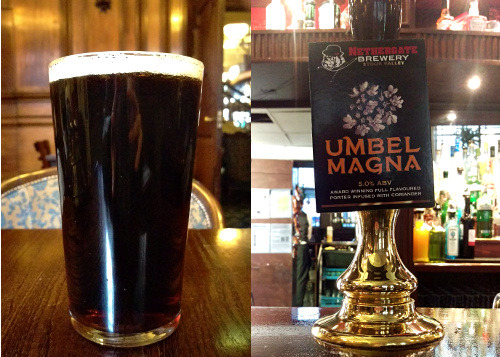
Conveniently enough, a recent weekend saw something of a tap takeover by Essex’s Nethergate Brewery, makers of that rather fine Old Growler I enjoyed a while ago, and of this: Nethergate Umbel Magna.

Nethergate Umbel Magna at the Crosse Keys, London

Umbel Magna is a recreation of a 1750s Porter recipe brewed with an addition of coriander to spice things up a little. It has won awards left right and centre, and I’m going to have a pint, even if it isn’t quite midday yet on a Tuesday morning.

It’s lovely stuff too, malty and chocolatey and hugely aromatic. It’s sweet and rounded at first, but with a hefty great dose of bitterness in the finish to balance things out and keep the beer hopelessly moreish. There are toasty notes alongside the chocolate sweetness too.

True to the Porter style, the body is a little lighter than a stout, while the colour is more of a deep, warm mahogany than a black. There’s a bit of booze in the nose, though perhaps that’s the early hour making me a little more sensitive than usual.

I didn’t actually know at the time that coriander was involved, and I certainly didn’t spot it, which suggests it’s contributing to the overall flavour of the beer rather than dominating proceedings, which suits me.

Either way, Umbel Magna is a cracking winter beer and one I’d happily drink again, especially at the Crosse Keys’ improbably reasonable prices. Good stuff from Nethergate once again.

Facts and Figures

Brewery: Nethergate Brewery, Pentlow, Essex, England
Style: Porters and Stouts
Strength: 5.0% ABV
Found at: The Crosse Keys, Gracechurch Street, London EC3V
Serving: Cask, pint

161. Wychwood Hobgoblin

I’ve been scandalously neglecting the Threehundredbeers project recently, but I’m still here. That this beer was consumed back in March will tell you how far behind we are, and so the time has come to get things back on track.

This particular beer was consumed at the London Palladium, more specifically at one of the finest gigs I’m ever likely to attend. This was the night Glen Hansard nearly took the roof off the place with a three hour set (setlist here) including six encores, a guest appearance from Dublin poet Stephen James Smith, and even some death-defying balcony-dangling from Glen himself.

Glen Hansard poster outside the London Palladium

The choice of beers at the Palladium is, to put it politely, limited. So unless you fancy a Stella Artois (I didn’t) it’s a Hobgoblin for you tonight. Fortunately, that’s one we’ve yet to tick off The List, and doubly fortunately, it’s the stronger, 5.2% bottled version and not the watered-down cask offering.

Wychwood Hobgoblin

Furthermore, the good people at the Palladium are more than happy to let you take it to your seat while Glen makes whiskery love to your earholes with his big ginger acoustic face.

Glen Hansard onstage at the London Palladium

The beer itself is a bit of an English classic. It isn’t as strong as it used to be, even the bottled stuff, but it’s still welcome enough tonight. It’s a beautiful deep ruby colour with a small yet firm tan head, even in an idiotproof plastic pint pot. It still packs a punch at 5.2%, but that strength is well backed up by big, fat fruits and juicy malts. There’s almost a wine-like finish and it all goes down very easily indeed, especially if you’re on some sort of musical cloud nine as I clearly was by this point in proceedings.

I’ll leave you with some shakily-filmed moments from the gig. Here’s Glen taking an old Frames song up a notch. The video doesn’t quite capture the walls of the Palladium visibly shaking in response to Glen’s bassist’s thumping great bass line:

Here’s Her Mercy from the 2015 album Didn’t He Ramble:

This is the sort of thing you don’t want to see when your vertigo is already playing up from being way up in the cheap seats for the last couple of hours:

And finally an unexpected highlight of the night. This is Stephen James Smith performing perhaps his best known poem, Dublin You Are, which had about 2,500 people on the edge of their seats, hanging on his words in quiet awe:

It’s impossible to put into words how good this show was: the cameraderie and warmth and love in the room, the audience participation and the sheer spectacle of the last night of the tour. All in all, a pretty magical evening, and Hobgoblin did a fine job of accompanying it, even if I did later have to run to The Lyric for an emotion-calming pint of Magic Rock Cannonball just in time for last orders.

Facts and Figures

Brewery: Wychwood Brewery, Witney, Oxfordshire, England
Style: Extra Strong Beers and Bitters
Strength: 5.2% ABV
Found at: The London Palladium, Argyll Street, London W1F
Serving: 500ml bottle

160. Woodforde’s Wherry

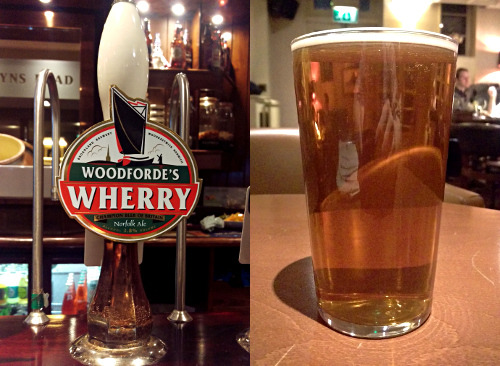
It’s getting rarer to find these beers by accident now we’re beyond the halfway mark. But here we are back at the Alleyn’s Head—right near my house—for a spot of dinner, and look what’s on the pumps at a mere £2.59 a pint.

Woodforde's Wherry at the Alleyn's Head, Dulwich

Woodforde’s Wherry hails from Woodbastwick, way out in Norfolk. On the face of it, it’s a pretty standard English Bitter of the type that rarely gets me excited. But this pint is in impeccable condition, as is so often the case with the cask ales here at the Alleyn’s Head.

It’s a little paler in colour than most bitters, pouring a rich copper colour with a modest off-white head. It’s as smooth as can be, too, with none of the harsh aftertaste that can plague a lot of beers of this style.

Instead, there’s a full-yet-balanced, malty body with a fruity, almost tangy, caramel sweetness and a little peppery bitterness from the English hops.

Wherry successfully packs in a great deal of flavour for its eminently sessionable 3.8% strength. I’m still not sure I’ll be going out of my way for a pint of bitter, even this one, but served in this good a condition it’s a great little beer.

Facts and Figures

Brewery: Woodforde’s, Woodbastwick, Norfolk, England
Style: Bitters
Strength: 3.8% ABV
Found at: The Alleyn’s Head, Park Hall Road, London SE21
Serving: Cask, pint

159. Beavertown Black Betty

It’s time for another substitution for a discontinued beer, and it’s a bit of an old favourite of mine. This one replaces Hogs Back BSA, an English-style IPA that I fear I might have struggled to get excited about anyway.

Beavertown Black Betty at the Beavertown Brewery Taproom

You may remember London’s Beavertown from a previous substitution, the Bloody ‘Ell blood orange IPA, and may be concluding that I’m something of a fan. This is their Black IPA, named Black Betty. I’ve wanted to sneak a Black IPA in here for some time, as it’s a style I’m rather fond of, and yet it’s one that simply didn’t exist at the time The Book was written.

Whether an example of the style would have been featured anyway is open to debate. The author Roger Protz apparently is not convinced. Addressing a summit of brewers in Burton-on-Trent a couple of years ago, Protz said:

If you’re tempted, please don’t brew something called Black IPA. As the great American brewer and beer writer Garrett Oliver said on the subject: “Don’t get me started”. In other words, which part of India PALE Ale do you not understand? Black IPA is absurd and an insult to history.

Cue dozens of new wave breweries falling over themselves to brew a Black IPA and name it “Insult to History”.

Black Betty has really become the classic example of the style, and is a thing of beauty. Where better to try it than at the Beavertown Brewery itself, where the tap room is open on Saturday afternoons and into the evening.

Beavertown Brewery

The tap toom is bustling by the time I arrive, barely an hour or so after opening. But the staff are plentiful and efficient, and Threehundredbeers soon has a half pint of beer number 159 resting on a keg of Gamma Ray in front of us.

And what lovely stuff it is. What you get with a Black IPA of this quality is a giant hit of big, hoppy IPA bitterness and tropical fruit balanced out by rich, smooth and toasty chocolate and black malts.

Beavertown Black Betty packs a punch at 7.4%, and I think that’s appropriate for what is, after all, an IPA. I’ve seen weaker Black IPAs at around 5%, but they never seem to quite cut it for me.

This one does. There’s no question this is one of the finest beers being brewed in London today, and Black Betty seems to get better every time I try it, with an almost chocolate milk shake sweetness creeping in these days, and a full, smooth body to match.

A true modern classic, I reckon.

The Bar at the Beavertown Brewery Tap Room

After this it was time to work through the rest of the formidable tap lineup, sampling experimental IPAs, barrel-aged Imperial Stouts, and an Imperial Smoked Porter in short order, all in relaxed and convivial circumstances in among the fermentation vessels.

It was a grand day out, and there’s very little doubt that I’ll be returning to Beavertown before long.

Facts and Figures

Brewery: Beavertown, Tottenham Hale, London N17
Style: India Pale Ales
Strength: 7.4% ABV
Found at: Beavertown Brewery Tap Room, Lockwood Industrial Park, London N17
Serving: Keg, half pint

157. Abbaye des Rocs

The Threehundredbeers tour of Scotland continues. After a day out in Ellon, Aberdeenshire touring the BrewDog brewery and tasting some of their wares at the giant-dog-friendly DogTap [Edit 2022: the DogTap has been moved and enlarged], we’ll stop off for the night in Aberdeen and see what beery delights the city can offer us.

I’ve heard a lot of good things about six°north. Indeed, any bar that gets to hold a Cantillon Zwanze Day is going to be worth a little of our time. Plus it’s about 20 yards from my Premier Inn, so let’s pop in and have a look.

The Bar at six°north, Aberdeen

We’re officially in Scotland to look for Scottish beers, of course, but among six°north’s extensive menu of 313 bottles (yes, I counted them), Belgium is particularly well-represented. Here’s one I haven’t spotted on any of my trips to Brussels: a hefty 9.0% Abbey Beer from Montignies-sur-Roc, a tiny village close to the border with France.

Abbaye des Rocs at six°north, Aberdeen

We’ve already tried Abbaye dec Rocs’ Blanche des Honnelles wheat beer, but this is a very different proposition: stronger, darker and heavier, I can see the good people of Aberdeen welcoming a glass of this on a near-Arctic winter evening.

Abbaye des Rocs is a deep, rich chestnut colour, though by no means opaque. There’s very little in the way of froth, in part due to the well-trained barman’s careful pour.

The aroma is as Belgian as it gets, with those distinctive esters front and centre. Goodness me it’s rich too, and full of that roasty, bonfire toffee caramel sweetness. In fact this one probably has more in common with a Barley Wine than a typical Belgian brown.

It’s pretty easy to forget the strength, and glug away happily as the beer gets to work and keeps you warm, despite the proximity to the Arctic circle, which I haven’t actually checked on a map. But this is the furthest north that we’ve sampled any of the list so far, and it seems a fitting choice.

Good stuff then, and I can definitely recommend a visit to six°north any time you’re in town.

Facts and Figures

Brewery: Brasserie de l’Abbaye des Rocs, Montignies-sur-Roc, Belgium
Style: Abbey Beers
Strength: 9.0% ABV
Found at: six°north, Littlejohn Street, Aberdeen
Serving: 330ml bottle